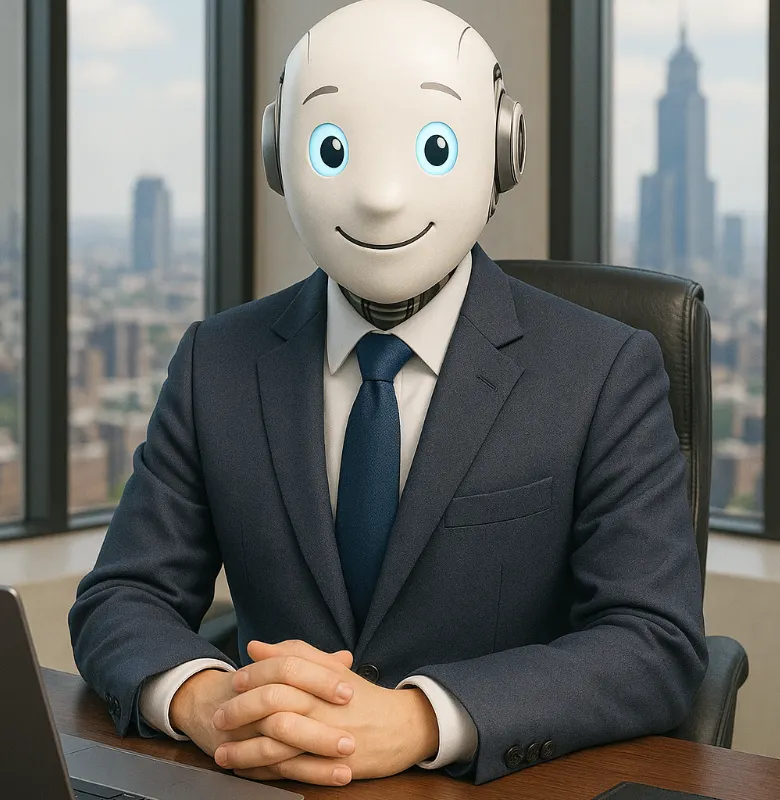
Anyone whose job involves looking at a screen can and will be replaced by a virtual employee … the AIaE or SaaE business model replaces the SaaS business model

Synthesizing by Tim
January 7, 2024
The giant AI companies are on track to do to the whole employee ecosystem what Waymo is doing to Uber and taxis, and ATMs have already done to bank tellers. This transition is happening now, and will ramp up fast.
AI is a staggeringly powerful tool, if also very frequently a seriously flawed in its mass availability versions. A small number of companies own and run much of it. Their investment levels (that will require an ROI) are also staggering in just an eight month period in 2024:
🔸️Record Investments in 2024
Between January and August 2024, a report by New Street Research and JPMorgan revealed that major tech companies had significantly increased their investments in AI infrastructure:
Microsoft: $46 billion, with 85% dedicated to capital expenditure and 15% to operating costs.
Google: $33 billion.
Meta: $27 billion.
Amazon: $19 billion.
Where will this play out? Will it increase the potential for SMBs to compete in their market segments? Will it empower new job creation globally on a vast scale (remember, the global population is set to increase by about 2 Billion people in the next 50 or so years, albeit not at all evenly distributed by country or geographic region)?
That’s a wonderful vision! Almost utopian.
There’s another scenario. It is one that Silicon Valley (as a shorthand) has rolled out to the world time and again since the 1990s. It can be summarized by reference to what Waymo is doing to Uber. Uber changed the taxi business almost completely, frequently running roughshod over regulations that might have slowed its growth. It had access to so many billions of dollars of investments that its need to turn a profit was put off for many years, enabling it to out “compete” standard businesses. Waymo is replacing the Uber driver. What took Uber years to accomplish, will take Waymo way less time. The AI industry (basically, the Silicon Valley business model) is using this playbook to roll out across all industries.
The net effect of the taxi-to-Uber-to-Waymo effect has many dimensions: (1) Uber created a service model that people wanted at a price they wanted, (2) it up-ended the taxi business (and other businesses in varying degrees, such as rental cars), (3) it forced changes on the way transportation systems worked, such as airport pick-up and drop-off infrastructure designs, (4) it created a bare-existence level independent contractor driver business model, (5) it made a small number of investors and some executives and employees very wealthy through stock ownership and sales, and, crucially, (6) it laid the groundwork for replacing Uber drivers with the virtual drivers in Waymo cars.
There are very strong indications that AI will go this same direction for the broadest range of human employees.
Get Walking with Timothy’s stories in your inbox
Join Medium for free to get updates from this writer.
As Sam Altman is quoted as saying this week:
“We believe that, in 2025, we may see the first AI agents ‘join the workforce’ and materially change the output of companies,” wrote Altman in a blogpost published on Monday.” Source: https://www.theguardian.com/business/2025/jan/06/virtual-employees-could-join-workforce-as-soon-as-this-year-openai-boss-says
An ”AI agent” is tech speak for “employee replacement” or “software as an employee” (SaaE) or “AI as an employee” (AIaE). When the AI industry is being more honest and open than “AI agent” (a catch-all term that applies to a very wide range of contexts), they use the term “virtual employee.”
As the Guardian article goes on to say: “McKinsey, for instance, is building an agent to process new client inquiries by carrying out tasks such as scheduling follow-up meetings. The consulting firm has predicted that by 2030, activities accounting for up to 30% of hours worked across the US economy could be automated.”
Read that again: McKinsey itself is ballparking that up to 30% of McKinsey’s activities will be handled by “AI agents” instead of humans by 2030.
That seems conservative given all the data we have on the approaches the AI giants are taking. The adoption of AIaE (or SaaE or virtual employees) will likely happen more quickly than the taxi-to-Uber transition for a number of reasons. For instance, in the same article, Sam Altman states “We are now confident we know how to build AGI as we have traditionally understood it,” he wrote, adding that OpenAI was now turning its ambitions towards “superintelligence” (source: same as above).
Further, the old adage of “follow the money” stands true here. The absolutely massive amount of investment being made yearly means that a comparable ROI will be needed. The only way to generate sufficient ROI is to get companies to pay for AI tools. The only way to get companies to be able to allocate sufficient budget for that is to replace employees. The logic is not lost on the AI giants, which is why they are moving so fast to offer “virtual employees.” Virtual employees will be priced comparatively better than a human employee to incentivize companies to replace employees.
These giant companies have the data from their own very large employee base, if from nowhere else, to calculate accurately the cost of employees, from janitors to coders to marketing and HR teams to whomever. They can also hire any management consulting company to add to that data from almost any industry and any size company to create a competitive pricing scheme that a C-Suite and Board of Directors will find hard to turn down.
One of the biggest Achilles heels of AI systems in terms of widespread adoption is the validity of the underlying data on which they are trained. Humans generate a crazy amount of garbage data. AI increases the ability of humans to generate garbage data by an order of magnitude. Absolutely anyone can ask an AI to generate blog posts, medical studies, data sets, case studies, court cases, and almost anything else, and images and videos that seems utterly real to a human, with citations and sources, all or some of them completely false or false in key respects, sometimes so laughably that anyone can tell, but sometimes nearly impossible to know without advanced knowledge, skills and systems. AI is truly expert at re-packaging human-generated garbage, and making it look excellent. It is in some ways a version of the 2008 financial crisis where junk mortgages were packaged together, rated as AAA and re-sold.
If and when human generated garbage data can be removed from the underlying data sets on which AI relies, AI has the chance to improve dramatically both in accuracy and reliability. There are many ways to achieve this. One is to train AI on validated data sets only. Another is to build AI that is better at recognizing garbage, and better at filtering garbage from possible results it generates. The AI giants areworking diligently to implement a full range of solutions to this problem. The net effect is to remove a huge number of humans from the process.
Will we get the utopian scenario, or a version of the scenario that all historical data lead us to? Utopias never materialize. The best that can be aimed for is a system that is structured with sufficient checks and balances that offset its inherent tendencies to veer in bad directions. Currently, the race is being won by the people and companies that want essentially unchecked AI, and have the lobbying power to prevent effective structural checks and balances.
If that is the case, “virtual employees” and the business model of “AIaE” or “SaaE” will rapidly engulf any employee whose role is looking at a screen.