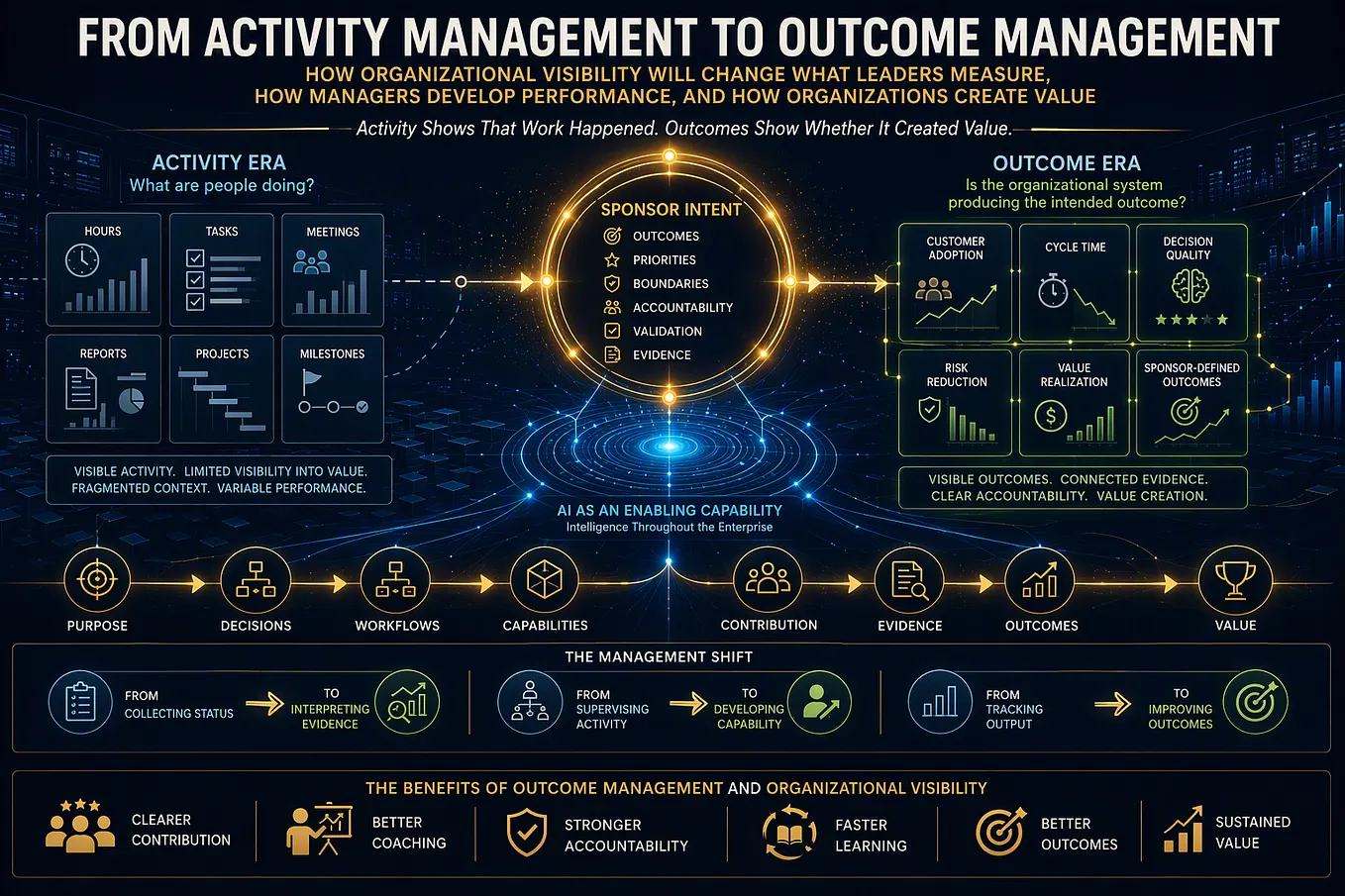
Why Executive Sponsors Still Lose Control Despite Having Every Transformation Framework

Business Intent Design Is the Missing Discipline for Turning Strategic Expectations Into an Explicit Foundation That Can Govern Contracting, Delivery, Validation, and Improvement

AI and image assistance disclosure: The image was generated with Microsoft Copilot. Microsoft Copilot was also used for editorial assistance, including drafting, restructuring, and refinement. The ideas, arguments, frameworks, professional perspectives, and final editorial decisions are my own, informed by more than 35 years of enterprise transformation experience.
The Unresolved Management Challenge
Experienced Executive Sponsors have access to an extraordinary range of frameworks designed to connect strategy with action. Organizations use Objectives and Key Results to establish measurable goals, Hoshin Kanri to deploy strategic priorities, Balanced Scorecards to connect objectives with performance, Business Cases to authorize investments, Stage Gates to control progression, PMO governance to manage execution, Agile methods to organize adaptive delivery, and Benefits Realization to manage expected value.
Each performs an important role. Yet organizations still struggle with a deceptively simple question: What does success actually mean for this Enterprise Transformation Program, and how will leadership preserve that meaning as hundreds or thousands of downstream decisions shape what is ultimately delivered?
That question points to a distinct management responsibility. Executive Sponsors need a durable way to translate strategic expectations into explicit Sponsor Intent and preserve that intent as solutions are selected, the Statement of Work is finalized, requirements are developed, designs evolve, implementation decisions accumulate, operations begin, and evidence emerges.
That is the role of Business Intent Design.
Execution Governance And Intent Governance Address Different Responsibilities
Organizations have become increasingly sophisticated at governing execution. Plans, budgets, milestones, risks, issues, requirements, architecture, testing, security, quality, resources, and delivery performance can all be governed through established mechanisms.
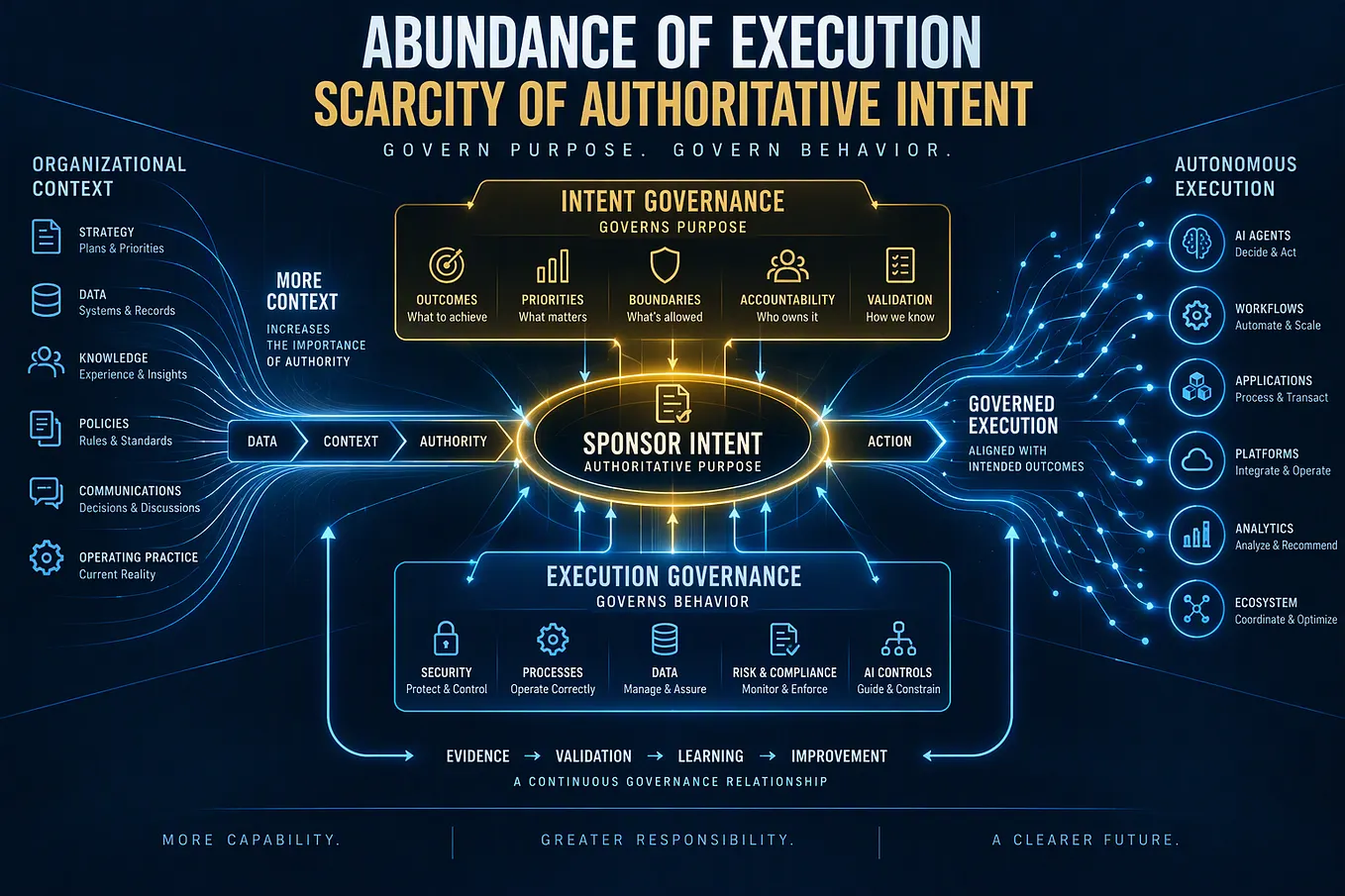
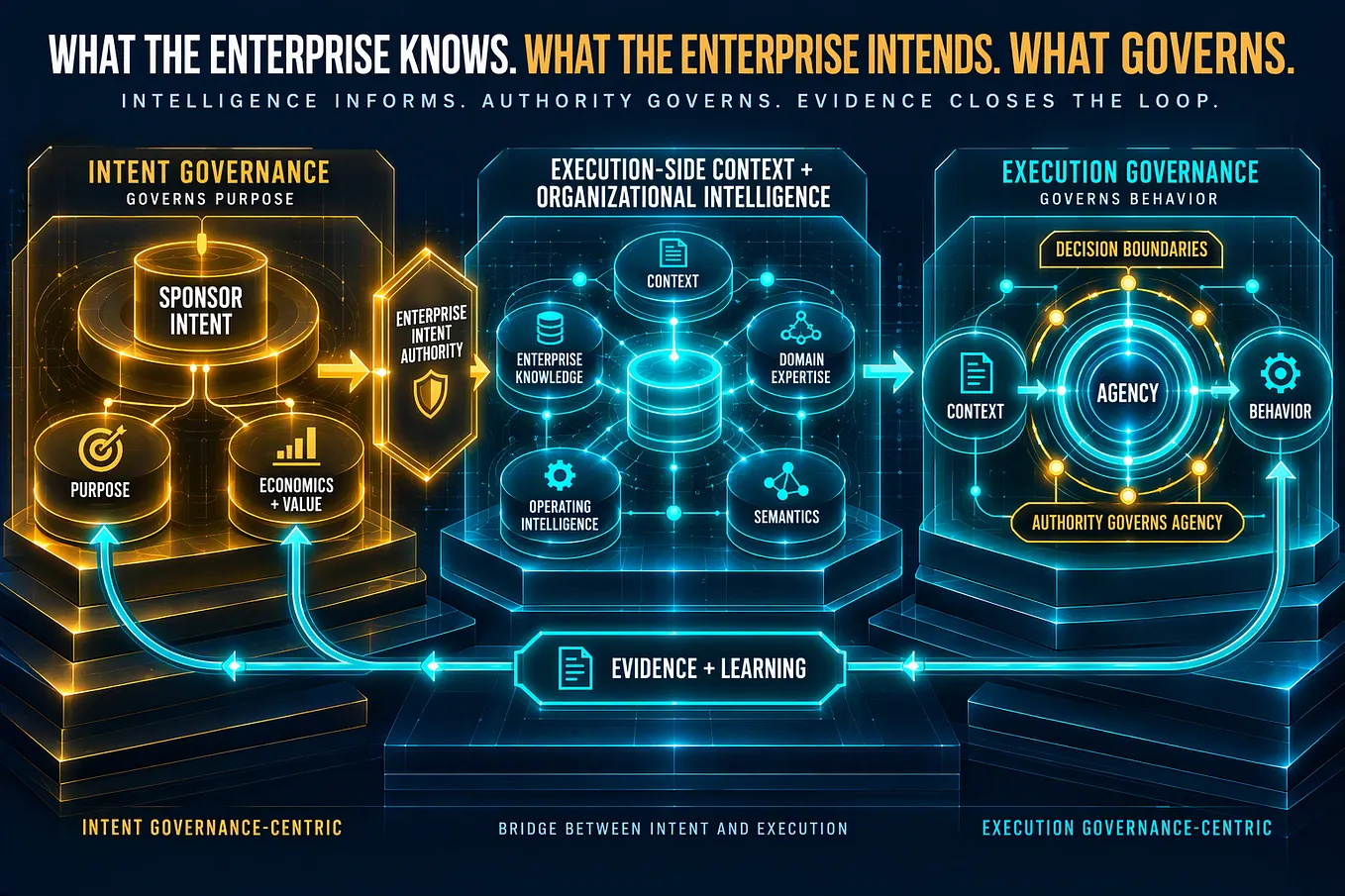
Execution Governance governs behavior. It asks whether the Enterprise Transformation Program is operating within approved plans, controls, designs, responsibilities, and decision structures.
Intent Governance governs purpose. It asks whether the decisions, capabilities, commitments, operating changes, and outcomes being produced still reflect what the Executive Sponsor intends the Enterprise Transformation Program to accomplish.
Both are essential because an Enterprise Transformation Program can execute effectively while its purpose gradually drifts. Individual decisions can be rational, governance reviews can operate as designed, and delivery metrics can remain healthy while the cumulative effect of interpretation gradually changes the meaning of what leadership originally authorized.
Intent Governance addresses both the enduring challenge of transformation drift and the emerging requirements of Agentic AI. It preserves authoritative Sponsor Intent as decisions, participants, assumptions, and operating conditions change. It also makes intended outcomes, priorities, boundaries, accountabilities, validation requirements, and evidence expectations explicit enough to guide increasingly autonomous execution.
People compensated for ambiguity. Autonomous agents amplify it. Organizations need to govern it.
Executive Intent Travels Through A Long Chain Of Interpretation
Consider an Executive Sponsor expectation such as:
“Create a standardized finance operating model that improves visibility, accelerates decision-making, and supports scalable growth.”
The strategic direction is understandable, but the transformation itself still requires definition. Leadership teams, procurement, solution providers, implementation providers, architects, business analysts, technology teams, Business-Side leaders, process owners, testing teams, and operational teams must translate that expectation into a vast number of consequential decisions.
Each participant sees the transformation through a different professional lens. A finance leader can interpret standardization as a common chart of accounts. A technology leader can interpret it as a common configuration. A business unit can envision standardized reporting with continued local processes. An implementation provider can define it through standard product functionality. Procurement can translate it into a commercial simplification opportunity.
Each interpretation can be individually reasonable. Across hundreds or thousands of decisions, however, small differences in interpretation can accumulate into material changes in what the Enterprise Transformation Program actually becomes.
This is transformation drift. It occurs when reasonable decisions progressively reshape the connection between the capabilities being delivered and the outcomes leadership intended those capabilities to produce.
Existing Frameworks Perform Important Jobs
The presence of transformation drift does not diminish the value of established management frameworks. Each addresses a legitimate organizational responsibility, and Business Intent Design strengthens their effectiveness by giving them a clearer Sponsor-owned foundation.
Objectives and Key Results express objectives and measure progress. Hoshin Kanri deploys strategic priorities through the organization. Balanced Scorecards structure strategic performance. Business Cases establish the rationale for investment. Stage Gates control progression. PMO governance governs execution. Agile methods support adaptive delivery. Benefits Realization manages expected value.
The remaining question is what authoritative Sponsor-owned foundation tells these mechanisms what leadership expects the Enterprise Transformation Program to accomplish, change, protect, and prove.
Business Intent Design answers that question by translating strategic expectations into explicit, governable, validatable, traceable, and durable Sponsor Intent.
OKRs Express Objectives And Measure Progress
Objectives and Key Results help organizations articulate objectives, establish measurable results, align teams, and maintain focus on important outcomes. An OKR can establish that the organization intends to reduce financial close time, improve forecast accuracy, increase customer retention, or lower operating cost.
A major Enterprise Transformation Program requires additional Sponsor-owned meaning around those objectives. Leadership must establish what needs to change in the business, why that change is expected to produce the outcome, which capabilities enable it, what organizational conditions must exist, which boundaries govern decisions, who remains accountable, and what evidence will validate achievement.
That broader definition provides the governing context within which an OKR becomes meaningful.
OKRs measure progress toward an objective. Business Intent Design establishes the Sponsor Intent that governs how the Enterprise Transformation Program pursues that objective.
Hoshin Kanri Deploys Strategy Through The Organization
Hoshin Kanri provides a structured approach for connecting long-term direction with nearer-term priorities, initiatives, measures, and organizational action. Its strength lies in strategy deployment and organizational alignment.
When a strategic priority requires a major Enterprise Transformation Program, leadership also needs to define the specific transformation it intends to authorize. Strategic direction must become explicit Sponsor-owned expectations concerning outcomes, required changes, scope, boundaries, accountability, acceptable tradeoffs, decision authority, evidence, and the expected approach to transformation.
Business Intent Design provides that additional precision. It establishes governable Sponsor Intent that can guide solution decisions, commercial commitments, implementation choices, organizational change, and Value Realization.
The Balanced Scorecard Structures Strategic Performance
The Balanced Scorecard gives organizations a structured view of strategic performance across interconnected objectives and measures. It can show leadership whether performance is moving in the desired direction.
An Enterprise Transformation Program also needs an explicit definition of the Business-Side changes expected to produce that movement. Improved forecast accuracy, for example, can depend on changes to forecasting decisions, business processes, organizational behaviors, data accountability, standardization boundaries, enabling capabilities, and underlying assumptions.
Business Intent Design creates that causal and governing context. The Balanced Scorecard structures strategic performance while Sponsor Intent defines the transformation leadership expects to change that performance.
Business Cases Authorize Investment
A Business Case establishes the strategic and economic rationale for an investment. It can define expected benefits, estimated costs, assumptions, major risks, alternatives, and projected returns.
Once the investment is authorized, those expectations begin moving through solution selection, development of the Statement of Work, requirements, implementation, organizational enablement, testing, and Operations. The quality of that translation materially affects what the organization ultimately receives for its investment.
Business Intent Design strengthens this transition by making intended outcomes, required Business-Side changes, organizational conditions, assumptions, accountabilities, Conditions of Success, and Evidence Requirements explicit before consequential commitments are made.
Capabilities are investments. Sponsor Intent is the governing definition of the value those investments are expected to deliver.
PMO Governance Governs Enterprise Transformation Program Behavior
PMO governance provides essential controls for plans, milestones, budgets, risks, dependencies, resources, issues, decisions, reporting, and escalation. These mechanisms help leadership determine whether the Enterprise Transformation Program is operating according to its approved execution model.
Intent Governance adds the corresponding test of purpose. It gives governance an authoritative Sponsor-owned reference for determining whether consequential execution decisions continue to support intended outcomes, required Business-Side changes, governing boundaries, and accountability expectations.
This distinction allows PMO governance and Intent Governance to reinforce one another. Execution Governance protects disciplined delivery. Intent Governance protects the purpose that delivery is intended to serve.
Benefits Realization Manages Expected Value
Benefits Realization helps organizations identify expected benefits, connect them to strategy, assign responsibilities, establish measures, plan realization activities, and evaluate whether value has been achieved and sustained.
Business Intent Design begins further upstream by defining the Sponsor-owned foundation from which credible benefits can emerge. That foundation addresses:
- Intended outcomes
- Required Business-Side changes
- Value mechanisms
- Enabling capabilities
- Necessary organizational conditions
- Critical assumptions
- Baseline disposition
- Accountability
- Conditions of Success
- Evidence Requirements
- Validation approach
Consider a projected reduction in operating cost. The value could come from process standardization, role redesign, automation, improved data quality, provider rationalization, reduced rework, or several mechanisms working together. Each path requires different capabilities, organizational changes, assumptions, accountabilities, and evidence.
Business Intent Design strengthens the definition of intended value before consequential commitments are made. Benefits Realization then has a stronger foundation for managing and evaluating whether that value is achieved.
Stage Gates Control Progression
Stage Gates create formal decision points where leadership determines whether an Enterprise Transformation Program should proceed, change direction, pause, or conclude. Their effectiveness depends on the quality of the decision criteria applied at each gate.
Schedule, budget, risk, readiness, deliverables, resources, and technical completion remain important criteria. Sponsor Intent adds another dimension by testing whether the Enterprise Transformation Program remains aligned with intended outcomes, boundaries, required Business-Side changes, accountabilities, and evidence expectations.
A Stage Gate therefore becomes an opportunity to assess both execution readiness and continued integrity of purpose. This gives leadership a stronger basis for determining whether the Enterprise Transformation Program should proceed in its current form.
Agile Planning Organizes Adaptive Delivery
Agile methods allow teams to incorporate learning, reprioritize work, respond to evidence, and adapt delivery as new information becomes available. That adaptability is especially valuable in complex Enterprise Transformation Programs.
Effective adaptation also requires clarity about what teams are empowered to change and what must remain aligned with authoritative Sponsor Intent. Decision Boundaries establish where teams have delegated authority, while Exception Rules identify circumstances requiring notification, review, or Sponsor Determination.
Sponsor Intent Assets provide durable meaning that teams can reference while requirements, designs, priorities, and implementation decisions continue to evolve. Agile methods create adaptive execution, and Business Intent Design provides the governing purpose within which that adaptation occurs.
The Frameworks Share A Governing Foundation
Organizations can use every framework described above effectively and still experience transformation drift when leadership’s intent remains distributed across Business Cases, presentations, meeting records, scorecards, the Statement of Work, requirements, program plans, emails, and individual memory.
The opportunity is to create a coherent Sponsor-owned foundation connecting these mechanisms.
Strategy establishes direction. OKRs express objectives. Hoshin Kanri deploys priorities. Balanced Scorecards structure performance. Business Cases authorize investments. Stage Gates control progression. PMO governance manages execution. Agile methods support adaptive delivery. Benefits Realization manages expected value.
Sponsor Intent provides the authoritative expression of purpose that these mechanisms can reference.
Business Intent Design turns dispersed leadership expectations into governed Sponsor Intent that can remain accessible, referenceable, traceable, validatable, and durable throughout the Enterprise Transformation Program lifecycle.
Sponsor Intent Is The Governing Foundation
Sponsor Intent is the Executive Sponsor-owned expression of purpose and the foundation of the Transformation Definition. It is formed through three Sponsor-owned responsibilities: Business Intent, Scope Intent, and Transformation Approach Intent.
Business Intent defines the intended outcomes, required Business-Side changes, rationale, priorities, and expected value. Scope Intent defines the transformation boundaries, including what must change, what is included, what is excluded, and what is expected to remain in place. Transformation Approach Intent defines leadership’s expectations for how the transformation will proceed, including standardization expectations, organizational participation, adaptation boundaries, acceptable tradeoffs, decision authority, and accountability.
Together, these responsibilities establish what leadership intends the Enterprise Transformation Program to accomplish and the governing context within which downstream decisions are made.
A governed artifact chain can then carry Sponsor Intent into Meaning-Aligned Requirements, solution designs, specifications, implementation plans, controls, organizational enablement, validation activities, Operations, and continuous improvement. This allows Executive Sponsors to govern purpose without personally controlling every downstream decision.
Business Intent Design Is A Distinct Discipline
Business Intent Design is a discipline within Intent Governance. It defines, validates, and governs Sponsor Intent so leadership expectations can become explicit enough to shape consequential transformation decisions.
Its object of management is Sponsor Intent. Its accountable owner is the Executive Sponsor, supported by Business-Side leaders, process owners, subject matter experts, and applicable specialists. Its purpose is to establish the Sponsor Intent needed to guide solution selection, the Statement of Work, implementation, validation, Operations, and continuous improvement.
Business Intent Design begins before solution selection and Statement of Work finalization. Foundational and Solution-Critical Sponsor Intent that materially influences those decisions must be sufficiently defined before they are finalized. This gives leadership the foundation needed to shape solution fit, scope, provider responsibilities, commercial commitments, implementation assumptions, accountability, validation, Total Cost of Ownership, and expected outcomes.
Business Intent Design then continues throughout the Enterprise Transformation Program lifecycle. Discovery, specialist expertise, prototypes, implementation learning, operating experience, validation, and accumulating evidence progressively refine Sponsor Intent while the governing foundation remains explicit and authoritative.
Sponsor Intent Assets Make Purpose Governable
Sponsor Intent becomes durable through Sponsor Intent Assets. A Sponsor Intent Asset is a governed business artifact that captures the Sponsor’s intended outcome, required change, rationale, Decision Boundaries, validation requirements, and evidence model.
The most consequential of these are Foundational Sponsor Intent Assets because they shape large numbers of downstream decisions. They provide durable guidance as specialists interpret requirements, providers develop solutions, Business-Side leaders make organizational choices, and technology teams translate intent into operational capabilities.
Get Tim Hourigan’s stories in your inbox
Join Medium for free to get updates from this writer.
Sponsor Intent Assets remain governed throughout the Enterprise Transformation Program lifecycle. They are reviewed, monitored, validated, improved, and supported by accumulating evidence as decisions are made, assumptions change, implementation learning develops, and operating conditions evolve.
This creates continuity without freezing the transformation in time. Sponsor Intent can improve while preserving authoritative ownership, traceability, and deliberate change.
Business Intent Design Strengthens The Existing Management System
Business Intent Design is designed to strengthen the frameworks organizations already use. OKRs gain greater precision when objectives can be traced to explicit Sponsor Intent. Hoshin Kanri gains a more explicit transformation foundation for deploying strategic priorities. Balanced Scorecards gain measures connected to required Business-Side changes, Conditions of Success, and Evidence Requirements.
Business Cases gain stronger outcome logic, clearer assumptions, explicit organizational conditions, and more credible definitions of intended value. The Statement of Work gains a clearer foundation for connecting scope, responsibilities, commercial assumptions, accountability, evidence obligations, and contractual commitments to leadership expectations. PMO governance gains a Sponsor-owned reference point for evaluating continued alignment with purpose.
Stage Gates gain more explicit criteria for evaluating Sponsor Intent alignment, unresolved uncertainty, outcome readiness, and required evidence. Agile teams gain Decision Boundaries and Exception Rules that enable adaptation within governed intent. Benefits Realization gains a clearer definition of the outcomes, Business-Side changes, value mechanisms, organizational conditions, accountability, and evidence that must be managed and validated.
The result is continuity from what leadership expects to what the organization selects, contracts, implements, validates, operates, and improves.
A Practical Test: Does Your Organization Already Perform Business Intent Design?
An organization performing the complete responsibility of Business Intent Design should have an authoritative, accessible, Executive Sponsor-owned foundation capable of answering questions such as:
- What outcomes does leadership intend to produce?
- What must change in the business for those outcomes to occur?
- Why should those changes create the expected value?
- What assumptions support the value logic?
- What organizational conditions must exist?
- What is included in the transformation?
- What is excluded?
- What is expected to remain in place?
- What tradeoffs are acceptable?
- Which decisions can teams make autonomously?
- Which exceptions require Sponsor review?
- What accountability must remain visible?
- What Conditions of Success must be supported?
- What evidence will validate outcome achievement?
- How does this intent guide solution selection?
- How is it reflected in the Statement of Work?
- How is it traced into requirements, designs, implementation decisions, and Operations?
- How are authorized changes incorporated while preserving continuity of purpose?
- How will leadership determine whether intended outcomes were actually achieved?
Organizations often possess answers to many of these questions. The answers can exist across strategies, Business Cases, workshops, governance materials, requirements repositories, the Statement of Work, operational documentation, meeting records, and the knowledge of experienced people.
The distinction is authority.
Retrieval can locate those sources. Sponsor Intent establishes which expectations govern, who owns them, how they can change, and how downstream decisions remain traceable to them.
An ERP Transformation Example
Return to the earlier expectation:
“Create a standardized finance operating model that improves visibility, accelerates decision-making, and supports scalable growth.”
Established frameworks can translate this expectation into useful management mechanisms. An OKR can target a shorter financial close, a Business Case can forecast operating savings, a Balanced Scorecard can monitor performance, PMO governance can manage plans and risks, Stage Gates can control progression, Agile methods can organize development, and Benefits Realization can track expected value.
Business Intent Design addresses the Sponsor-owned meaning required underneath those mechanisms:
- What does standardization mean across business units?
- Which local variations create legitimate business value?
- Which local practices must change?
- Which decisions should become centralized?
- Which decisions should remain local?
- What visibility does leadership require?
- What Business-Side behavior must change?
- Which capabilities enable that change?
- Which assumptions make the expected value credible?
- Who owns the Business-Side change required to produce the outcome?
- What evidence distinguishes capability availability from actual operational improvement?
- Which exceptions require Sponsor Determination?
Sponsor Intent Assets preserve the material outcomes, required changes, boundaries, assumptions, accountabilities, Conditions of Success, and Evidence Requirements as durable business artifacts. Transformation Value Design connects intended outcomes to their value mechanisms, enabling capabilities, organizational conditions, and evidence models. Meaning-Aligned Requirements then carry Sponsor-owned meaning into forms that downstream teams can use.
The organization continues using its established frameworks, now grounded in a clearer definition of what those frameworks must remain aligned with.
Authority Becomes Critical In An AI-Enabled Enterprise
AI dramatically expands an organization’s ability to retrieve and use information. Strategies, requirements, policies, contracts, process documentation, operational records, historical decisions, and institutional knowledge can increasingly become accessible to AI-enabled systems and autonomous agents.
That creates an important distinction between retrieval and authority.
Retrieval answers: What information can the system find?
Authority answers: What governs?
An AI system can retrieve contradictory requirements, obsolete decisions, historical practices, approved exceptions, superseded policies, meeting discussions, and current guidance. Access to more information therefore increases the importance of knowing which source is authoritative, who owns it, whether it remains valid, and what happens when competing sources disagree.
Sponsor Intent provides authoritative Business-Side context. It establishes what the Executive Sponsor intends, which outcomes matter, which boundaries govern decisions, who holds authority, what conditions require escalation, and what evidence is required to demonstrate alignment and achievement.
Agentic AI Makes Explicit Sponsor Intent More Consequential
A capability is not intent. An agent, workflow, automation, or platform describes a potential means to an end, not the end itself.
As AI progresses from producing information toward analyzing, recommending, coordinating, deciding, and acting, organizations need to make more of their organizational intelligence explicit enough for AI. That includes intended outcomes, priorities, Decision Boundaries, delegated authority, retained human authority, Exception Rules, escalation conditions, accountability requirements, validation requirements, and evidence expectations.
Historical organizational data remains valuable context, but historical behavior does not independently define intended future behavior. Organizations implementing transformation are deliberately trying to change how the enterprise operates. AI therefore needs governed future-state intent in addition to access to historical knowledge.
Making Organizational Intelligence Explicit Enough for AI becomes a core management responsibility.
Sponsor Intent gives AI-enabled systems an authoritative Business-Side reference for evaluating recommendations and actions. Decision Boundaries define where delegated authority begins and ends. Exception Rules identify conditions requiring escalation. Evidence Requirements determine what the organization expects to observe and preserve.
Human governs the loop.
Sponsor Intent Requires Lifecycle Management
Sponsor Intent continues to develop as specialist expertise, implementation learning, operating experience, validation, and evidence accumulate. Lifecycle management keeps that evolving body of intent authoritative and useful throughout the Enterprise Transformation Program.
Organizations need capabilities that:
- Establish Sponsor Intent from strategic direction, executive priorities, desired outcomes, Business Cases, assumptions, and consequential decisions
- Preserve Sponsor Intent through organizational, provider, platform, and personnel changes
- Validate Sponsor Intent through planned activities defined within the Sponsor Intent Validation Plan
- Monitor conditions, assumptions, boundaries, accountabilities, and evidence continuously
- Improve Sponsor Intent continuously as learning and operational evidence accumulate
- Prove how intended outcomes, required Business-Side changes, decisions, commitments, evidence, and achieved results remain connected
- Maintain Intent Memory, Decision Memory, and Learning Memory
- Support structured authoring, analysis, review, coordination, and executive decision support
- Connect Sponsor Intent to solution selection, the Statement of Work, requirements, designs, implementation decisions, validation, Operations, and Value Realization
- Preserve durable evidence on the client’s infrastructure
These capabilities transform Sponsor Intent from dispersed organizational understanding into a durable Business-Side management capability.
The objective is straightforward: keep what leadership expects connected to what gets selected, contracted, implemented, validated, operated, and improved.
The CFO-TA Operationalizes The Discipline
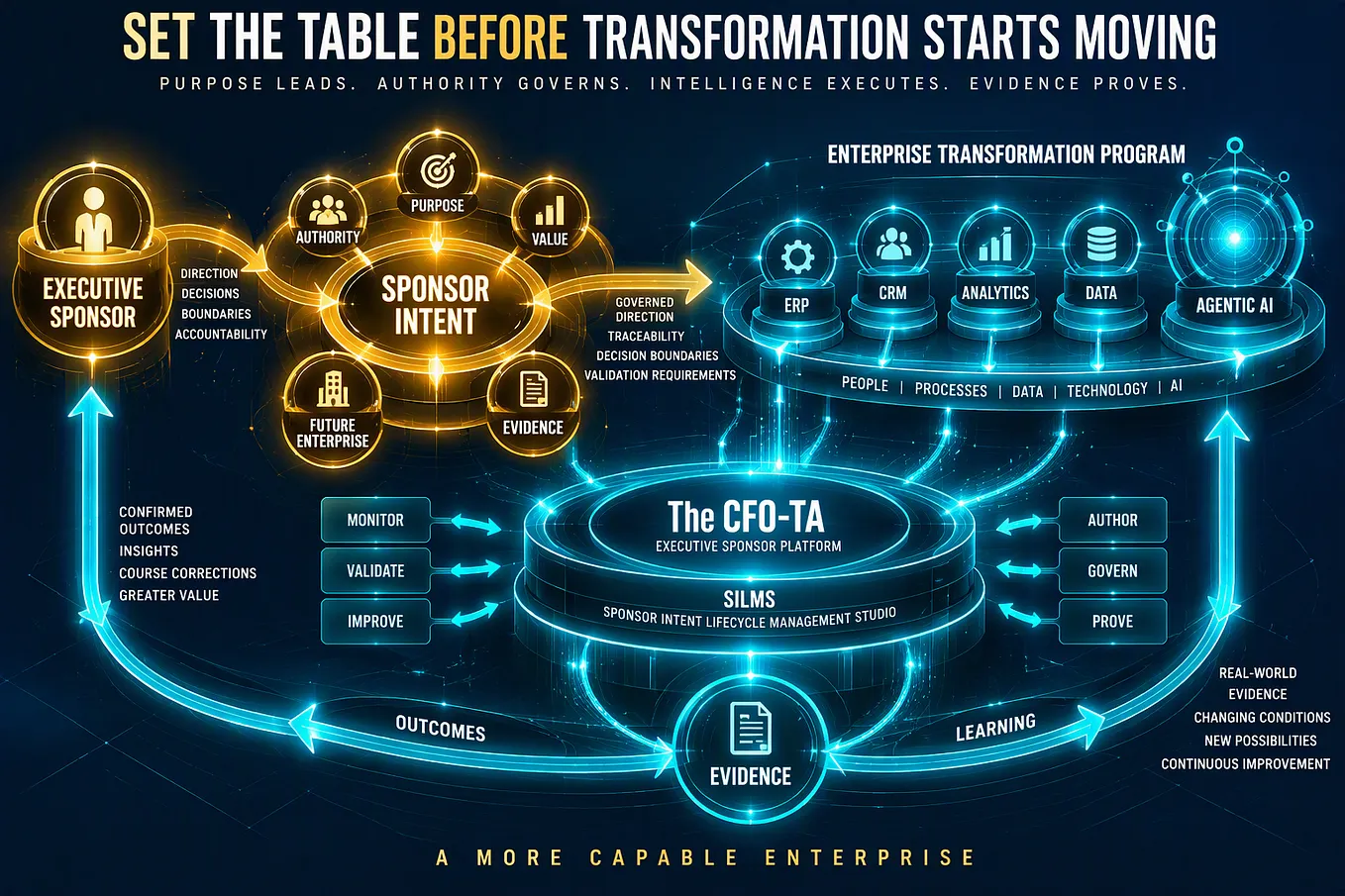
The CFO-TA is the Executive Sponsor Platform. It is a Business-Side platform purpose-built for Executive Sponsors responsible for major transformation investments.
The platform supports Executive Sponsors through guidance, methodology, authoring, analysis, deliverable production, validation, review, coordination, decision support, continuity, and Sponsor Intent Lifecycle Management across the Enterprise Transformation Program lifecycle. Business Intent Design and Intent Governance provide hallmark disciplines within that broader capability.
The SILMS is a major capability of The CFO-TA used to establish, preserve, validate, monitor, improve, and prove Sponsor Intent. A governed artifact chain then carries that authoritative Sponsor Intent through consequential decisions, commitments, requirements, designs, validation, Operations, and evidence while persistent evidence remains on the client’s infrastructure.
This architecture becomes increasingly important as AI enters the Enterprise Transformation Program lifecycle. Retrieval can give people and AI extraordinary access to organizational knowledge. The CFO-TA and the SILMS address the complementary requirement of preserving authoritative Sponsor Intent so people, providers, systems, and AI can distinguish available information from what actually governs.
The Missing Discipline Has A Specific Purpose
Organizations already have sophisticated disciplines for strategy, investment, planning, measurement, delivery, architecture, testing, governance, organizational change, and Value Realization. Business Intent Design adds a specific management responsibility that becomes increasingly consequential as complexity and autonomy increase.
It translates strategic expectations into explicit Sponsor Intent before consequential commitments are made. It establishes the Foundational and Solution-Critical Sponsor Intent needed to guide solution selection and finalize the Statement of Work. It then enables that intent to be governed, refined, validated, monitored, improved, and supported by accumulating evidence throughout implementation and Operations.
Business Intent Design gives existing management disciplines an authoritative Sponsor-owned definition of the purpose they collectively serve.
The Question Executive Sponsors Should Ask
Organizations know how to plan, measure, govern, and execute Enterprise Transformation Programs. The opportunity now is to govern purpose with equivalent discipline as hundreds or thousands of downstream decisions determine what gets selected, contracted, implemented, changed, adopted, operated, and ultimately achieved.
Business Intent Design creates the Sponsor-owned foundation. Intent Governance preserves its authority. Execution Governance governs the behavior of the people, providers, systems, processes, and AI responsible for translating that purpose into results.
Together, these capabilities allow Executive Sponsors to retain control of purpose while enabling specialists, providers, teams, and increasingly autonomous systems to operate with appropriate delegated authority.
The defining question is straightforward:
What authoritative Sponsor-owned foundation preserves what leadership actually means?