The Political King
It was late at night, and the road lay deserted.
Darkness had spread everywhere, thick and impenetrable.
The line between the forest and the road had blurred,
and the shadows of the trees stretched across the asphalt as if the darkness itself was moving forward.
The air was heavy with silence, and in that silence, fear hid.

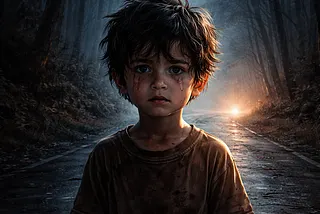
On that lonely road stood a small boy.
His name was Vikrant.
He was very young, yet the weight of the world seemed already on his shoulders.
He did not know it yet, but this night would change the course of his life forever.
He was crying out loud.
He had been crying so long that his voice was breaking.
His throat was dry, his eyes burning,
yet the tears would not stop.
His sobs had become uneven, ragged, and unsteady.
And still, he stood there.
He did not run.
There was nowhere to run to.
Fear lingered, but deeper than that were the questions in his mind —
questions that were tearing him apart from the inside.
He wondered why this had happened to him.
What had he done wrong?
Was telling the truth a crime?
Was asking questions a punishable act?
Was staying silent the only way to be safe?
Vikrant lived in an ashram, a place that claimed to care for children.
On the surface, everything seemed proper.
Slogans of virtue were painted on the walls.
Everything was neatly arranged for show.
But inside, fear ruled.
Beatings were common.
Scolding, threats, and intimidation were daily rituals.
Children who stayed quiet were considered safe.
Those who questioned were considered troublemakers.
And Vikrant was one of them.
Whenever he saw injustice toward another child, he spoke up.
His body was small, but his courage to speak the truth was immense.
He asked questions and demanded answers.
And that became his greatest mistake.
The ashram authorities did not like questions.
Because questions reveal truth.
And those who have something to hide fear the truth the most.
They decided that Vikrant could no longer stay there.
A child who never feared had become a threat.
They needed to get rid of him.
So, in the dead of night, they left him on the road near the forest.
No explanations were given.
The car simply drove away.
Get Vikrantthakur’s stories in your inbox
Join Medium for free to get updates from this writer.
They believed he would either run away in fear
or be taken by some wild animal,
and the matter would end there.
To them, it was over.
But they did not know that some stories are never meant to end.
Vikrant stood there for hours, crying.
His voice echoed deep into the forest, as if demanding justice from the darkness itself.
The night grew even more terrifying.
Fear and cold crept over him, moment by moment.
The chilly wind pierced through his body.
His legs had gone numb.
His lips were trembling.
His eyes were stinging.
Yet he did not move.
He did not know where to go.
He did not know the way.
But he knew one thing: he had done nothing wrong.
And that belief kept him standing there.
Two, maybe three hours passed.
And at that moment, the convoy of the state’s Chief Minister, Mohandas, was passing through the same road.
The night was deep, but lights appeared in the distance.
The sound of vehicles broke the forest’s silence.
Suddenly, the driver saw the small figure standing on the road.
He immediately slowed down, then stopped completely.
A child, standing alone, in the middle of the night on such a deserted road —
it was unusual, to say the least.
The convoy halted, security measures instantly activated.
Alertness spread in every direction.
Chief Minister Mohandas asked why the vehicle had stopped.
A security officer replied, “There’s a child standing on the road ahead.”
Hearing this, Mohandas was startled.
So late at night,
in such a lonely place,
and a child, all alone.
He decided to step out himself.
Slowly, he approached the boy.
As the light fell on Vikrant’s face, it revealed a small, tear-streaked face.
Red eyes, cheeks wet with saltwater, lips trembling.
He was crying,
but there was more than fear in his eyes.
Something inside him had filled up so much,
but words had long since abandoned him.
Mohandas looked at him quietly for a few moments.
He understood immediately: this was no ordinary child.
Circumstances had made him wise beyond his years,
and he had seen and endured far more than anyone should.
In a gentle voice, Mohandas asked,
“Son, what are you doing here all alone?”
Vikrant’s voice trembled as he whispered,
“They left me here…