Why Your Development Team Feels Busy But Nothing Ships

You’ve hired talented developers. Sprint reviews happen on schedule. The team uses all the right frameworks. Yet somehow, features that should take two weeks are taking six, and nobody can explain why.
This isn’t a developer problem. It’s a structure problem. When business demands grow faster than your delivery system can handle them, even the best engineering practices start to buckle under pressure.
The solution isn’t more standups or better project management tools. It’s rethinking how teams organize around outcomes instead of just tasks.The delivery speed trap
Most development teams today operate like well-oiled machines that produce the wrong output. They complete story points, close tickets, and ship code regularly. But business value moves at a crawl.
Here’s what I see happening: A marketing team needs an A/B testing feature for next month’s campaign. Engineering estimates two sprints. Three months later, the feature finally launches — perfectly built, thoroughly tested, completely irrelevant.The math doesn’t add up. If developers are productive and processes work, why does value delivery feel so slow?
The bottleneck isn’t coding speed. It’s the gap between what teams build and what customers actually need, amplified by handoffs, context switching, and misaligned priorities.
Consider this scenario: Your team builds a checkout optimization that increases conversion by 0.3%. Technically successful, sprint goals met. Meanwhile, your competitor ships a one-click purchase flow that boosts their conversion by 4.2%. Same development effort, vastly different business impact.What traditional team structures miss
Scrum works. Kanban works. Most Agile practices work exactly as designed. But they optimize for team efficiency, not business outcomes.
Traditional structures create invisible delays through three main gaps:Requirement translation. Business needs get filtered through multiple layers before reaching developers, losing context each time.
- Feedback loops. Teams wait for sprint reviews to learn if they’re building the right thing, wasting weeks on misaligned work.
- Outcome accountability. Developers optimize for code quality and feature completion, not customer value or business metrics.
A fintech startup I worked with illustrates this perfectly. Their engineering team delivered every sprint commitment for six months. Users loved the app’s performance and reliability.
Revenue flatlined.The team had optimized their development process without connecting it to business results. They built what was specified, not what would drive growth.
“We realized we were measuring the wrong things. Our developers were hitting every technical metric while our customers were churning because core workflows remained broken.” — Sarah Chen, VP of Engineering, PayFlow Systems
The product-oriented delivery shift
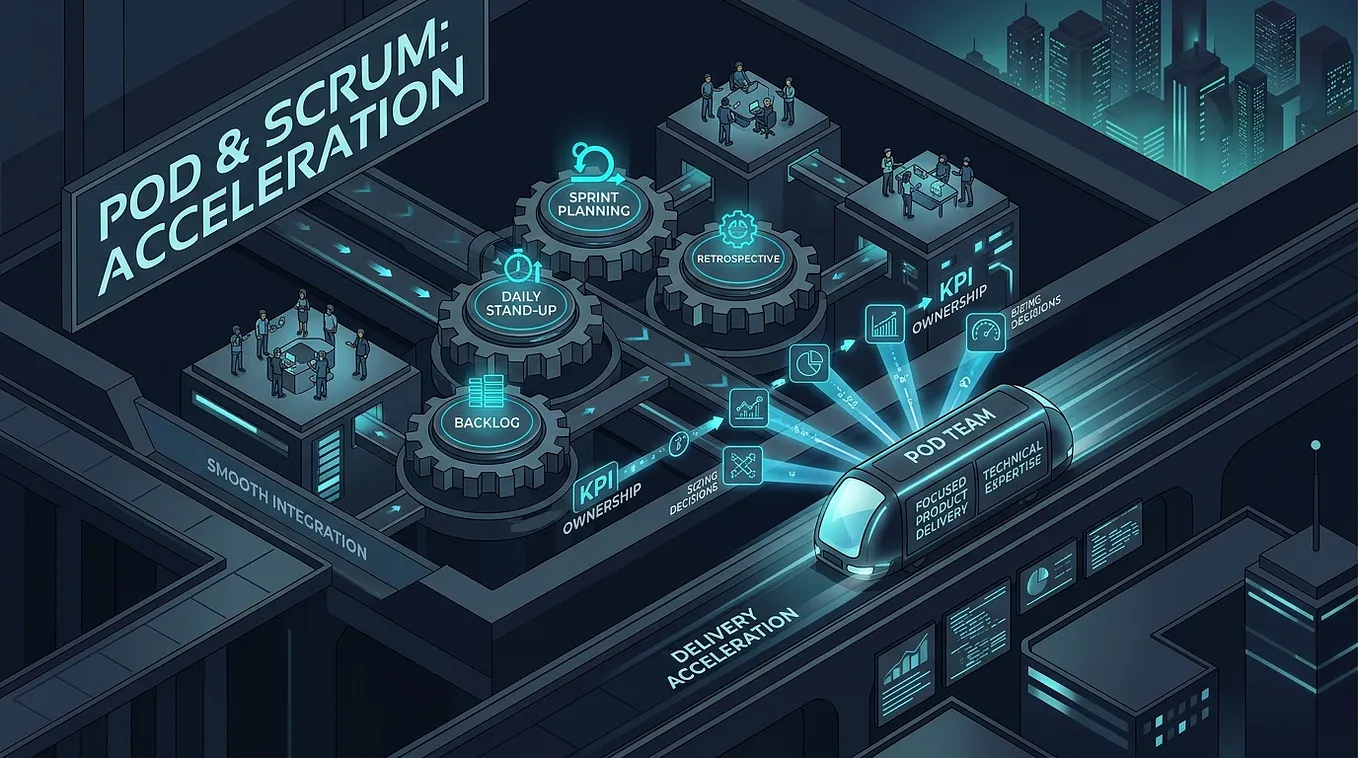
Product-oriented delivery (POD) models flip this dynamic. Instead of organizing around technical skills or project phases, teams organize around customer outcomes and business value.POD teams own results, not just deliverables. They track metrics like user activation rates, feature adoption, and revenue impact alongside traditional engineering metrics.
This shift changes everything about how work gets prioritized and executed:
- Customer focus. Every feature decision connects directly to user behavior and business goals, eliminating work that doesn’t move key metrics.
- Rapid iteration. Teams can pivot based on real usage data rather than waiting for formal requirement updates.
- Outcome ownership. Success gets measured by business impact, creating natural alignment between engineering effort and company priorities.The difference shows up in delivery speed. When teams understand the business problem they’re solving, they make better technical decisions. They build simpler solutions faster because they know what actually matters.
How POD models accelerate delivery
Product-oriented teams don’t just work differently — they work faster. The speed comes from eliminating waste, not working longer hours.Direct stakeholder connection.
Get Vlad Koval’s stories in your inbox
Join Medium for free to get updates from this writer.
POD teams maintain continuous contact with customers and business stakeholders. This eliminates the telephone game between business requirements and technical implementation.
Instead of building what’s specified, teams build what’s needed. They catch requirement gaps before code gets written, not during user acceptance testing.Integrated feedback loops.
Traditional teams get feedback at sprint reviews. POD teams get feedback continuously through user analytics, customer support data, and direct stakeholder interaction.
This real-time feedback allows course correction within days instead of weeks. Features that aren’t working get fixed immediately rather than accumulating technical debt.Outcome-driven prioritization.
When teams track business metrics alongside technical metrics, prioritization becomes clearer. High-impact features bubble up naturally while low-value work gets deprioritized without lengthy stakeholder negotiations.
A SaaS company using this model reduced their average feature delivery time from 8 weeks to 3 weeks. Not by working faster, but by building fewer unnecessary features and focusing on higher-impact work.The measurable difference
POD models produce specific, trackable improvements in delivery performance. Based on teams I’ve observed making this transition, here are the typical results:
- Feature delivery speed. 40–60% reduction in time from concept to production for similar-scope features.
- Customer satisfaction. Higher user adoption rates for new features because they solve real problems rather than assumed requirements.
- Developer productivity. Engineers spend less time in meetings and more time building because priorities stay stable and requirements are clearer.
- Business alignment. Revenue and user metrics improve alongside engineering velocity because teams optimize for the right outcomes.The key insight: speed comes from building the right thing efficiently, not building everything faster.
“After switching to POD teams, our engineering velocity actually decreased slightly in the first quarter. But our feature adoption rates doubled because we were finally building what users actually wanted.” — Marcus Rodriguez, CTO, DataSync Solutions
Making the transition work
Moving to product-oriented delivery requires changes in structure, metrics, and mindset. Teams need different skills, different tools, and different success measures.Start with one pilot team working on a customer-facing feature with clear business metrics. Give them direct access to user data, customer feedback, and business stakeholders. Measure both technical delivery and business impact.
The pilot will reveal gaps in your current process. Maybe developers need training in user research techniques. Maybe your analytics setup doesn’t provide the right feedback loops. Maybe stakeholders need to change how they communicate requirements.
Address these gaps systematically. The goal isn’t to change everything at once, but to prove the model works before scaling it.Most importantly, expect the transition to feel uncomfortable. Teams used to optimizing for story point completion will need time to learn outcome-driven prioritization. Stakeholders accustomed to detailed requirements will need to adapt to more collaborative planning.
This discomfort is normal and temporary. Teams that push through it consistently report higher job satisfaction because their work creates visible customer value.
Beyond faster delivery
Product-oriented delivery models solve the speed problem, but they unlock bigger opportunities. When teams organize around outcomes, they start identifying new possibilities that traditional structures miss.They notice user behaviors that suggest unmet needs. They spot integration opportunities between features. They identify technical improvements that would accelerate multiple business goals simultaneously.
This is where the real competitive advantage emerges. Not just delivering requested features faster, but discovering better solutions that nobody thought to request.
The development chaos isn’t inevitable. With the right structure, teams can deliver value at the speed business demands while maintaining code quality and developer satisfaction. The key is aligning how you work with what actually matters.