403 Isn’t a Failure — It’s Your First Debugging Clue

If you’ve done any real-world scraping, you’ve seen it:
403 ForbiddenMost people treat this as an error.
Experienced teams treat it as feedback.
A 403 isn’t the site saying “go away.”
It’s the site saying: “I know who you are, and I don’t trust you.”
Understanding that distinction changes how you debug, scale, and design crawlers.
Why 403 Is More Informative Than a Timeout
When a request times out, you’re blind.
When you get a 403, the server made a conscious decision.
It evaluated signals like:
- IP reputation
- Request frequency
- Session behavior
- Geographic consistency
- Header fingerprints
And it decided your request didn’t match a real user.
That’s not failure — that’s signal exposure.
The Common Mistake: Treating 403s as Exceptions
Many crawlers handle 403s like this:
if response.status == 403:
    retry()
That’s like knocking louder after being told you’re not welcome.
Retries don’t fix trust problems.
They amplify them.
What a 403 Is Actually Telling You
A 403 usually means one (or more) of these is true:
- Your IP doesn’t match typical user traffic
- Your request pattern is too consistent
- Your geography doesn’t match the content you’re requesting
- Your session behavior resets too often
- Your crawler looks automated across requests, not just within one
Notice what’s missing?
It’s rarely about a single request.
It’s about patterns over time.
Why Local Tests Lie
Locally, everything works:
- Low request volume
- Fresh IP
- Minimal repetition
In production:
- Requests cluster
- IPs get reused
- Behavior becomes predictable
That’s when 403s appear — not because your code broke, but because your traffic profile changed.
Datacenter Traffic vs. Residential Behavior
One hard-earned lesson:
Get Rapid proxy’s stories in your inbox
Join Medium for free to get updates from this writer.
Sites don’t block scripts — they block infrastructure patterns.
Datacenter IPs:
- Are heavily fingerprinted
- Often shared by scrapers
- Trigger suspicion faster at scale
Residential traffic behaves differently: - Natural IP reputation
- Regionally consistent
- Aligned with real user access patterns
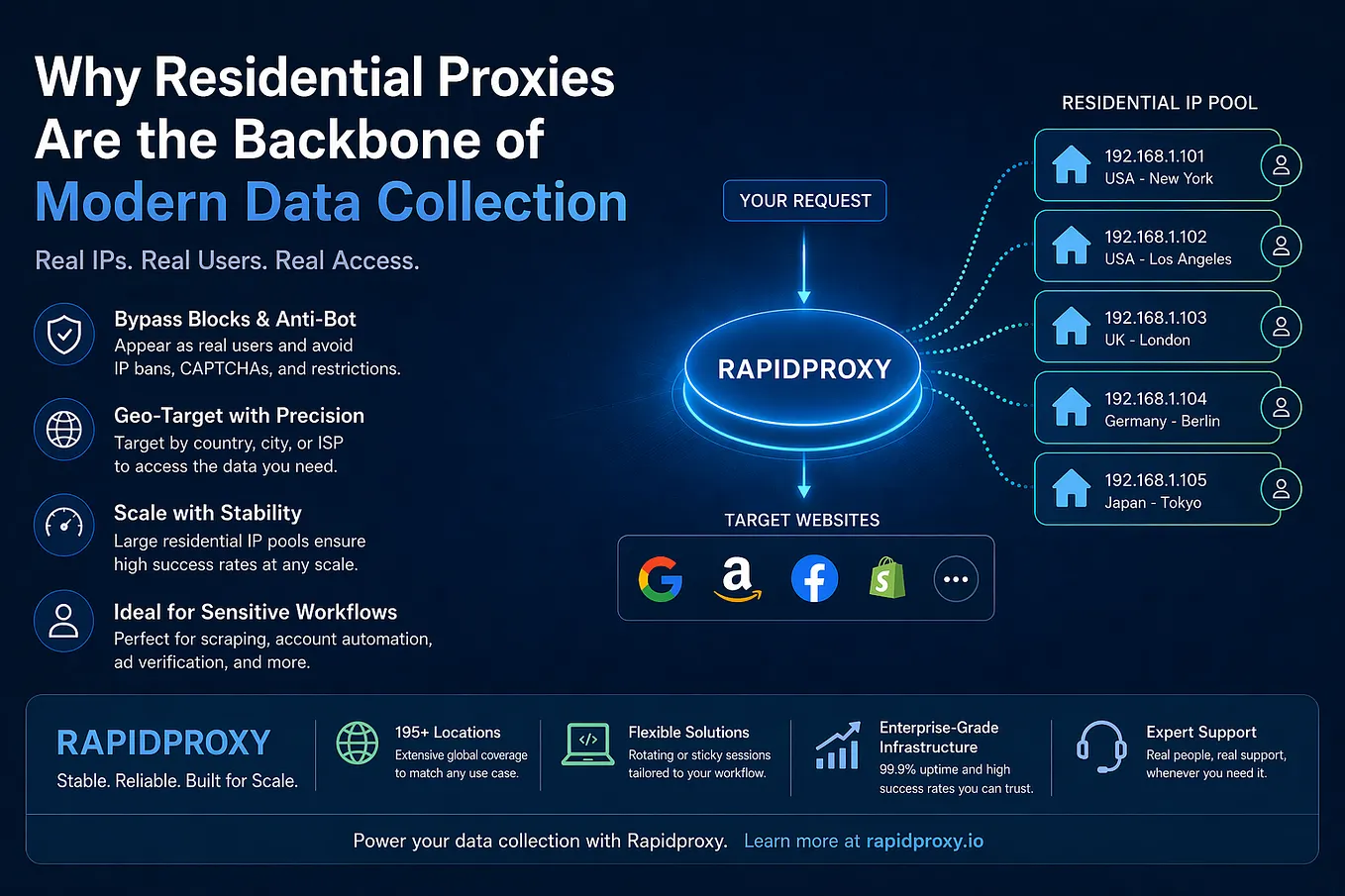
This is where residential proxy infrastructure (like Rapidproxy) quietly matters — not as a bypass, but as a way to reduce the mismatch between crawler behavior and user behavior.
No tricks. No exploits. Just alignment.
Debugging 403s the Right Way
Instead of asking:
“How do I get past this 403?”
Ask:
- What does this site expect a real user to look like?
- Does my session persist naturally?
- Does my IP geography match the content?
- Am I rotating too aggressively?
- Am I collecting partial truth and calling it data?
When you ask better questions, 403s stop being blockers and start being design inputs.
The Counterintuitive Fix: Slow Down and Stabilize
Some of the most effective changes I’ve seen:
- Fewer IP rotations, longer sessions
- Lower concurrency, higher consistency
- Region-aware routing
- Treating crawlers as long-lived actors, not stateless scripts
The goal isn’t invisibility.
It’s believability.
Final Thought
A 403 isn’t your enemy.
It’s the server being honest.
If you listen to it, you’ll build:
- More reliable scrapers
- Cleaner datasets
- Systems that scale without constant firefighting
And once you start treating access errors as signals instead of obstacles, your crawler stops fighting the web — and starts understanding it.