Poetic Conversations: Ferry Me There ~ Review of Across the Acheron (Virgile, non) by Monique Wittig


To cross the water by ferry is to enter a space in itself and a realm of transition and translation between worlds. Across the Acheron (Virgile, non), Monique Wittig’s ambitious and wide-ranging reenvisioning of Dante’s Divine Comedy, takes the space of the Acheron and the journey to Hades and reshapes it as lesbian struggle and lesbian potential. Where Dante separates the Divine Comedy into Inferno, Purgatorio, and Paradiso, Wittig cycles through the three, guided by Wittig’s answer to Vergil, Manastabal, and by Ma Providence (My Providence), the unnamed patron saint of the work, who recalls Dante’s Beatrice.
This reissuing of the English translation by David Le Vay with Margaret Crosland, edited by Alice Centamore, brings the work vibrantly and queerly back into publication with revisions based on Wittig’s annotations and spelling standardization for American English. For Wittig this work “functions both as a film and as a kind of Beggar’s Opera á la John Gay or á la Brecht, composed of a series of songs” with a character named Wittig, a reference to French author and playwright Jean Genet’s use of his own name as a character in his plays. Wittig uses the indefinite pronoun “one” (on in French) “to escape the gender trap.” Wittig also insists on referring to the other characters as “the lost souls,” not “men or women, biological realities” but “creatures, abstraction, fiction.” For readers wanting further background on the work, Sandra Daroczi’s 2025 article, “Publication and Reception of Virgile, non (1985): The Long Way Up,” provides a detailed history and analysis of the work and Wittig’s development of the concepts and structure through various manuscripts, including the development of the characters of Providence and Manastabal, which can refer to a type of moth, another symbol of the underworld.
I choose to read Across the Acheron in constellation with other genre-bending works including the work of Polish exile writer Witold Gombrowicz, who also uses his name for various characters, and who wrote in Polish for several decades while living in exile in Argentina. Across the Acheron also meets common ground in the work of Saidiya Hartman to recuperate the lives of queer women outside the limits of the archive in Wayward Lives, Beautiful Experiments, a multi-genre work that explicitly incorporates theater and plays and celebrates the lives of Black queer women. Additionally, I read Across the Acheron in conversation with Dictée, by Theresa Hak Kyung Cha, another film and language oriented work, which also incorporates Greek drama in the form of the muses who structure the sections of Dictée. Cha’s work partly centers on gaps within and between English and French languages, as well as the lives of Korean women under patriarchal systems, creating a vital counterpoint with the characters and themes of Across the Acheron.
Wittig’s work takes place in semi-autobiographical and semi-figurative locales, including a partly fictive version of San Francisco and a liminal desert space. This desert resembles the realm of Alice through the Looking Glass, several desert regions where Wittig lived in California and Arizona, and, to learners of French language, the Sahara desert of Antoine de Saint-Exupéry’s Le Petit Prince. The locales of Across the Acheron serve as productive spaces for their literal and figurative associations, as well as creating somewhat problematic reproductions of Dante’s orientalism in the case of the desert, and queer separatism in the case of San Francisco. Dante scholar Teodolinda Barolini notes the orientalism of Dante’s desertscapes, “here we encounter medieval orientalism mediated by classical erudition: the sand of this desert is like the Libyan sand trod by Cato during the Roman Civil War detailed by Lucan in the Pharsalia (Inf. 14. 15); the flames falling on this desert are like those experienced in India by Alexander the Great and his battalions (Inf. 14.31–33).” The richness of Wittig’s language in the opening of Across the Acheron also brings to mind the language of Italian Futurist Filippo Tommaso Marinetti in the Futurist Manifesto.
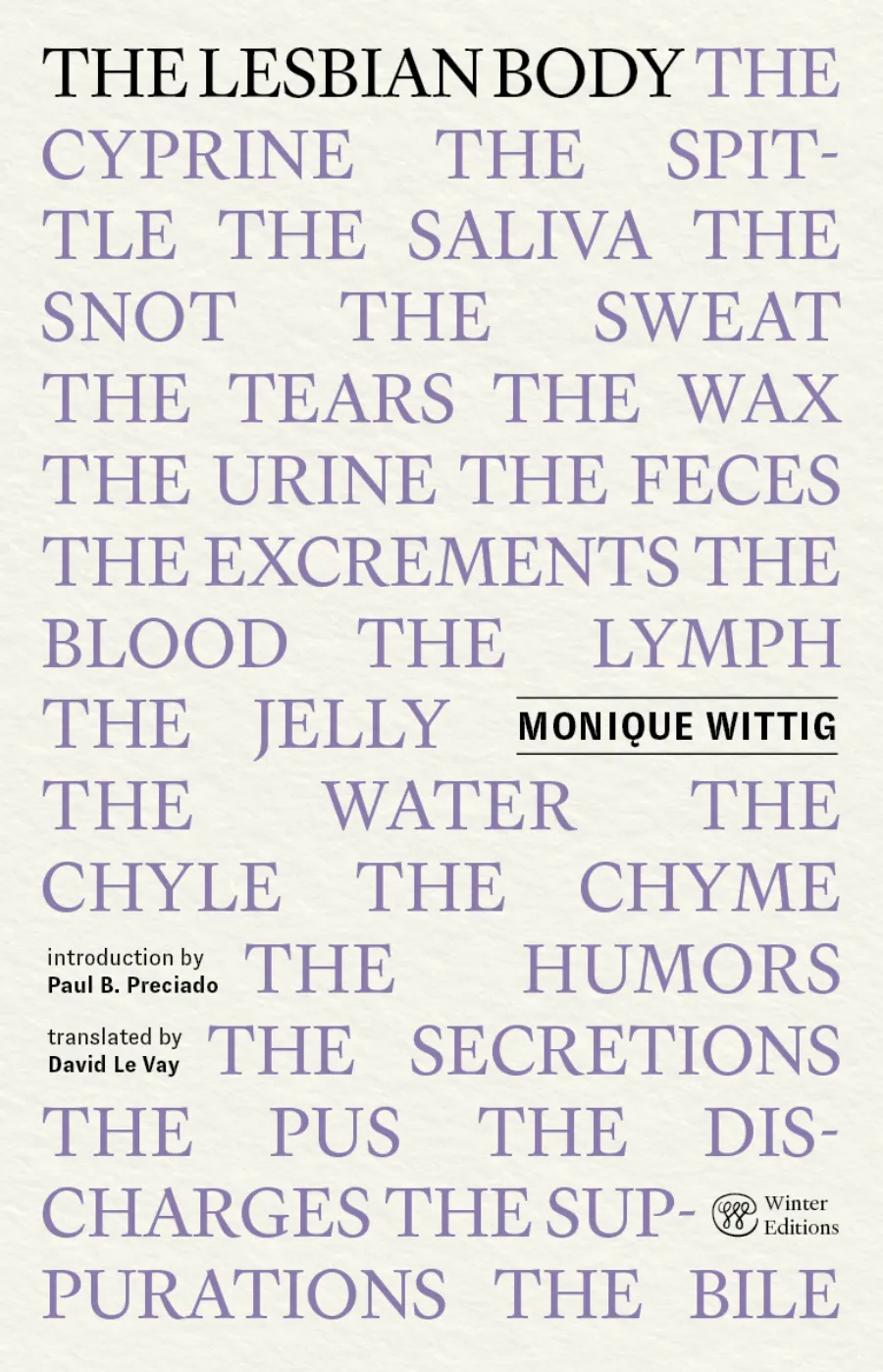
The opening of Across the Acheron, which also appears on the front cover of the current edition, thrusts the reader into the desert space, “The space is devoid of ornamentation. The sand passes in fine, hard blades over the beaten surfaces. Manastabal, the one who calls herself my guide, walks ahead of me. Fortunately we don’t have to wear tunics for this journey, which is both sacred and profane, for they would be instantly torn off by the wind.” With these evocative images, we enter the journey of the Acheron, “In fact we are following the route which must be taken to arrive in Hell, since it is there that Manastabal, my guide, says she is taking me.” Wittig links the desert metaphorically to the ferry, “Is she going to take me on her shoulders to get me to make the crossing? But what crossing? There’s no river here. There’s no sea.” The desert in Across the Acheron functions primarily as a space of crossing rather than a location in itself, the main events that happen here occur in dialogue between Wittig, Manastabal, and the characters that Wittig encounters, who range from the animatronic Eagle to the philosophical Ulliphant. These desert sections are interspersed with sections of Paradise, Limbo, Acheron, and locations around San Francisco.
Where Dante organizes the Divine Comedy with separate sections for Hell, Purgatory, and Paradise, Wittig’s Providence and Manastabal deconstruct this order, “(I don’t know, Wittig, whether the circles of Hell have been enumerated. But never mind that, I’ve no intention of making you visit them in order.) It takes all my energy to reply: (Let’s go there in disorder, then.)” Wittig as author uses parenthetical statements as a form of dialogue — when the characters speak to each other, their words are marked by parenthesis. Across the Acheron is divided into 42 sections. In the French the sections are numbered, in English translation they are numbered and also given names, listed below:

Each section constitutes its own journey in the progression between desert, hell, purgatory, Acheron, and paradise. The cantos of this work function as separate but interconnected interludes, under the guidance of Manastabal and Providence, as well as the chorus of voices of the various lost souls that swirl around and sometimes accost Wittig. One such abrasive chorus materializes in the laundromat section, where a chorus of women launch accusations at the character Wittig, collected from ongoing verbal assaults the author Wittig apparently fielded from obnoxious homophobic neighbors in San Francisco, as she mentions in a 1995 CUNY lecture and reading. The author Wittig indicates the contradictory character of San Francisco as a queer space — while certain areas of the city have been known as centers of gay men, the Castro, or of lesbian culture, centered around Valencia Street in the Mission District, the city as a whole can’t easily be read as a queer paradise or even as a safe space for lesbians or people marked outside binary gender. Although I was born in San Francisco, I have never felt particularly comfortable there as a queer and nonbinary person — the Castro in particular feels very much exclusionary to people who are not gay men, and the Valencia and Mission District of the 70s shifted in the ensuing years, and felt much less at home to me in the 90s and 2000s than parts of Oakland, Berkeley, and the East Bay.
Wittig and Manastabal encounter the dangers of leaving Valencia Street when Wittig is accosted by a volley of verbal abuse from a chorus of lost souls in the laundromat. They accuse Wittig of using outdated references to Sappho, “You go about using a name that’s been out of date for two thousand four hundred years” and of “claiming that you want to lead our entire sex out of servitude.” Wittig takes a certain pride in having gained their attention, “I have come to taste a certain delight in their belligerence, their resentment, not to mention their hatred. After all, aren’t these the same creatures, who, while there was still no question of the lavender threat, wouldn’t look up when you passed them in the street.” As in author Wittig’s theoretical writings, the character Wittig emphasizes the social construct of lesbian invisibility and the ways that the myth of the category of woman erases individual women as autonomous subjects.
Being seen gives Wittig power that was previously denied, “Their present hatred, then, if nothing else, at least proves that I frighten them.” Wittig as character takes this moment of visibility to attempt outreach to this chorus, “(You wretches! Listen to me!),” which of course does not land well with the chorus. However, Wittig attempts to pacify them, “(Sappho is my witness that I wish you no harm. On the contrary, I’ve come here to defend you and redress your wrongs, for I suspect that they multiply among you, like misfortunes.)” The chorus does not appreciate this gesture either, “But in their confusion and agitation they stand in a circle, swaying from right to left, while they emit a kind of whistling sound.” The chorus here begins to take on supernatural and uncanny qualities, transforming from an embodiment of homophobic social norms to a mythological foe.
Wittig’s attempts to establish common ground with the chorus continue to go awry, “Since no word seems to penetrate their understanding, I strip naked between two rows of washing machines and advance among them, not like Venus emerging from the waves, nor even as my mother bore me, but at any rate with two shoulders, a torso, a belly, legs, and the rest.” The chorus, however, are unable to recognize Wittig as related to them or as sharing a similar body type, and Manastabal appears and intervenes, “These furies might reserve for me the same fate as the Bacchantes inflicted on Orpheus, but an external event stopped them: Manastabal, my guide, miraculously stole a cloak from a dryer and threw it over me to conceal my nudity — the cause, she said, of all this uproar.” Author Wittig transforms the obnoxious homophobic neighbors and their rhetoric into Greek furies and potential homicidal (or femicidal) Bacchantes, while associating the character Wittig, or the character’s self image, with the pied piper figure of lute-playing Orpheus. As the furies in Greek mythology serve to protect the so-called natural order, Wittig as author can be seen to undermine the social imposition of the category and myth of “woman” as part of the natural order.
Manastabal’s attempt to rescue Wittig also veers off course when the social assumptions and homophobic myths of the chorus of furies become embodied by the character Wittig, “(Look, she’s covered with hair from head to foot, even her back’s hairy.) I look at myself in astonishment: it’s true, long, black, glossy hair covers my entire body, replacing what had previously been only down.” The myths the furies hold about lesbians are transformed from stereotypes to markings on the body of the character Wittig.
Get LynleyShimat Lys’s stories in your inbox
Join Medium for free to get updates from this writer.
As Wittig attempts to assimilate and reconceptualize this phenomenon, “(Ah, here’s something to keep me warm in winter!),” the furies continue to pile their assumptions on Wittig’s body, “yelling again: (Look, she has scales on her chest, on her shoulders, and on her belly.) I look down at my body once again and see that the hair has now been replaced by hard, shiny scales that I find most attractive. They won’t fail to glitter in the sun.” Just as the character Wittig begins to enjoy becoming a lizard or dragon, the furies begin to shift from body modification to potential bodily harm, “I look up again and one of them, pointing at the center of my body, bellows: (Look, it’s as long as a middle finger. Cut it off, cut it off.) And at this point I haven’t time to verify the accuracy of their claims by looking at the incriminated object, for they’re already flinging themselves at me.”
Manastabal once again intervenes, this time on Wittig’s request, “shaken in my self-respect, trembling, I cry: (In our own city, who would have believed it, who would have said it? Oh, I beg you, Manastabal, my guide, take me for a drink. I’ve had enough.)” The laundromat scene gives an introduction to what’s at stake and the challenges of a lesbian consciousness in a world of compulsory heterosexuality. We also witness the ways that women can become complicit in the oppression of lesbians and of other women, and ways that women might choose oppression by a sexist society over a perceived threat of lesbian domination. We also encounter some of the tension between the attitudes of the characters Wittig and Manastabal toward these women. Where Wittig frequently succumbs to irritation and frustration, Manastabal attempts to push Wittig away from a position of superiority toward one of patience and empathy.
Across the Acheron moves between multiple liminal spaces as well as spaces of graphic violence and conflict. As the English title of the work centers the Acheron, I find it productive to engage with Wittig the author’s treatment of the rivers of Hell. Where Dante’s Inferno contains four rivers: Acheron, Styx, Phlegethon, and Cocytus, Wittig combines these into three visits to Acheron. While Acheron is itself a liminal space and a form of limbo, there is also a distinct limbo which appears in sections V, VIII, XV, and XXXI. In Canto XIV of Inferno, Dante describes the four rivers as teardrops that drip from the fissures in an old man made of metal inside the Cretan mountain of Ida, “d’una fessura che lagrime goccia, / le quali, accolte, fóran quella grotta. / Lor corso in questa valle si diroccia; / fanno Acheronte, Stige e Flegetonta; / poi sen van giù per questa stretta doccia, / infin, là ove più non si dismonta, fanno Cocito.” While the rivers share a point of origin, their characteristics are vastly different and they take full form in diverse locations.
In contrast to Dante’s four rivers of Hell and their specific locations, the river Acheron in Across the Acheron simply appears at the beginning of section XI, “I’m sitting with Manastabal, my guide, on the bank of the River Acheron. We dip our feet into the water, which is warm. Sulphurous vapors emanate from it, forming ochreous clouds on the surface of the water and in the fields, where horses can be glimpsed. I inhale as deeply as I can to calm my anger and torment.” As with the majority of the translation, the English here hews closely to the French both in tone and on a sentence level.
To point out a fun and very minuscule translation detail here — because this is writing by Wittig, there is a small detour we can take at this point with the English sentence “We dip our feet into the water, which is warm.” This sentence is very slightly different from the French, “L’eau dans laquelle on trempe les pieds est chaude.” Because the difference in French is so subtle, it would not be notable in writing by anyone other than Wittig. However, given Wittig’s preference for the nonspecific pronoun “on” as a way of avoiding gendered pronouns, the use of “on” here is an interesting feature, even if not a reason to change the English translation.
In French, the term “on” could be interpreted as “one” or “you” in the generic sense. For example, English might construct a sentence such as, “if you know what’s good for you” where the “you” refers to people in general rather than the specific person one happens to be talking to. The words “les pieds” (literally “the feet”) could mean “one’s feet” “our feet” or “your feet” because French will often use “the” instead of a possessive pronoun (my, hers, your) for body parts; for instance, to say “your hair” French uses “les cheveaux” (literally “the” hair) instead of “tes cheveaux” (a literal translation of “your hair”). “On” can also have an informal quality when it is used to replace “nous” (the standard form of “we / us”). Additionally, there is some overlap between the use of the French pronoun “on” and the use of the generic “they” in English — both can refer to an unspecified and non-gender specific person. For instance, in the example sentence, “on m’a volé mon portefeuille” — in English this could mean “someone stole my wallet” or “they stole my wallet” indicating that we don’t know who stole the wallet. Other possible translations of Wittig’s sentence, “L’eau dans laquelle on trempe les pieds est chaude” might include, “the water in which you soak your feet is hot,” “the water in which one soaks one’s feet is hot,” “the water in which people soak their feet is hot,” or “the water in which they soak their feet is hot.” None of these options would quite make sense or flow well in the context of the rest of the English translation, and none of them quite bring across the subtle difference in the French either.
To bring up another challenge in the French itself, the past tense in French can sometimes be marked for gender, and in one case, Wittig’s French does actually mark the character Wittig as singular and female through the use of the participle “née” — the word “born” which is marked specifically for one woman. Singular masculine would be “né,” plural masculine “nés,” and plural feminine “nées.” In general Wittig tends to use the plural feminine, so this also creates a subtle difference. It’s unclear whether this feminine singular “née” was intentional, or an editorial oversight in the French publication, or whether Wittig simply didn’t find it useful to alter the language here.
To return to the Acheron, Manastabal brings the character Wittig to the river Acheron in three sections of the book. During the first visit, which occurs after a violent interlude at a train station, Manastabal and Wittig are arguing over Wittig’s attitude toward the unfortunate women involved in the train station scene when the river begins to exert its influence, “as soon as I start to swim I forget who I am, in what company, where and why, for the Acheron is the river of oblivion and Manastabal, my guide, has thought it right for me to bathe in it. But I am unable to thank her for her courtesy, since, as I follow the current, it is now an unknown person I see walking alongside me on the bank.” Manastabal is once again forced to rescue Wittig, whose identity and memory have been temporarily disrupted by the river. The river also serves to reduce the traumatic impact of the train interlude.
In the second Acheron section, which comes immediately after what Manastabal refers to as the “last circle” of Hell or “extreme limit” of existence, the character Wittig is once again thrown off course by the river. This time Wittig is waylaid by the Acheron while rowing a boat across the river, “we have hardly progressed a little distance before swirls of ochre vapor rise from the river. They press so thickly around the boat that I can no longer make out any of the surroundings. And even the figure of Manastabal, my guide, grows blurred.” In this section, the river creates a physical challenge to visibility as well as challenges to memory and identity, “The air I inhale mounts to my head and at once I forget who I am, whom I’m with or what I’m in process of doing.” Manastabal once again rescues the amnesiac Wittig, who has fallen out of the disintegrating boat and faded out of consciousness, “Then I plunge into the deepest part of the river, where it really seems that I’ve touched bottom. But I wouldn’t swear to that because, at a given moment, in addition to the oblivion I have gained, I have completely lost consciousness. Yet I believe I’m surfacing from sleep.” Despite not remembering who Manastabal is, Wittig thanks her and asks for an explanation of what happened. Manastabal explains that the Acheron contains a magnetic island and the magnetism pulled all the metal nails out of the boat, causing its dissolution. This episode, like the first Acheron section, serves to reduce for the character Wittig the traumatic impact of the section before it by disrupting and erasing her memory.
In Acheron 3, section XXXVI, Manastabal guides the character Wittig on a subterranean water journey to the origin point of the Acheron, referencing elements of the four rivers of Hell in Dante’s journey, “We arrive at the River Acheron, where the water darkens, the trees are dark green and the rocks like amber and jet glitter with all their silica.” The translation captures the tone and poetic sound repetitions present in the French, “On arrive à l’endroit du fleuve Achéron où l’eau s’assombrit, les arbres sont vert foncé et les rochers comme de l’ambre et du jais brillent de tous leurs silices.” Wittig the author again uses the pronoun “on” instead of “nous” (the more official “we”). Wittig’s Acheron captures aspects of all of Dante’s four rivers, “at the tip of the island, a rocky prow shape; the waters of the river beat against it and divide into two currents, one of liquid amber, the other of black chalcedony, fused onyx or jet. The liquids I saw boiling upstream freeze here and turn to ice.” Manastabal also comments on the black and gold colors which appear repeatedly in Across the Acheron, “(The tears shed for the dead are black and yellow. Here is the river they form and which, just as it is, traverses Hell.)” Manastabal also elucidates the Acheron journey, “(To go where we are going, Wittig, we must follow underground the river of tears that are shed for the dead, up to its mouth at the other side of the mountain it traverses.)” These Acheron interludes provide a highly poetic and meditative counterpoint to the often graphic violence of many of the other sections of the work. This counterpoint allows both Wittig the character and readers of the work a needed chance to pause, and to assimilate, or recover from the frequently heavy themes and scenes of Hell and of the desert with its varied antagonists and philosophers.
Across the Acheron gives readers a glimpse into the state of French feminism from the 1960s to the mid 1980s when it was published, always through the lens of the creativity, idiosyncracy, and frenetic energy of Wittig’s creative work. The work is well worth reading both in French and in this translation that attunes so well to the French. The translation manages to carry Wittig’s unique voice over into the English in ways that are fun to read and think about, as well as carrying the prose poem tones and the philosophical ones. The writing in French and in the English translation are by turns poetic, theatrical and dialectic, and irascible, incorporating both a love of Dante and a critique and reinterpretation based in Wittig’s feminist principles and poetic aesthetic.
On the theme of critique, Wittig’s Across the Acheron, like the overarching feminist philosophy of Wittig, contains particular knowledge gaps worth mentioning. For some reason, the majority of French feminists during the time when Wittig was writing were clearly able to read and cite the work of French feminist and social theorist Colette Guillaumin on gender and sexism. Despite this, Wittig and other French feminists were somehow unable to cite Guillaumin’s equally relevant work on race and racism. While the character Wittig makes reference to sexism and abuses against women she associates with Africa, she seems unaware of the ongoing violations of women’s independence and bodily integrity that were still occurring in the U.S. and Canada during her stay in the United States, particularly and governmentally directed against African American and Afro Canadian women, Native American women, FNMI (Native peoples in Canada) women, and Latina populations, as well as government and social violence against transgender people and medical violation of intersex people at birth and beyond.
While I wouldn’t expect Wittig as a white French person to lead queer communities of color, Wittig’s lack of awareness on these issues also leaves room for philosophical and policy based forms of race based sexism, including governmental misogynoir and misogyneity (against Indigenous women). As American anthropologist Lila Abu-Lughod has shown, the orientalist idea that Muslim women need EuroAmerican societies to “save” them from sexism has frequently been used as a pretext for EuroAmerican governments to impose unnecessary military force and xenophobic orientalist policies against Muslim countries, as well as to spread propaganda based in combined racism, sexism, and general bigotry. For these reasons, I would suggest additional reading in conjunction with readers approaching Across the Acheron. In particular, I would recommend Abu-Lughod’s Do Muslim Women Need Saving, Saidiya Hartman’s Wayward Lives, Beautiful Experiments, which uses theater as a formal basis and focuses on Black queer women (Hartman’s academic career included studying with Judith Butler, who has written about Wittig), and work by Dionne Brand and Christina Sharpe. Also of relevance, Theresa Hak Kyung Cha’s Dictée, which uses film, theater, and gaps between languages to carry histories of Korean women in the spaces between nationalism and existing as women, and work by Andrew Jolivette on gender, including 2-Spirit communities, Creole communities, and AfroIndigenous communities. Like the Acheron river segments of Across the Acheron provide a respite from some of the more graphic violence of Hell, these works can provide respite from the occasional places where Wittig shows a lack of knowledge about the embodied histories of women and queer people from Indigenous, African Diaspora, and POC communities.
As a final tangent, I find it quite fun when Wittig brings in French history, traditional knowledge, and storytelling. Two such moments occur when Wittig mentions the 18th century Beast of Gévaudan and the prehistoric horse paintings from the caves of Quercy. In a work with claims to universality, these mentions function to tie Wittig (author and character) to a specific and personal location and history. Rather than the Florentine Dante, Wittig is clearly French, as well as raised Catholic, which the character mentions obliquely, describing Paradise as “C’est pour moi un mystère aussi insondable que le mystère de l’incarnation dans la religion d’où je viens.”, or “For me it’s a mystery as unfathomable as the mystery of the incarnation in my native religion.” I would have appreciated more of these hints at personal specificity from Wittig, especially given the strength and uniqueness of her authorial voice throughout her work.
Across the Acheron, Wittig’s second-to-last published creative work (short story collection Paris-la-politique et autres histoires was published in 1999) brings together Wittig’s inimitable creative and political voice to draw a sprawling view of an imagined San Francisco where members of the lesbian and queer community come together to cook up a paradise despite, or perhaps by overcoming the challenges and violence directed against the community. The English translation, by David Le Vay with Margaret Crosland, edited by Alice Centamore, carries across the tone, poetics, and idiosyncratic voice of Wittig. This edition makes it possible for English readers to access this work and Wittig’s particular contribution to French and Franco-American Feminist philosophy and practice. Fans of Dante will also enjoy the ways that Wittig riffs off the theory and aesthetic energy of Divina Commedia.