Opinion
Stop Searching for “Games Like Minecraft”
You don’t need a replacement — you need to figure out what you actually miss about Minecraft.

Every “top 10 games like Minecraft” list has failed you. Not with bad games, but with the wrong question.
Here’s what those lists produce. You buy the #3 pick because the screenshot looks close. You play for six hours. The blocks are there. The magic isn’t. So you refund it, go back to the list, buy the #7 pick, and do it all over again. Somewhere in the refund history of every long-time Minecraft player, there’s the same graveyard of games that were “like Minecraft” in the way a mannequin is like a person.
The lists keep failing because the logic is broken. It has blocks, so it’s Minecraft-adjacent. It has mining, so it’s a cousin. Nobody stops to ask the obvious thing: which part of Minecraft were you trying to replace?
I say this as someone who’s refunded more “alternatives” than I’d like to admit. It took me a while to realize the problem wasn’t the games. It was the question.
Minecraft isn’t a genre. It’s six different games taped together.
If you separate Minecraft into its systems, they pull in completely different directions:
- A creative sandbox. Absolute freedom to build anything, anywhere.
- Unknown-world exploration. The itch that never quite goes away.
- A resource loop with survival pressure. The thing that makes your base feel earned.
- Long-term growth. A world that compounds, that you keep coming back to for years.
- Multiplayer creation. Building together, showing each other what you made.
- Mods. The game that outlives everything else because of its community.
Most “Minecraft clones” copy the blocks and miss the loop. That’s why they feel dead after ten hours. The blocks are there. The magic isn’t.
So the useful question isn’t “what’s like Minecraft.” It’s smaller, and more annoying:
What part of Minecraft are you actually missing?
Answer that, and the “alternative” basically picks itself. Here’s how it breaks down, from the hours I’ve spent wrong-footed in all of these worlds.
If you’re burned out on easy survival — Vintage Story
You don’t craft a stone knife in Vintage Story. You find a rock, and you knap it: bash it against another rock until it has an edge. That’s the first five minutes of the game, not the late-game content.
Vintage Story is what happens when someone asks “what if Minecraft took survival seriously.” It keeps the voxel world, the mining, the building, the exploring. Then it adds weight to everything. Food rots. Winter kills. Metal doesn’t come from a crafting table; you build a forge, manage temperature, and hammer it out. There are seasons, an agricultural cycle, and a temperature system that is actively out to get you. Your first year in that game is a real fight to stay alive.
The shift is philosophical, not just mechanical. Minecraft is a blank page: I want to create a world. Vintage Story is: I want to learn to live in this one. If Minecraft survival has stopped scaring you — and if you’ve been playing since 2012 or so, it probably has — Vintage Story brings the fear back.
It’s the closest thing to a true spiritual successor, I think. Honestly, the closest. But it’s also the hardest sell on this list. The learning curve is steep, the art direction is deliberately old, and if what you want from Minecraft is a cozy house-building afternoon, this game will eat you alive. It’s not for everyone. It’s for the player with a thousand hours in Minecraft who still wants to be humbled.
If you want a game with a spine — Terraria
I bounced off Terraria twice before it clicked. The third time it ate months of my life.
The mistake I made the first two times is the same mistake everyone makes: I went in expecting 2D Minecraft. It’s not that. Terraria is an action-RPG with building mechanics and a tech tree as deep as anything I’ve played. It has a spine: bosses, armor tiers, biome progression, events. There’s always a next thing, and it’s always visible.
That’s the real trade. Minecraft is a blank canvas that waits for you to have an idea. Terraria is a game that always knows what’s next and drags you toward it. If your favorite part of Minecraft is freeform architectural building, Terraria may not scratch the same itch. It has an incredibly creative building community, but the game’s progression naturally pulls most players toward exploration, combat, and boss progression rather than construction itself. If your favorite part is digging down, finding ore, and getting stronger, Terraria might do that loop better than Minecraft does.
Rule of thumb I now give people: house-builder, maybe not. Cave-diver, yes. Gear-chaser, absolutely.
If Minecraft feels too “toy-like” now — Valheim
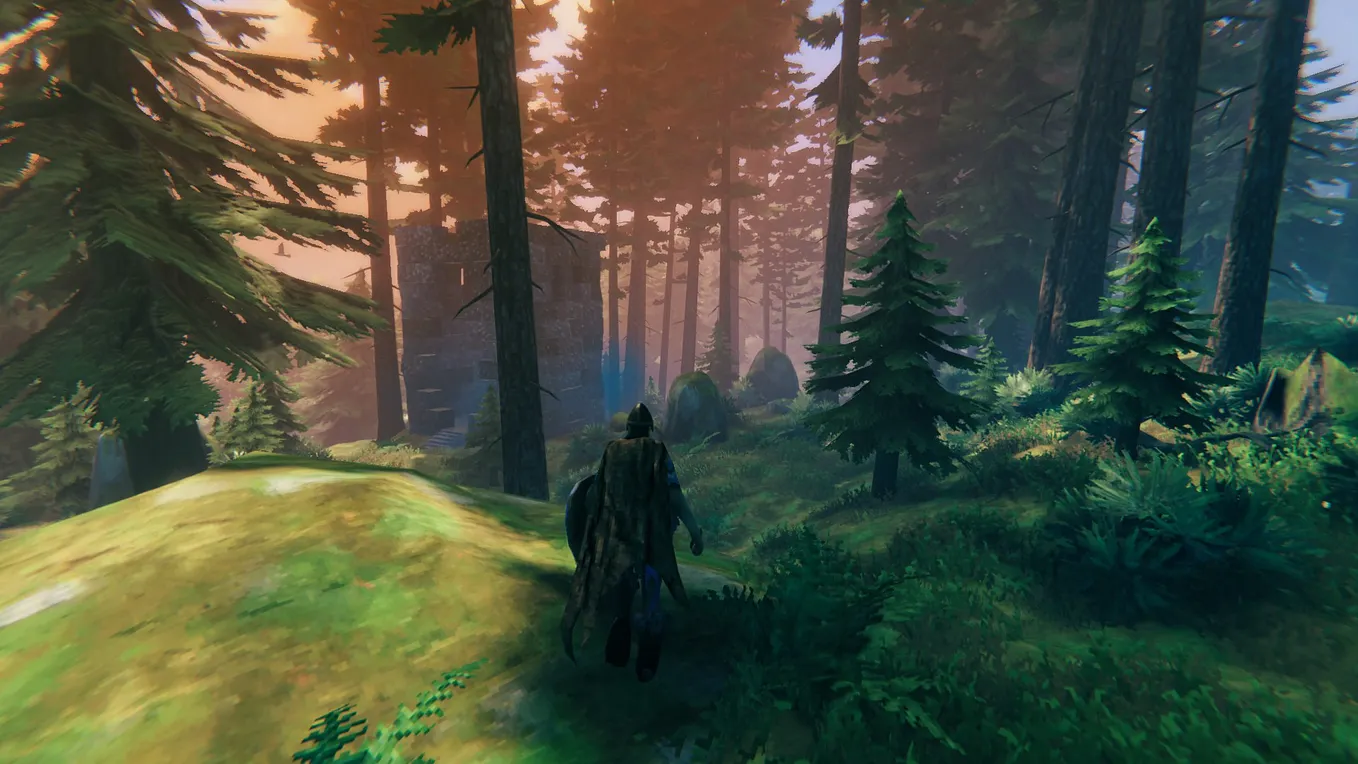
My first Valheim house collapsed on me. I’d built the walls, slapped a roof on top, and walked inside like I owned the place. The roof didn’t have support. It fell on my head.
That’s the whole pitch in one collapse. Valheim keeps the gather-build-craft-fight-boss loop, but the building has physics you can feel. Wood needs support. Rooms need planning. When you build a house in Valheim, it feels like you built a house, not like you painted a square.
It’s the most natural pick for a certain kind of Minecraft player: the one who grew up, still loves the loop, but finds the toy-blockiness a little childish now. The world isn’t infinite, exploration does start repeating, and late-game resource runs turn into a chore. But that first spring, in the rain, next to a fire, in a house you engineered to stay standing? That’s the adult version of the Minecraft feeling.
If you want the building without the blocks — Enshrouded
Here’s the pick that surprised me. Enshrouded isn’t trying to be Minecraft. It’s trying to be what Minecraft players wish Minecraft looked like.
The building system is the best on this list. Voxel-based, so the freedom is real: dig into terrain, carve a cliff-face home, build with actual architectural logic. Terraforming gives you control Minecraft doesn’t. And it’s pretty. Not “better textures” pretty. A real lighting model, real materials, a world that holds up in screenshots.
Get Willanlima’s stories in your inbox
Join Medium for free to get updates from this writer.
The trade-offs are honest. The world is handcrafted, not infinite; your freedom lives inside a designed space rather than over an endless one. Survival pressure is light; the game never threatens you the way Valheim or Vintage Story does. And it’s still evolving, so I could be wrong about where it lands in a year. But right now, for the player who’s tired of blocky aesthetics and refuses to give up creativity? Enshrouded.
If the best part is not knowing what’s out there — No Man’s Sky
Some people play Minecraft for the building. Some for the survival. And some, I’m in this group, play for the specific dread-and-wonder of cresting a hill with no idea what’s on the other side.
No Man’s Sky is that feeling, scaled to a universe. The core loop is almost identical to Minecraft’s: explore a planet, gather resources, upgrade gear, build a base, fly to the next planet, repeat. But the planet is a planet. The mountains are real mountains. The weird animal on the horizon is actually weird.
I want to be clear about what it isn’t, because the lists never are. No Man’s Sky is not a building game in the Minecraft sense; bases are functional, not expressive, and anyone who loves fine decorative construction will hit its limits fast. Survival pressure is weak. It doesn’t humble you. It expands you, outward, endlessly. If Minecraft’s magic is “I don’t know what’s over there,” buy it today. If it’s “I want to build something beautiful,” you’ll be frustrated by Thursday.
If you were a redstone person — Scrap Mechanic
Not everyone who loved Minecraft loved the same thing. Some of us spent hours not building houses but building machines. Redstone circuits. Automated farms. Contraptions that did one job with unnecessary elegance.
Scrap Mechanic is the game for that brain. You build vehicles, machines, and automated systems out of physics-based parts, and the things you make actually move, break, and sometimes betray you. Minecraft builds a world; Scrap Mechanic builds machines that change a world. If you were the friend who never showed up to the group project because you were optimizing an iron farm, this is your game.
The caveats are real. Survival content is thin. There’s no strong goal structure, so you have to supply your own ambition. If you need a game to tell you what to do, this one won’t. But if you have the problem where you can’t stop designing, this is a drug.
If freedom gives you anxiety — Dragon Quest Builders 2
Some players boot up Minecraft, look at the infinite world, and quietly think: …and now what? There’s a whole type of person for whom open-ended freedom isn’t a gift, it’s a burden. I know this type. I’m married to one.
Dragon Quest Builders 2 is the answer for them. Minecraft’s building with a quest log and a story bolted on: the game tells you what to build, why, and then shows you the result. And it does something Minecraft never does. The NPCs use what you build. Build a kitchen, villagers cook in it. Build a bedroom, they sleep in it. The world reacts to your construction, and that feedback loop is addictive in a way Minecraft’s silent canvas can’t match.
The trade-off is the freedom you give up. The game runs on rails through its RPG structure, and you can’t do whatever you want whenever you want. But for the player who feels lost without a goal, that’s not a bug. That’s the feature.
If you play with friends and want your walls to matter — 7 Days to Die
Every Minecraft base I’ve ever built has ended up the same way: pretty, unthreatened, and totally unneeded. Nothing in that world cares that it exists.
7 Days to Die fixes exactly that. Minecraft’s survival-building loop crossed with a zombie apocalypse, where every seventh night a horde comes for your walls. Suddenly the base isn’t decoration. It’s a bet. Did you build the walls thick enough? Will the trap corridor hold? Defense gives your construction a meaning that survival Minecraft rarely does.
It shines as a multiplayer game, for the group that wants to build, arm, and hold a position together. The atmosphere is grim, the difficulty spikes brutally, and if you’re the relaxed-creative Minecraft player, this is not your world. It’s for the crew that wants create, defend, survive. In that order. On a server that never sleeps.
If you have no budget and an old computer — Luanti
The honest answer to “I want Minecraft but I can’t pay for it” is Luanti, which you probably know as Minetest. It’s free, open source, runs on hardware that makes other laptops cry, and gives you the voxel experience with a large ecosystem of community-created games, mods, and content packs.
But I’m not going to oversell it, because the lists always do. Luanti is an engine, not a finished game. Out of the box it’s thin. The default content is sparse, and you’ll spend your first sessions installing content packs and mods before it feels like anything. You’re not trading money for the game; you’re trading setup time and tinkering. Which, full disclosure, is exactly the kind of rabbit hole I disappear into for a weekend. If that sounds fun, it’s a real steal. If you wanted pick-up-and-play, it’ll feel like homework. Fair warning.
The games that look like Minecraft but aren’t
Let me say something nice about Rust, ARK, and Palworld first: they’re good games. They’re all bad “Minecraft alternatives,” and knowing which is which saves you money and a refund cycle.
- Rust has building. But the base is a vault, not a home. The core of Rust is PvP and player-on-player aggression; you build a base to protect your loot from other humans, not to express anything. It’s a survival game about distrust. Wrong category.
- ARK: Survival Evolved has building, collecting, and survival. And it’s really a tame-and-raise game. The center of gravity is dinosaurs, breeding, stats, and fighting. The building is storage with walls. ARK doesn’t want you to live in a world; it wants you to conquer one.
- Palworld is Pokémon crossed with survival automation. Actually fun, great automation loop. But its building is basic, and it never once makes you feel like a creator. It wants you to be a rancher with guns.
None of these are bad. They’re just not Minecraft. And that’s exactly what the “top 10 Minecraft alternatives” lists keep getting wrong about them.
So what should you actually play?
Here’s the table I wish I’d had before the refunds:

Minecraft’s biggest strength isn’t that it’s the best building game, the best survival game, or the best exploration game. Plenty of games do each of those things better on their own.
What makes Minecraft special is that it does all of them well enough at the same time. It blends creativity, exploration, survival, multiplayer, and modding into a single experience that’s remarkably hard to replicate.
That’s why every so-called “Minecraft alternative” ends up specializing. One game offers deeper survival. Another focuses on progression. Another delivers better building tools or a stronger sense of exploration.
None of them replaces the whole package.
And the part that took me the longest to accept: there is no true replacement for Minecraft, and there probably won’t be. The combination is weirdly special. Infinite creation plus exploration plus mods plus multiplayer plus a world that stays with you for years. Nobody’s copied that bundle, because you can’t remake that much game at once.
So the question “what’s a good game like Minecraft” is a trap. The useful version is: what part of Minecraft am I actually missing right now? Answer that honestly, and the pick stops being a gamble.
The last time someone asked me for a Minecraft alternative, I didn’t hand them a list. I asked what they missed. They said exploring. I pointed at No Man’s Sky, they loved it, and I only felt slightly smug about it.
Ask the smaller question. You’ll stop refunding games.
Image Credits & Fair Use Disclaimer: Images © Mojang Studios, Coffee Stain, Hello Games, Keen Games and their respective owners. Used for editorial commentary under fair use where applicable.