Review | The studio is a metaphor for the world in William Kentridge’s Self-Portrait as a Coffee-Pot

For Books24, a review of William Kentridge’s book, Self Portrait as a Coffee Pot.
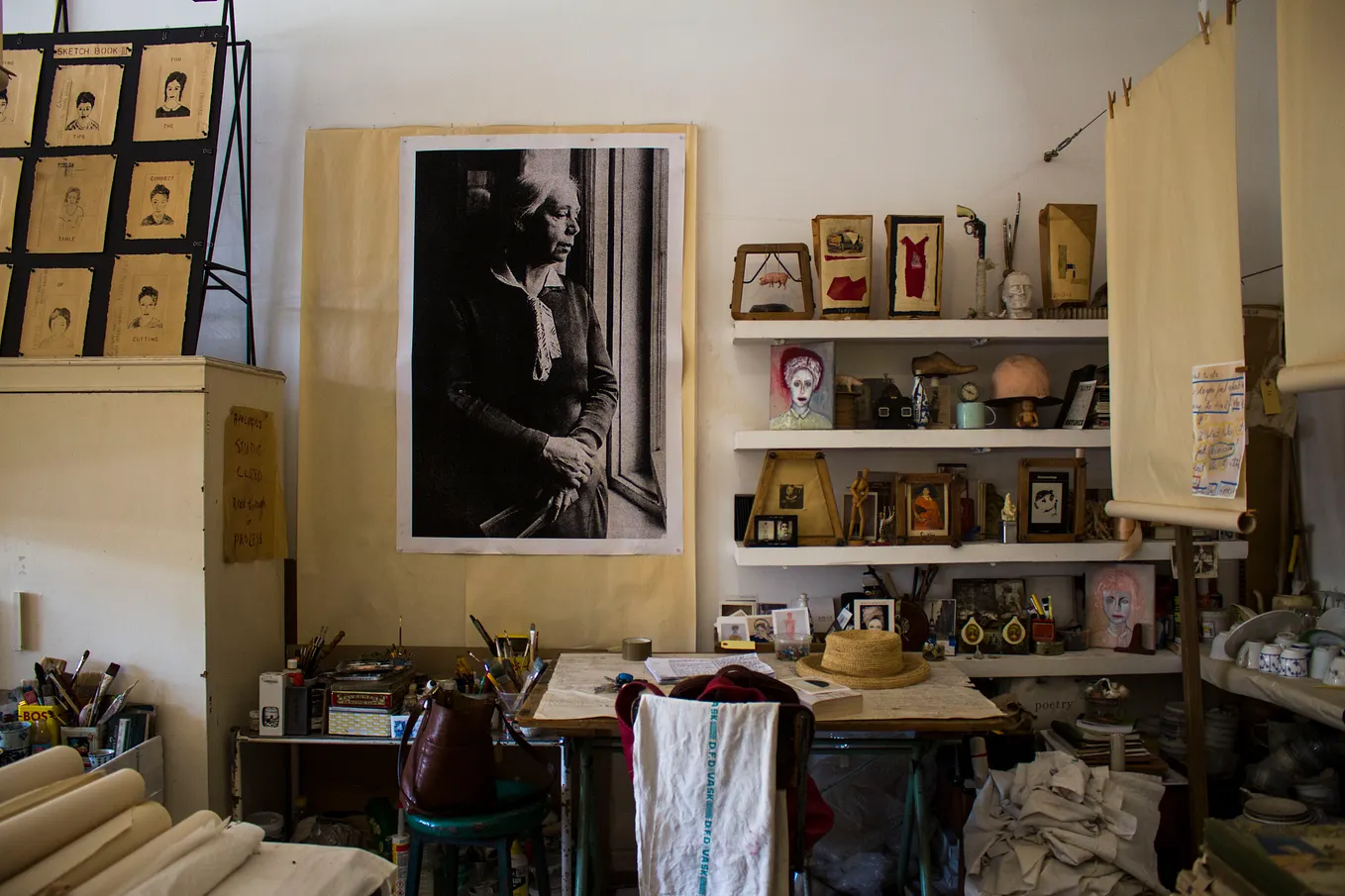
“How do we know our place in the world?” asks William Kentridge. He is standing in his studio beside two different landscape drawings in charcoal. The one, he explains, is a reproduction of a landscape painting that used to hang over his grandparents dining room table — mountains, streams, dappled light. “No,” says another Kentridge, standing beside the second landscape. “We had none of this. There was no mountain. The only mountain we had was the mine dumps… there was no river. We had, at most, a ditch.”
It’s one of many moments in Self-Portrait as a Coffee-Pot where Kentridge meditates on memory, mark-making, belonging, and more through short and sometimes sardonic quarrels with a more critical version of himself. It’s a familiar relationship — artist and critic, dreamer and realist, optimist and pessimist — and one that shapes and drives the narrative of the nine-part film and recent publication.
For many artists, the studio is a sacred or deeply personal place. It’s a generative space, where work is carefully thought through and puzzled out before it meets the world. This is true for Kentridge, too, though for him the studio is also a metaphor for the world, and therefore a deeply porous realm.

Self-Portrait as a Coffee-Pot isn’t a retrospective, but many of the artist’s early works and recognisable works are there — the binoculared officials of Tide Table, the bustling Johannesburg city grid of Other Faces, as well as the early characters, the anxious Felix Teitelbaum and the pinstriped industrialist Soho Eckstein, both borrowing from Kentridge’s likeness. Then there is the newer work — the film accompaniment to Shostakovich’s symphony no. 10, Oh to Believe in Another World, the opera documenting Africa’s involvement in the first World War, The Head & The Load, and the chamber opera Waiting for the Sibyl with its prophetic aphorisms about death, ambition, and halted progress. Here, process and collaboration are foregrounded, detailing the conversations, decisions, and incidental moments that emerge in the act of making.
Over the course of the nine instalments, Kentridge makes a series of arguments — often literally arguing with himself — around ways of seeing and being in the world, how history and power echo into the present, fate, desire, erasure, failure, stupidity and more. His drawings, operas, films and sculptures are the materials he uses to illustrate these arguments, and the studio, of course, is both the lectern and the seat in the lecture hall. Filmed during the 2020 COVID-19 pandemic and subsequent lockdowns, the film also carries the strange quality of isolation and yearning that characterised the period. The overarching narrative arc is one of deep solitude — Kentridge alone in studio, drawing — followed by bouts of intense collaboration.
Get David Mann’s stories in your inbox
Join Medium for free to get updates from this writer.
The film series first came out in 2024 on the streaming platform Mubi, and has had episodes screened at exhibitions and festivals around the world, premiering at the Venice Biennale. The book, published by Kentridge’s new international gallery, Hauser & Worth, and distributed in South Africa by Jonathan Ball Publishers, came out this year and is essentially a transcription of the dialogue in the film series, as well as an array of images — artworks, film stills, handwritten notes and drawings — packed into 800 pages. So, with the film series being such a successful format, why a book?
It’s a question the artist and writer Terry Kurgan has as well. Speaking with Kentridge at the packed Johannesburg launch at Goodman gallery in late August, she is curious about the choice to commit an online film series to paper.
“It’s partly to have a record,” Kentridge responds. “In the way that an opera has a libretto to keep it alive. This series is being shown on Mubi now, but it may not always be in the world in this way and so the book becomes the record.”
But this is also a way of working for Kentridge — creating, documenting, picking apart, rearranging and sending back out in a different form. As he notes in his introduction to the book: “The world is invited into the studio. There it is fragmented. The fragments are rearranged and sent back out into the world as a drawing, a performance or a text.”
Earlier this year, Kentridge held a solo exhibition at Goodman’s Johannesburg gallery titled To Cross One More Sea, named after his film of the same name, and featuring many of the drawings, puppets, and works on paper from his monumental new chamber opera project with The Centre for the Less Good Idea, The Great Yes, the Great No. While the opera has been staged in numerous countries abroad, exhibitions like this one make use of the materials from the studio and the workshop floor, to provide a fragmented view of both process and of the discoveries made in the studio towards the final project.
The puppets, for example, with their metal and paper bodies in miniature, find full realisation in the human-sized puppets in The Great Yes, the Great No, while the three-channel film contains the enduring refrain of the women’s chorus, a central choral component of the chamber opera.
Self-Portrait as a Coffee-Pot, the book, adopts a similar approach, distilling, reappropriating, and presenting the material of the film series in book form. Yet, the book is more than an accompaniment to the film series. As a publication, it does the work of gathering the frenetic, disparate marks, gestures, thoughts and phrases generated in the studio, and puts them in a sequence and format that allows for pause, for breath, for the unappreciated act of sitting with an image and allowing it to affect you, change you.
Self-Portrait as a Coffee-Pot is also a joy to page through. Key scenes from the film series are replicated here, frame by frame across a handful of pages, allowing for the pleasure of leafing through the book and watching a landscape change, a figure dance, a building collapse. Other pages echo the philosophy of the studio in their transparency and porousness, allowing the mark and the text of the page to bleed through to the next, changing its composition or disrupting its logic.
Though the film series is undeniably engaging, with its gorgeous soundscapes and considered cuts (lauded editor Walter Murch worked as lead editor on the film, assisted by Kentridge’s studio team), there’s a quiet contemplation about the book that feels singular, rare. Then again, my love of printed words may sway my opinion. As the critic says to the artist: “Love of words is love of self.” It’s one of only a few moments that they seem to agree about something, if only because they’re understanding it differently.