The Undercurrent of My Work
A compass for those willing to look closer


If you have ever read one of my stories, essays, or articles, you might have noticed that my topics vary quite a bit. One day I will write about geopolitics or artificial intelligence; the next, it is a fragment of a childhood memory, a philosophical reflection, or a piece of fiction with an absurd twist. Oh, and music and satire make an appearance too. Honestly, anything goes.
At first glance, these pieces might seem completely unrelated. Many readers naturally assume I simply have a broad, somewhat restless range of interests. While that curiosity is definitely real, an underlying current of the exact same, recurring questions and motifs moves beneath all these subjects. These are the questions that have stayed with me for most of my life.
What Lies Beneath the Surface
It is tempting to say that my work is primarily about “consciousness” — a term I frequently use myself. Yet, that does not quite capture the whole picture.
Consciousness itself is elusive; we are trying to understand reality using the very instrument through which we experience it — much like an eye trying to see itself without the help of a mirror.
I am not interested in consciousness as an abstract or philosophical end goal. I am interested in the movement. It is about the process of slowly untangling ourselves from the beliefs and masks we once took for granted. It is a layered journey of learning to question our assumptions and discovering who we truly are, stripped of the pressure to live up to the world’s expectations.
If I had to capture it in a single word, it would be self-realization: recognizing and embracing what has always been there deep within us, instead of focusing on what we want to project.
What Kinds of Questions Do I Ask?
Of course, there are the well-known, big questions that philosophers have been asking for thousands of years. Why is there life? What is its purpose? Where is it all heading? Does God exist? Is there life on other planets?
And then there are the questions we all ask ourselves at some point. Who am I? What am I doing here? What does happiness mean to me? Am I with the right partner?
But for me, the questions run deeper. How do I become more fully myself? How do I learn to listen to “life”? How do I find love within myself? In fact, I am trying to uncover the questions that lie beneath these questions.
In a way, I am not looking for direct answers; I am searching for the “ultimate question.”
The Existential Engine
Along my journey through these questions, I naturally find answers. But those are my answers. And for me, they are only true for the time being. New insights constantly shift and reshape my answers. That is why — I think — the questions intrigue me far more than the answers themselves.
I am not trying to build a bulletproof philosophy with my questions and answers. On the contrary, I have experienced how seductive and easy it is to get trapped in the stories we tell ourselves about who we are and how the world works. We build walls of apparent certainties just to feel safe. But that safety is an illusion, one that narrows our perspective.
For me, writing is a way to see where those walls show cracks — I want to tear them down. The more I examine things, the less self-evident the world becomes. That can be uncomfortable, because you lose the solid ground beneath your feet. Yet, it is the only way I know to get any meaningful answers.
My drive is not academic curiosity; it is an existential necessity — a flat-out refusal to fall asleep in a comfortable illusion.
The Stories We Inhabit
As human beings, we live in stories. Some of these are collective — like politics, religion, economics, and culture. Others are deeply personal: the stories of whether we are successful or whether we are failing, or whether we truly belong.
Most of the time, we do not even realize we are being lived by these stories; we mistake the map for the terrain, the story for reality itself.
Get Nico Cost’s stories in your inbox
Join Medium for free to get updates from this writer.
In many of my fictional stories and personal essays, I explore what happens when those familiar narratives begin to waver or collapse entirely. You can see this in the tension experienced by the characters in Surrender or Now for the Rest of the World. I also wrestle with my own personal stories, as seen in I Am an Accident and The Years I Grew Up With Him.
The stories we live in are not inherently wrong — after all, we need them as anchors to make sense of our lives. But we must learn to see them for what they are: temporary truths that might not actually be true.
We need to be able to step out of these self-created narratives when they no longer serve us, or when they stand in the way of our self-realization.
Why My Work Often Has Multiple Layers
Readers sometimes tell me they sense there is “more” to a story than what is literally on the page. They are right, and that is a deliberate choice. Life itself, after all, unfolds on several levels at once.
A story can certainly be entertaining, suspenseful, or strange at first glance, but beneath the surface, I like to look for something that reaches beyond just the plot. Sometimes I write a piece that has no plot at all — only an underlying question.
These layers are not complicated puzzles you must solve to properly understand the text. They are invitations. In my guide How to Get More Out of My Work, I offer a few playful, intuitive ways to explore deeper meanings in texts, using an AI assistant as a sparring partner if you like. Which layer you connect with depends entirely on where you are in your own journey. There is no wrong way to read.
If you want to go further, two pieces are worth your time. The Master Prompt Story Analysis is a structured way to look beneath the surface of any story — a sparring partner for the curious. And The Fiction Vault is the complete catalogue of my fiction, sorted by mood and atmosphere, with every story’s surface and undercurrent mapped out. Start wherever you like. There is no wrong entrance.
Questions Open Doors, Answers Close Them
As humans, we are constantly hunting for answers because they give us peace of mind. Yet, the most profound moments of growth in my own life have never come from finding a ready-made answer; they have come from allowing a better, sharper question to surface.
Questions crack open rigid beliefs; they create room and movement where thinking had grown stagnant. This is also why many of my stories end without a clear moral or a tidy resolution. Life itself rarely offers neat endings. An open ending forces us to carry the question with us, rather than filing it away as a solved problem.
Truth Is Self-Realization
Truth is sacred to me, but I do not believe any of us holds a monopoly on Truth with a capital T. We can only approach it by continuing to investigate, by daring to put things into perspective, and by remaining humble enough to discover, time and again, where our own lens distorted reality.
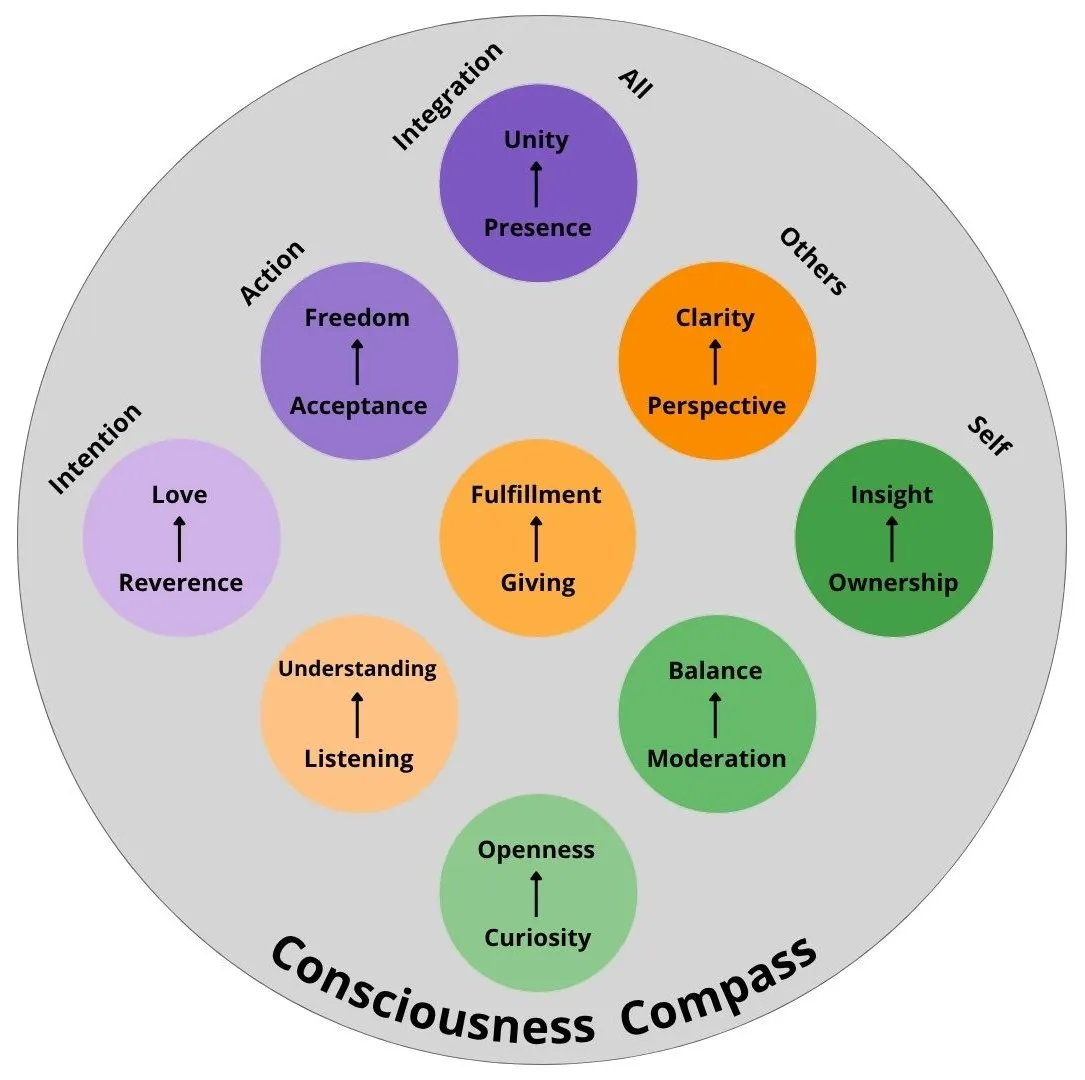
This requires a mindset where curiosity, perspective, and acceptance come together. We can stay in constant motion by questioning absolutely everything. Sometimes we can just shrug our shoulders. Sometimes things simply are what they are. But we keep questioning — so that we can become more aware, and more fully ourselves.
To help with this, I created The Consciousness Compass, which features nine universal values. I warmly invite everyone to journey through it, because I believe it captures the essence of how we can become more human.
A Further Invitation
In my essay To Understand Me, You Need to Read More of Me, I wrote that we can never truly know each other inside and out. We only ever see a fraction of another person, and even that fraction is viewed through our own tinted lens.
This article, then, is not a manual meant to define me or my work once and for all. The moment something claims to be finished, the movement stops — and with it, life.
At its core, my work is an invitation to walk with me for a little while. You do not have to agree with me — in fact, differences of opinion invite deeper reflection, provided we can keep meeting each other open-mindedly and without judgment.
Read one piece, or read ten. Challenge my ideas, weigh them against your own values, and see what happens within you. The ultimate goal of my writing is not to tell you what to think, but to create a space where we can dare to stay curious about the mystery of our existence just a little longer.
My goal is not to impose my temporary truth on others, but to help generate the momentum people need to become more fully themselves.
We are all different, and there are no answers, solutions, or truths that apply to everyone. Not yet.
Keep asking questions!