James Madison Was Twenty-Five and Not Yet a Delegate When the Declaration Was Signed — Then He Spent the Next Sixty Years Building Everything That Came After It
He lost his first election for refusing to bribe voters with liquor. He helped write the Constitution, then the Federalist Papers defending it, then the Bill of Rights amending it. He started a war as president that burned down his own White House. And on his deathbed, he refused a chance to die on the Fourth of July. Day 15 of The Unfinished Founding.
James Madison was twenty-five years old in 1776 — a member of the Virginia state legislature, not yet a delegate to the Continental Congress, with no formal role in the Declaration of Independence at all. He wouldn’t reach Congress for another four years, arriving in 1780 as its youngest member at twenty-nine.

Belle Grove to Montpelier
Madison was born March 16, 1751, at Belle Grove, his grandmother’s plantation in Port Conway, Virginia, the oldest of twelve children, seven of whom survived to adulthood, born to James Madison Sr. and Eleanor Conway Madison. His father was a successful Virginia planter.
Madison was privately educated before attending the College of New Jersey — now Princeton — studying classical languages, mathematics, rhetoric, geography, philosophy, and Hebrew. He returned to Montpelier in 1772 to tutor his younger siblings, a quiet domestic role before any political career had begun.
One Phrase, Weeks Before Independence
Madison’s political career began, in its earliest form, in April 1776, when he was elected a delegate to Virginia’s Fifth Revolutionary Convention, drafting Virginia’s own state constitution ahead of the larger national question Congress was still debating in Philadelphia.
His first substantive contribution echoes a thread this series has traced repeatedly. The convention worked from George Mason’s draft Declaration of Rights — language this series has already identified as a direct influence on Jefferson’s Declaration. On religious liberty, Mason’s draft called for “the fullest toleration in the exercise of religion.” Madison, twenty-five, persuaded fellow delegates to change it. The final text, ratified June 12, 1776 — less than a month before national independence — instead guaranteed “the full and free exercise” of religion.
The distinction is small in word count and large in implication, structurally similar to Franklin’s edit of “sacred and undeniable” into “self-evident,” examined in this series’ flagship episode. “Toleration” implies government permission that could, in principle, be withdrawn. “Full and free exercise” implies an inherent right existing independent of government permission. A twenty-five-year-old with no vote in the Continental Congress had already made one of the period’s more philosophically consequential single edits, weeks before the Declaration existed.
A Lost Election, On Principle
Madison’s early career wasn’t uniformly triumphant. In 1777, he lost reelection to the Virginia House of Delegates — for a documented reason revealing his character. Virginia electoral custom involved candidates providing liquor to voters, widely understood even then as a form of vote-buying. Madison refused on explicit principle. He lost.
He didn’t disappear. He was appointed to Virginia’s Governor’s Council, bringing him into direct contact with recently elected Governor Thomas Jefferson — the start of one of the most consequential political partnerships this series has examined, eventually producing the Democratic-Republican Party, the Louisiana Purchase, and decades of shared work.
In 1780, Madison was elected to the Continental Congress, becoming its youngest delegate at twenty-nine. His own “Notes of Debates in the Continental Congress” remain one of the best primary sources for understanding the years leading to the Constitutional Convention.
The Virginia Plan
By the mid-1780s, the Articles of Confederation had proven structurally inadequate. Madison’s response is, in this article’s assessment, the single most consequential individual act of preparation this series has documented from anyone not directly responsible for the Declaration itself.
Get M.T. Bevis’s stories in your inbox
Join Medium for free to get updates from this writer.
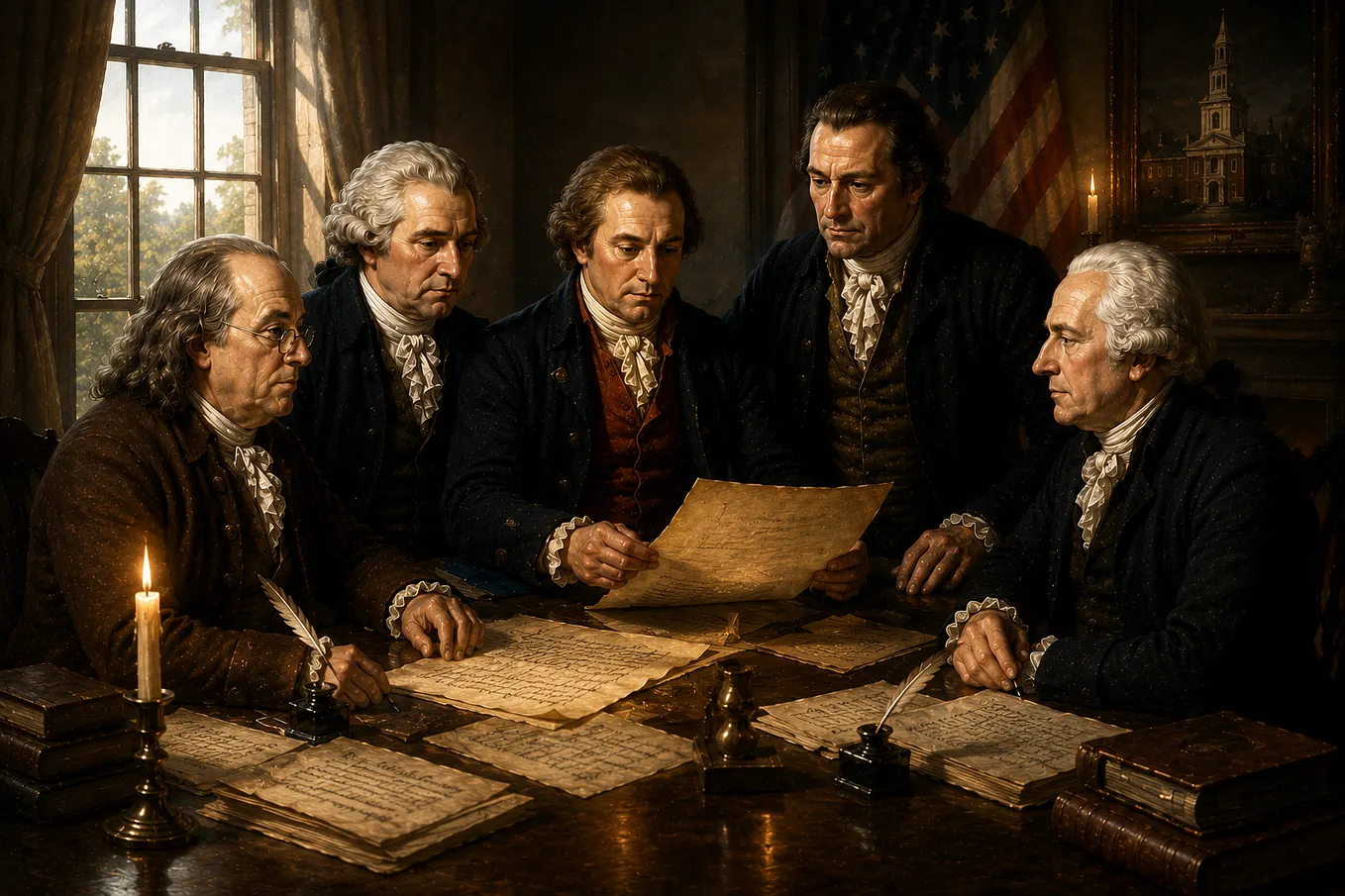
Ahead of the 1787 Constitutional Convention, Madison spent months in his Montpelier library studying historical confederacies, identifying their structural failures, and drafting the Virginia Plan — a proposal for a federal government built around three branches with checks and balances designed to prevent any single branch from accumulating excessive power. When the Convention assembled, the Virginia Plan became its actual working basis.
Madison, thirty-six, took an active role in the debates and kept detailed records he deliberately chose not to publish during his lifetime, reportedly concerned about being drawn into exactly the kind of authorship dispute that had already entangled Jefferson over the Declaration. As the Constitution’s fiftieth anniversary approached, people had begun calling Madison the Father of the Constitution — a title he treated with genuine ambivalence, understanding correctly that a document built through a summer of collective argument had many fathers.
Ratification was far from guaranteed. Madison, joining Alexander Hamilton and John Jay — Hamilton profiled directly two days ago in this series — wrote a sustained public defense under the shared pseudonym Publius. The Federalist Papers remain one of the most influential works of political theory in American history; Madison’s analysis of factions and the case for an extended republic are still studied directly as foundational political philosophy.
As a freshman House member, Madison personally sponsored the Bill of Rights — addressing exactly the concerns about concentrated federal power that this series’ Day 14 episode documented Mercy Otis Warren raising in her own published objections to the Constitution. Madison had helped build the structure Warren feared, then personally authored the amendments addressing much of her concern.
The Presidency and “Mr. Madison’s War”
Madison’s partnership with Jefferson deepened through the 1790s; together they founded the Democratic-Republican Party, examined from its opposing Federalist perspective in this series’ Hamilton episode. As Jefferson’s Secretary of State, Madison directly oversaw the 1803 Louisiana Purchase, covered in this series’ Jefferson episode as one of that presidency’s most consequential achievements.
Elected the fourth President in 1808, Madison’s two terms were dominated by the War of 1812. Years of British shipping harassment and sailor impressment led Madison to ask Congress for a war declaration in June 1812. The war was genuinely unpopular — derisively called “Mr. Madison’s War,” with several Northern states refusing to commit militias and New England factions threatening withdrawal over the economic damage to maritime trade. An underfunded, underprepared military lost repeatedly on land and sea through the war’s early stages.
The low point came in August 1814. In retaliation for an earlier American raid burning York, British forces marched on Washington, forcing Madison’s government to flee. British soldiers burned the Capitol, the Treasury, and the President’s House — the building later rebuilt and repainted into the White House.
Dolley Madison’s actions during the evacuation remain among the most celebrated individual moments of the war. She stayed as long as safely possible, directing the rescue of state papers and valuables — including the full-length Gilbert Stuart portrait of George Washington, which she ordered cut from its frame rather than left for British forces.
The war dragged on inconclusively. American forces stopped a subsequent British invasion that September. The Treaty of Ghent, signed December 24, 1814, restored prewar borders and resolved essentially none of the war’s original disputes. News hadn’t yet reached America when Andrew Jackson won a decisive, celebrated victory at the Battle of New Orleans in January 1815 — fought after the war had technically ended — transforming public perception of a costly stalemate into a remembered national triumph.
Madison was praised even by some contemporary critics for one aspect of his wartime conduct: he permitted sustained public criticism of his war policies without the prosecution or suppression that had characterized the Alien and Sedition Acts under John Adams, examined in this series’ Adams episode as among the most damaging policies of that earlier administration.
Later Years
Madison and Dolley retired to Montpelier in 1817. He remained active in limited capacity — helping Jefferson establish the University of Virginia, serving as a delegate to Virginia’s 1829 constitutional convention, and, in 1833, serving as president of the American Colonization Society, a subject this publication has examined in considerable depth in a separate, dedicated series on the history of slavery in early America.
June 28, Not July 4
Madison spent his final years editing his notes and papers for publication, partly to secure Dolley’s financial future — a concern proven well founded, given the financial difficulties that later consumed much of Montpelier, driven significantly by the gambling debts of Dolley’s son from her first marriage.
He died at Montpelier on June 28, 1836, at eighty-five, of heart failure. A specific, quietly remarkable detail closes his story appropriately: as his health failed in late June, doctors reportedly offered medical intervention that might have kept him alive long enough to die on July 4th — joining John Adams and Thomas Jefferson, both already documented in this series as dying on that exact date, the Declaration’s fiftieth anniversary, in 1826.
Madison refused. He died on his own schedule, June 28th, six days before the anniversary that had already claimed two of his closest political collaborators a decade earlier — a fitting final note for a man whose career was defined less by singular symbolic moments and more by the patient, structural, frequently unglamorous work of building the systems that gave those moments lasting meaning.
File 47: Investigative History — opening the cases that the official account left closed. This is Day 15 of The Unfinished Founding, a special daily series running through July for America’s 250th anniversary.