The Samsara Paradox: Hallucinating Reality in the Bouncing Box Multiverse

We are, fundamentally, 3D beings attempting to read a multi-dimensional map.
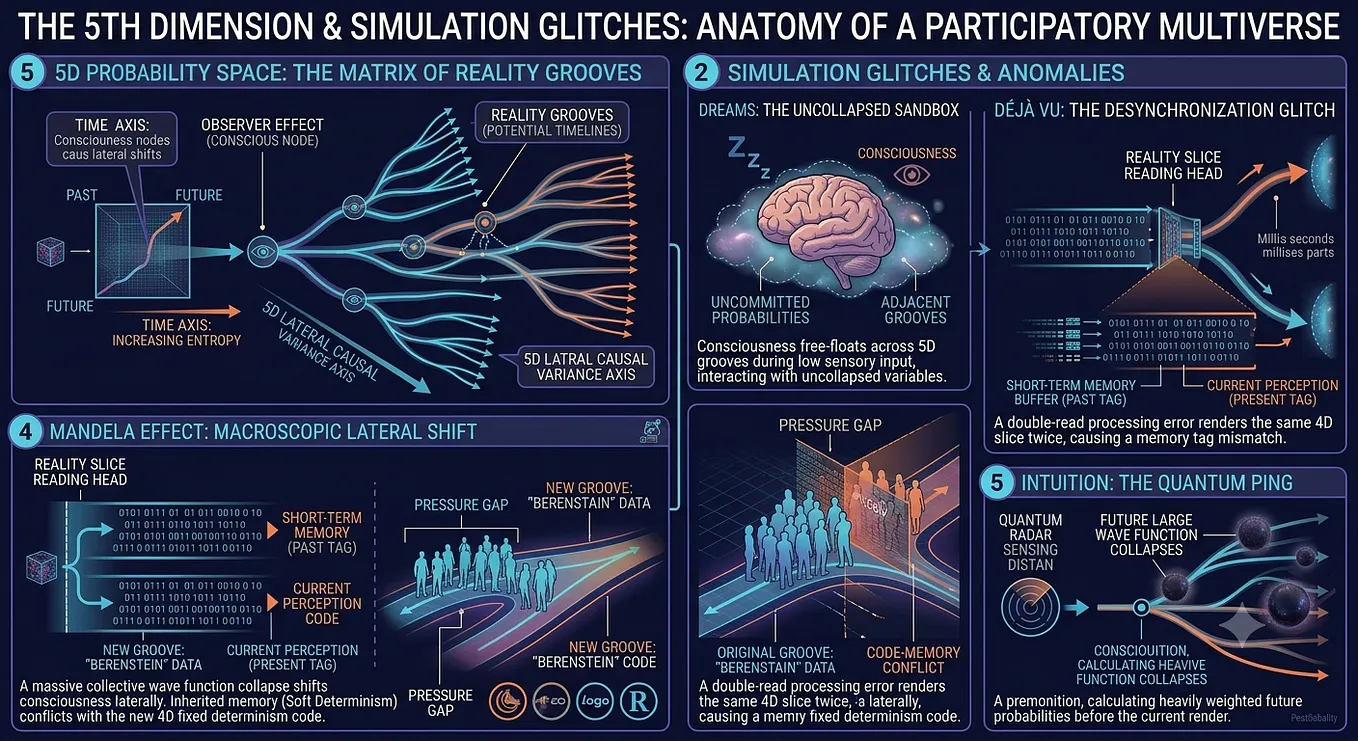
If you want to understand the nature of reality, you have to stop thinking of time as a river that flows, and start thinking of it as a hard drive being read by a scanner. We exist inside an eternal simulation — a bouncing box multiverse — where our consciousness is constantly hallucinating potential timelines. We navigate these reality grooves, which are carved out by both fixed and soft determinism, experiencing time slice by slice in the direction of increasing entropy.
This isn’t just philosophy; it is the point where relativity, quantum mechanics, and thermodynamics perfectly converge.

The Slice-by-Slice Hallucination
In Einstein’s Block Universe, the past, present, and future all exist simultaneously in a rigid four-dimensional structure. Time doesn’t move. We move through it.
Because our physical brains are constrained to 3D processing, we cannot perceive this entire 4D structure at once. Instead, our consciousness acts like the reading head on a Turing machine. It stitches together static, rapid-fire moments to create the illusion of continuous motion and a persistent self. Ancient frameworks perfectly anticipated this — such as the Abhidhamma, which describes reality as a rapid succession of discrete, impermanent mind-moments (citta-vīthi) arising and passing away to generate an unbroken continuum.
So why does the “movie” only play in one direction? The answer is the thermodynamic arrow of time. In a closed system, disorder always increases, governed by the Boltzmann entropy formula:

Our brains and physical systems can only record memories of a lower-entropy past, never the higher-entropy future. The hallucination of time flowing forward is a strict, unbreakable directional bias dictated entirely by the degradation of information.
Reality Grooves and the “Edit”
We are not merely passive observers watching a pre-recorded movie. The conscious act of observation actively modifies the underlying code of the next reality slice.
Get Dileepa Pothuhera ✨💚💡’s stories in your inbox
Join Medium for free to get updates from this writer.
Before an observation is made, a system exists in a quantum superposition of all possible states. It is the conscious act of observation that forces this wave function to collapse into a single, definite slice. We are constantly editing the code for the immediate next moment. However, this edit is strictly bound by two rules:
- Fixed Determinism (The Hard Constraints): The macro-structure of the box multiverse is locked. When consciousness collapses a wave function, it can only select from the menu of probabilities permitted by the laws of physics.
- Soft Determinism (The Weighted Dice): Even within permitted possibilities, the probability of which reality groove we slide into is heavily weighted by the macroscopic entropy of the past. Our biological hardware, historical causality, and accumulated momentum mathematically stack the deck.
We are continuously generating the next reality groove from inside a deeply conditioned state. Escaping that conditioned loop entirely — stepping outside the bounds of the simulation and freeing oneself from the cyclical bounce — is the ultimate objective, analogous to realizing Nibbana.
Entanglement: A Shared Line of Code
If consciousness is hallucinating a 3D reality from a 4D block universe, then the “space” between objects is merely a rendered variable on a screen.
This beautifully explains quantum entanglement. When two particles become entangled, they don’t communicate faster than the speed of light across the void. Instead, the architecture of the simulation merges their data into a single, indivisible state:

Even if the 3D render places these particles millions of lightyears apart, in the underlying 4D architecture, they are essentially two distinct “pointers” referencing the exact same line of code. When an observer forces the simulation to update that variable by measuring one particle, the 3D render instantly updates both. Entanglement is the physical proof that our localized, 3D separation is the hallucination, while the underlying, non-dual information state is the rigid reality.
Epochfall and the Samsara Paradox
If this “box” has finite computational capacity, it implies a cyclical cosmology — a universe that expands, collapses, and rebounds infinitely. But what happens to all our deeply entangled information when the multiverse reaches the end of its cycle?
According to the quantum principle of unitarity, information can never be permanently destroyed. When the bouncing box multiverse reaches its inevitable limit — a total Epochfall where the macroscopic thermodynamic arrow collapses and spacetime geometry breaks down — the simulation doesn’t crash to a blank screen. It compiles.
This aligns with Conformal Cyclic Cosmology, which suggests that the highly compressed, massless radiation at the very end of our universe becomes mathematically indistinguishable from the Big Bang of the next. The “hallucinated” 3D spacetime is wiped clean, but the underlying quantum information survives.
This brings us to the ultimate Samsara Paradox: how a system can undergo total physical annihilation, yet perfectly transfer its accumulated causal weight to the next eternity.
The fixed determinism of the physics engine resets the new universe, but the soft determinism is seeded by the informational entropy of the previous one. We are not just hallucinating a single reality; we are writing the mathematical code that will echo through the next iteration of the eternal bounce.