Spring Boot Interview Questions: Real-World Scenarios Every Java Developer Should Be Ready For (Part 3)

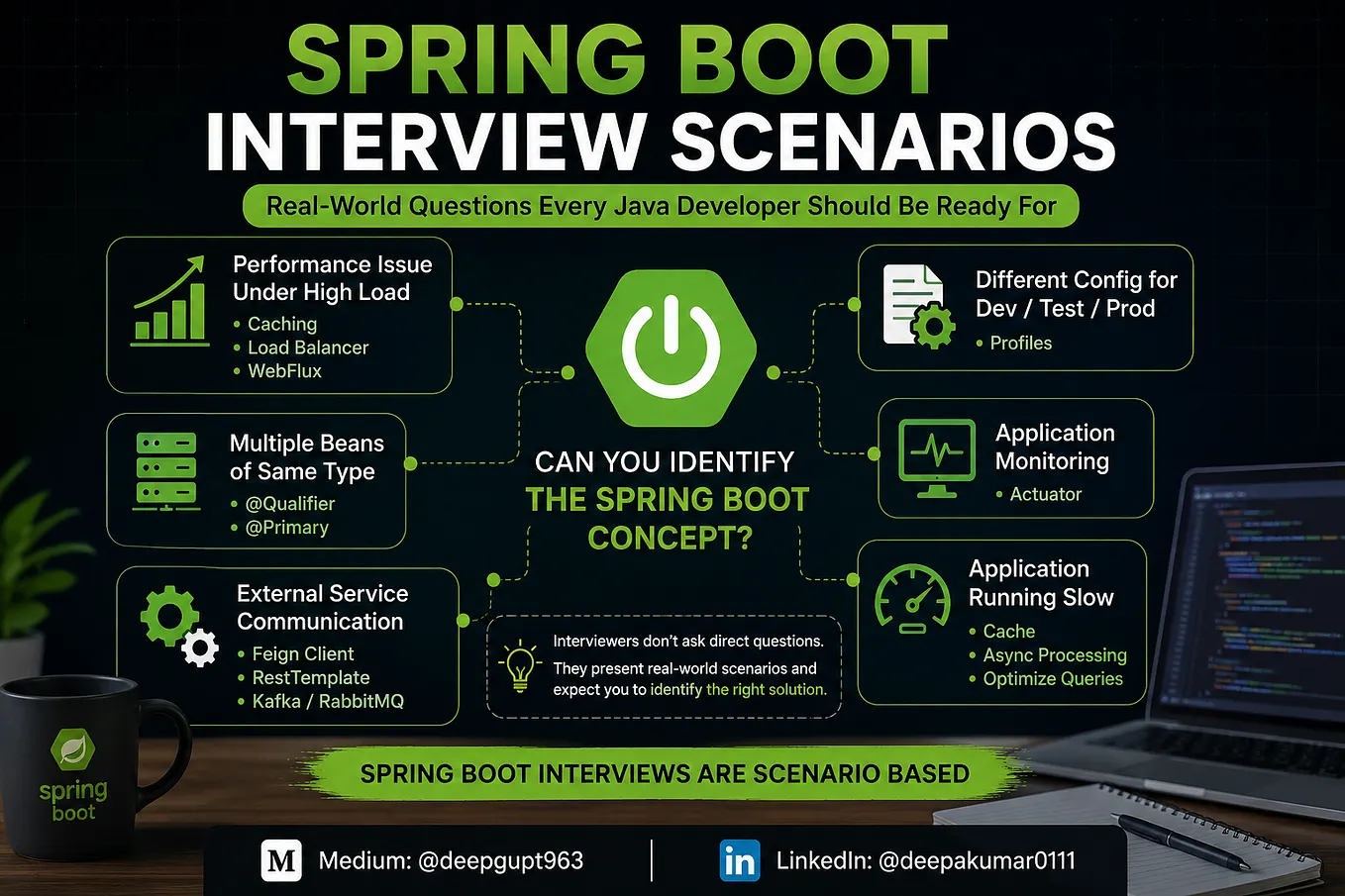
In this part, we cover: Security, JWT, Circuit Breakers, Resilience4j, API Gateway, Rate Limiting, Distributed Tracing, Docker, CI/CD, Event-Driven Architecture, Web Flux, Soft Delete, and Production File Storage.
In this final part, we’ll cover the remaining scenario-based Spring Boot interview questions that frequently appear in interviews.
35. How would you secure REST APIs in a Spring Boot microservices architecture?
Answer
I would implement Spring Security along with JWT authentication.
The API Gateway can validate tokens before forwarding requests to downstream services.
Role-based access control should be implemented to restrict access to sensitive endpoints.
Key Takeaway
JWT + Spring Security + API Gateway is a common microservices security approach.
36. How would you handle session management in a distributed microservices environment?
Answer
Instead of storing sessions in application memory, I would use:
- JWT Tokens
- Redis
- Spring Session
This ensures scalability across multiple service instances.
Key Takeaway
Stateless authentication is preferred in microservices.
37. What is a Circuit Breaker and why is it important?
Answer
A Circuit Breaker prevents repeated calls to a failing service.
When failures cross a threshold, the circuit opens and temporarily blocks requests.
Once the service recovers, requests are gradually allowed again.
Key Takeaway
Circuit Breaker prevents cascading failures.
38. How would you implement Circuit Breaker in Spring Boot?
Answer
The most common approach is using Resilience4j.
Steps:
- Add Resilience4j dependency.
- Configure thresholds.
- Apply @CircuitBreaker annotation.
- Define fallback methods.
Key Takeaway
Resilience4j is the preferred replacement for Hystrix.
39. Your downstream service is responding slowly. How would you improve resilience?
Answer
I would implement:
- Circuit Breaker
- Retry Mechanism
- Timeout Configuration
- Fallback Responses
These patterns prevent service degradation and improve availability.
Key Takeaway
Resilience is achieved through fault-tolerance patterns.
40. What is Spring Cloud Gateway?
Answer
Spring Cloud Gateway acts as a single entry point for all requests.
It provides:
- Routing
- Security
- Rate Limiting
- Logging
- Load Balancing
Key Takeaway
Gateway centralizes cross-cutting concerns.
41. How would you implement Rate Limiting in a Spring Boot application?
Answer
Rate Limiting restricts the number of requests a client can make within a time period.
Implementation options:
- Bucket4j
- Resilience4j
- Redis-based Rate Limiting
Most commonly implemented at the API Gateway layer.
Key Takeaway
Rate Limiting protects applications from abuse and excessive traffic.
42. What is Distributed Tracing?
Answer
Distributed Tracing helps track a request as it travels across multiple microservices.
Get Deepak Kumar’s stories in your inbox
Join Medium for free to get updates from this writer.
Tools include:
- Zipkin
- Sleuth
- OpenTelemetry
It helps identify latency and bottlenecks.
Key Takeaway
Tracing provides visibility into distributed systems.
43. How would you troubleshoot a request that fails across multiple microservices?
Answer
I would use:
- Correlation IDs
- Distributed Tracing
- Centralized Logging
- Monitoring Dashboards
These tools help locate the exact point of failure.
Key Takeaway
Observability is critical in microservices.
44. How would you containerize a Spring Boot application?
Answer
Using Docker:
- Create a Dockerfile.
- Package the application JAR.
- Build the Docker image.
- Run the container.
This makes deployment consistent across environments.
Key Takeaway
Docker enables portability and easier deployments.
45. How would CI/CD help Spring Boot deployments?
Answer
CI/CD automates:
- Build
- Test
- Deployment
Tools commonly used:
- Jenkins
- GitHub Actions
- GitLab CI
This reduces manual effort and deployment errors.
Key Takeaway
CI/CD improves delivery speed and reliability.
46. What is Event-Driven Architecture?
Answer
In Event-Driven Architecture, services communicate through events instead of direct API calls.
Common tools:
- Kafka
- RabbitMQ
This improves scalability and loose coupling.
Key Takeaway
Services communicate through events rather than direct dependencies.
47. When would you choose WebFlux over Spring MVC?
Answer
WebFlux is preferred when:
- High concurrency is required.
- Non-blocking operations are needed.
- Reactive programming is beneficial.
Spring MVC is generally sufficient for traditional applications.
Key Takeaway
WebFlux = Reactive + Non-blocking.
48. How would you implement Soft Delete in Spring Boot?
Answer
Instead of physically deleting records from the database, a flag such as:
isDeleted = true
is updated.
Queries are then filtered to exclude deleted records.
Key Takeaway
Soft Delete preserves historical data.
49. Where would you store user-uploaded files in production systems?
Answer
Production systems typically store files in cloud storage services such as:
- AWS S3
- Azure Blob Storage
- Google Cloud Storage
Storing files directly in application servers is generally avoided.
Key Takeaway
Cloud storage is scalable, durable, and production-friendly.
Final Note
As we know, Spring Boot is a very vast topic and is not limited to only these concepts. Even the topics covered here can be explored much deeper. The purpose of this series was to provide a practical interview-focused starting point covering some of the most commonly asked Spring Boot topics.
If these notes help you answer even one interview question more confidently, then they have served their purpose.
Happy Learning !!
Medium: @deepgupt963
LinkedIn: @deepakumar0111