Field Note #086 |The Proximity Bias
The talent was distributed. The trust was local.

On the subtle confusion between familiarity and competence
Watch what happens in a well-run office when a minor technical failure appears twenty minutes before a deadline.
Nobody pulls up the annual skills matrix.
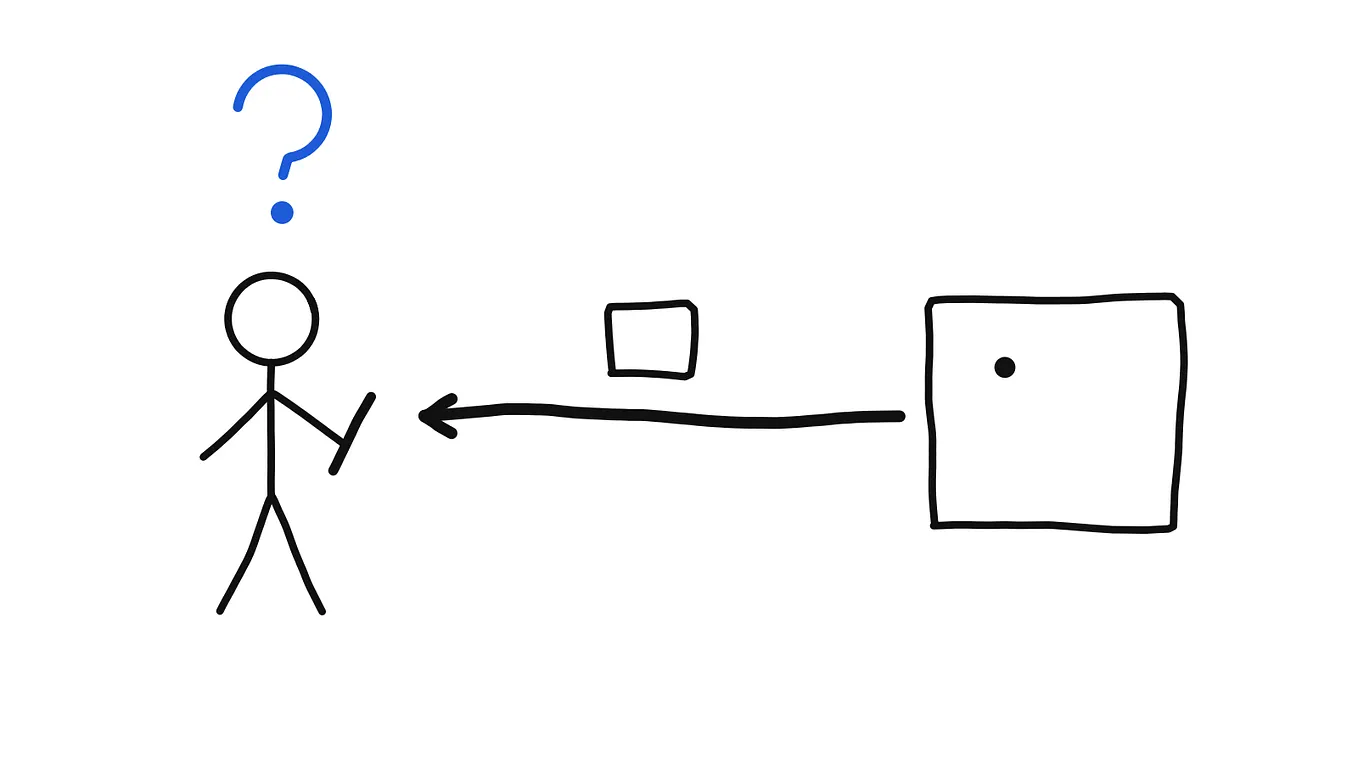
Instead, the person leading the room turns their head roughly thirty degrees, makes eye contact with whoever happens to be within speaking distance, and asks them to take a look.
By the end of the quarter, that small turn of the head has happened forty times.
And when promotion discussions begin, the person who sat within that thirty-degree arc doesn’t just feel more familiar to the manager.
They feel noticeably more capable.
We have taken to calling this proximity bias, usually framing it as a modern argument between remote workers and executives who enjoy looking at full car parks.
That framing misses the deeper human mechanism.
Long before anyone owned a webcam, physical distance was quietly editing how we judge other people’s minds.

The Geometry of Who Enters the Frame
In 1977, MIT professor Thomas Allen published a foundational study of how engineers communicate inside research and development laboratories ([S1], Allen, 1977).
He didn’t study remote work; he studied people employed by the same company, working in the same building.
Allen found that the probability of two engineers communicating at least once a week dropped steeply as the physical distance between their desks increased, flattening out once they sat more than 30 to 50 meters apart.
Think about how small fifty meters is.
It is the distance from one end of an office floor to the acoustic bay past the lifts.
Allen’s curve proved something simple about human friction: we talk to the people we bump into.
What it did not prove — and what we must be careful not to assume — is that talking more frequently automatically makes someone look more talented.
To understand how frequency of sight turns into a judgement of competence, we have to look at what happens inside the evaluator’s memory.

Why Witnessed Effort Weighs More Than Quiet Outcomes
Human memory was never designed to run an objective quarterly audit.
When a manager sits down to assess who carried a project, they rely on what Amos Tversky and Daniel Kahneman termed the availability heuristic ([S3], Cognitive Psychology, 1973, [https://doi.org/10.1016/0010-0285(73)90033-9](https://doi.org/10.1016/0010-0285(73)90033-9)): we estimate the size and frequency of a contribution by how easily examples of it come to mind.
Consider two engineers who each solve half of a difficult calibration failure.
The first sits four meters from the director.
Over three days, the director sees him frown at a schematic, hears him explain a bottleneck to a junior colleague, and notices his desk lamp still glowing at 6:30 PM.
The second engineer works thirty-eight meters down the hall — or from a quiet spare room across town.
He isolates the root mathematical drift, writes the patch, tests it twice, and pushes the code.
In the director’s mind, the first engineer’s contribution is stored as high-resolution sensory memory: voice, posture, visible problem-solving. The second engineer’s contribution arrives as a four-kilobyte notification toast that disappears while the kettle boils.
Witnessed work includes its friction.
Distant work arrives stripped of its struggle.
Ironically, the cleaner and more self-sufficient a distant colleague’s work is, the easier it is to forget how hard it was to produce.

Converting Attendance Into Character
Beneath retrieval ease sits an even quieter mechanism.
In 1968, psychologist Robert Zajonc demonstrated the mere-exposure effect ([S2], Journal of Personality and Social Psychology, [https://doi.org/10.1037/h0025848](https://doi.org/10.1037/h0025848)): repeated, unreinforced exposure to a stimulus increases perceptual fluency, which the brain interprets as warmth and safety.
When we see a colleague every morning by the espresso machine, our cognitive friction around them drops.
Five decades earlier, Edward Thorndike documented how easily a warm general impression bleeds into independent ratings of technical skill — the classic halo error ([S7], Journal of Applied Psychology, 1920,[https://doi.org/10.1037/h0071663](https://doi.org/10.1037/h0071663)).
Get PRASAD BHONDE’s stories in your inbox
Join Medium for free to get updates from this writer.
In 2010, Kimberly Elsbach, Dan Cable, and Jeffrey Sherman tested how this plays out in modern workplaces ([S4], Human Relations, [https://doi.org/10.1177/0018726709353139](https://doi.org/10.1177/0018726709353139)).
Across qualitative interviews and controlled experiments, they examined passive face time — merely being seen at work without an observer knowing anything about actual productivity.
Their findings were remarkably specific:
- Seeing an employee at their desk during normal hours (expected face time) caused observers to spontaneously infer traits of dependability and reliability.
- Seeing an employee around outside normal hours (extracurricular face time) triggered spontaneous inferences of commitment and dedication.
Notice the leap.
The observer sees a physical body in a chair and unconsciously writes a character reference.
We see the real-world shadow of this in Nicholas Bloom and his colleagues’ landmark 2015 randomised controlled trial at Ctrip, a 16,000-employee travel agency ([S5], Quarterly Journal of Economics,[https://doi.org/10.1093/qje/qju032](https://doi.org/10.1093/qje/qju032)).
Employees randomly assigned to work from home increased their measured output by 13 percent compared to the office control group.
Yet over 21 months, holding exact performance constant, home-based workers were promoted at roughly half the rate of their in-office peers.
Now, good science requires restraint here.
The Ctrip promotion gap wasn’t caused solely by managerial bias; some remote workers preferred not to return to the office for supervisory roles, and managers had fewer informal opportunities to observe leadership readiness.
Still, the core tension stands: measurable output rose while advancement fell.

The Honest Counterargument: When Proximity Actually Works
If we stop the story here, we risk turning every manager into a cartoon villain and treating physical offices as theatrical stages.
That would be dishonest.
Proximity has genuine operational utility.
In a 2023 study of software engineers at a Fortune 500 technology firm, Natalia Emanuel, Emma Harrington, and Amanda Pallais examined what happened when engineers sat near their teammates versus working across separate buildings or remotely ([S6], NBER Working Paper 31880, [https://doi.org/10.3386/w31880](https://doi.org/10.3386/w31880)).
They found that physical proximity significantly increased the volume of inline code-review feedback and informal mentorship.
Sitting near senior colleagues helped junior engineers learn faster — even though answering desk-side questions slightly reduced senior engineers’ immediate daily output.
In other words, when a manager relies on someone sitting nearby, they are not always hallucinating value.
Nearby colleagues genuinely absorb unspoken context faster and lower the coordination cost of urgent fixes.
The distortion begins at a very specific boundary: when a manager confuses low coordination friction with superior individual ability.
Finding it easier to brief the person sitting beside you is an operational reality.
Concluding that the person sitting beside you is therefore smarter, more committed, or more deserving of promotion than the person who quietly solved the back-end architecture out of sight is an evaluation error.

How to Correct the Sightline
You cannot fix proximity bias by asking managers to attend a forty-minute workshop on unconscious fairness.
As long as human beings have eyes, we will remember what we see more vividly than what we read.
What we can change is the resolution of the evidence on the table when decisions are made:
- Ban attendance adjectives unless paired with an artefact: When someone is described in a calibration meeting as “dependable,” “proactive,” or “always on it,” ask for the dated deliverable behind the adjective.
- Read the output log before opening the room to impressions: Reviewing completed technical logs, solved tickets, or shipped work before inviting open commentary prevents retrieval fluency from setting the anchor.
- Audit who gets the urgent Tuesday afternoon problem: Promotions rarely start at annual review time. They start six months earlier, in who gets handed the high-visibility problem when a manager turns their head thirty degrees.
Most leaders genuinely want to be fair.
They just forget that their eyesight has a thirty-meter radius — while their team’s actual capability does not.

The talent was distributed. The trust was local.

Stay Tuned…
Regards,
Top Voice
Maido; Konnichiwa minna! 👶🏻🧑🏻🦱👩🏻🦳
Wie Gehts guys? Mir gehts gut!!! ✌️🤘🙌
#business
#leadership
#fieldnotes
#systemsthinking
#organisationalpsychology
#workplaceculture