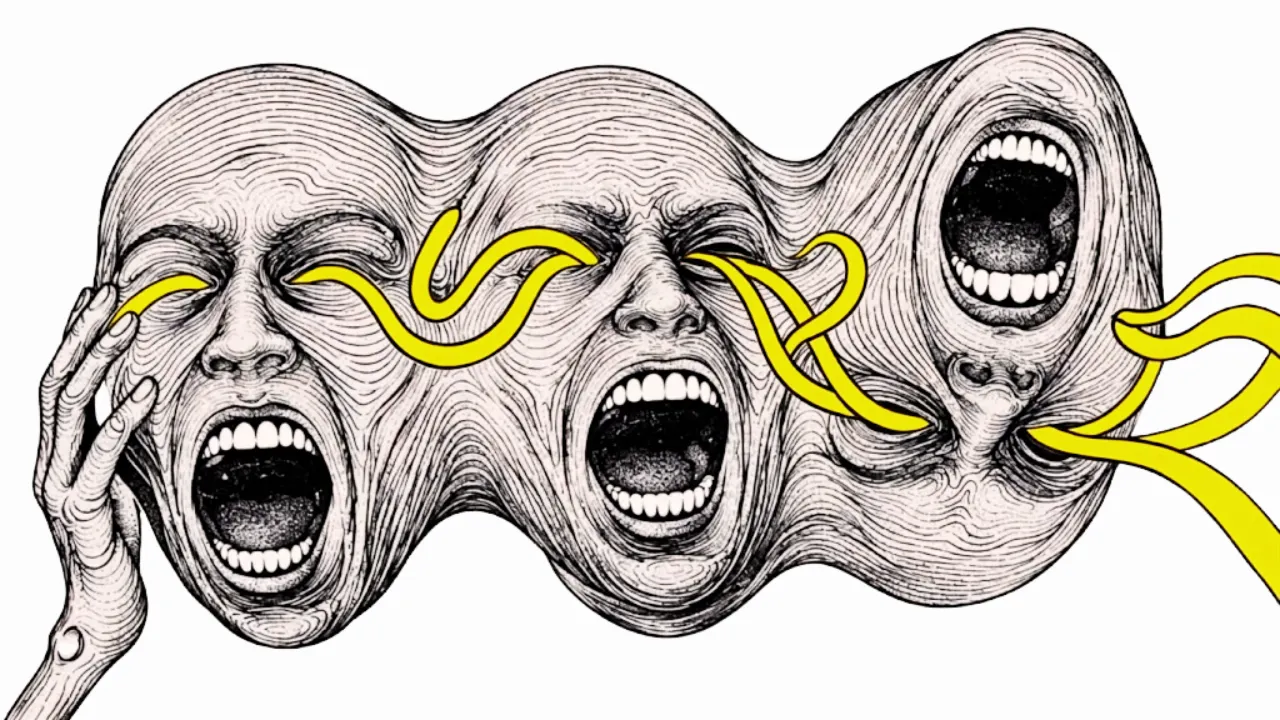
A Meditation Broke My Brain (And Quantum Physics Helped Fix It)
Quantum Physics, Simplified — Part 1

I was doing a guided meditation on Sadhguru’s app.
It was peaceful.
Soft chanting.
Slow breathing.
A voice calmly repeating:
“I am not this body.
I am not even this mind.”

At first, it sounded like typical spiritual poetry.
Then suddenly my brain slammed the brakes.
Wait. What?
If I Am Not the Body…
If I am not the body, then who exactly is walking around in this 77-kilo, 5’4”, premenopausal biological apparatus?
Whose knees complain when climbing stairs?
Whose stomach demands tea at irregular intervals?
Whose hair is slowly negotiating with gravity?
If I am not the body… does this body belong to no one?
And If I Am Not the Mind…
The chant then goes one step further.
“I am not even the mind.”
Now things got truly unsettling.
Because the mind feels even more “me” than the body.
The mind that studies.
The mind that jokes.
The mind that writes essays like this one.
The mind that is:
- a doctor
- a daughter
- a wife
- an observer of life
- occasionally a court jester
If I am not the mind…
Who exactly is thinking these thoughts?
Then who exactly is running this operation?
The Identity Earthquake
For a moment, the whole idea felt absurd.
If I am not the body
and not the mind
then what remains?
Nothing?
That seemed unlikely.
Because physics itself tells us something interesting about nothing.
Quantum Physics Has a Problem With “Nothing”
In everyday language we say something is empty.
But physics disagrees.
Even space is not empty.
Quantum physics shows that what we call the vacuum is actually buzzing with tiny fluctuations of energy and particles appearing and disappearing.
In other words:
Nothing is truly nothing.

Take an empty glass.
You pour the milk out.
Is the glass empty?
Get Dr Radha Narayanan’s stories in your inbox
Join Medium for free to get updates from this writer.
Not really.
It still contains:
- air
- molecules
- invisible particles interacting with each other
Even the glass itself is packed with atoms arranged in tight structures.
Break the glass and those atoms simply rearrange.
Nothing disappears.
It just changes form.
So What Does the Meditation Mean?
Maybe the chant was not saying the body and mind don’t exist.
Maybe it was pointing to something subtler.
The body is something we have.
The mind is something we use.
But neither may be the core identity.
Think of it this way:
The body is the hardware.
The mind is the software.
But there is still something watching both.
Something aware of the body.
Something aware of thoughts.
The Quiet Observer
When a thought appears, you notice it.
When your body hurts, you notice it.
Which means something is observing both the body and the mind.
That observer cannot be the thought itself.
And it cannot be the body either.
It’s something more subtle.
Something that simply knows.
Maybe Meditation Is Just Identity Debugging
Perhaps meditation is not trying to erase the body or destroy the mind.
Maybe it’s simply revealing that we are not confined to them.
The body is the instrument.
The mind is the interface.
But the player of the instrument remains strangely mysterious.
A Strange but Comforting Possibility
Physics tells us matter never truly disappears.
Energy never becomes zero.
It only transforms.
So perhaps our existence is not as small as we think.
Maybe we are not just this body.
Not just this mind.
Maybe we are temporarily experiencing both.
And meditation, annoyingly but effectively, keeps whispering:
“You are more than this.”
Key Takeaway
✅Sometimes a simple meditation sentence can cause a full-blown identity crisis.
✅But occasionally, that crisis opens the door to a deeper question:
✅If you can observe your body and your thoughts…
Who exactly is doing the observing?
✅That mystery might be where the real exploration begins.