3 Ways to Practice Yoga If You Are Stuck in a Commute or a Long Meeting
Stuck in a commute or a long meeting? Use these 3 invisible yoga techniques to reset your nervous system and fix your posture immediately


When I tell people I teach yoga, they often picture serene studios, expensive leggings, and difficult balancing poses. But as a yoga therapist, I believe the most productive and necessary practice doesn’t happen on a mat. It happens when you are actually stressed. The true test of your practice is not how long you can hold a headstand, but how you manage your physiology when you are stuck in gridlock traffic on the CTE or trapped in a ninety minute budget meeting.
In those moments, you are usually not in control of your situation, but you are absolutely in control of your response. When we are physically stuck, our nervous system tends to mirror that state. We clench our jaws, our breath shallows, and we collapse our structure. While you cannot exactly drop into a deep lunge in the middle of a conference room, you can use these three invisible, highly effective techniques to calm your nervous system and reclaim your physical space.
This is less about getting a workout and more about not letting your environment dictate your physiological state.
The 4–4–8 Breath: Flipping the Parasympathetic Switch
Most people stuck in stress are shallow breathing directly into their chests. If you observe your own breath when you are frustrated by a delay or an email, it is likely rapid and restricted. Physiologically, chest breathing signals “danger” to the brain. This activation of the sympathetic nervous system is the primary physiological driver of anxiety and panic attacks.
The fastest way to break this loop is to take control of your exhale. The 4–4–8 breath is a powerful tool for this.
How to do it invisibly
You do not need to make noise or close your eyes. Inhale slowly and silently through your nose for a count of four. Hold that breath for a count of four. Then, exhale very slowly and completely through your nose for a count of eight.
The long, controlled exhale physically forces your heart rate to slow down. It stimulates the vagus nerve, which immediately activates the parasympathetic nervous system (the “rest and digest” state). You can do this three or four times, and no one in the car next to you or across the boardroom table will know you are practicing. It is immediate physiological regulation. This is a foundational skill we teach in our traditional Hatha yoga classes at Rudrakshaa Yogashala, where breath is always the priority over movement.
Isometric “Seat” Grounding: Stabilizing Your Foundation
When you are forced to sit for long periods, your body does not stay neutral. Weight usually collapses into the lower back and pelvis, leading to that crushed, heavy feeling in your spine after a long day. You can feel physically exhausted just from sitting still because your core muscles have completely switched off.
Get Ritu Nanda’s stories in your inbox
Join Medium for free to get updates from this writer.
Instead of passively sinking into the seat, you can use invisible, isometric engagement to stabilize your structure.
How to do it invisibly
First, find your “sit bones.” These are the two bony protrusions at the base of your pelvis. Don’t slouch or tuck your tailbone; shift your weight until you feel evenly balanced on them. Then, actively press your sit bones down into the car seat or chair. Simultaneously, press your feet firmly and flatly into the floor.
This tiny, internal action stabilizes your pelvis and engages your lower deep abdominal muscles. It keeps your core active without requiring dynamic movement. This prevents that spinal collapse and the subsequent lower back pain. This concept of stabilizing from the ground up is essential in yoga therapy, where we identify how foundational alignment affects chronic pain patterns.
Chin Tucks: The Realignment for Your Cervical Spine
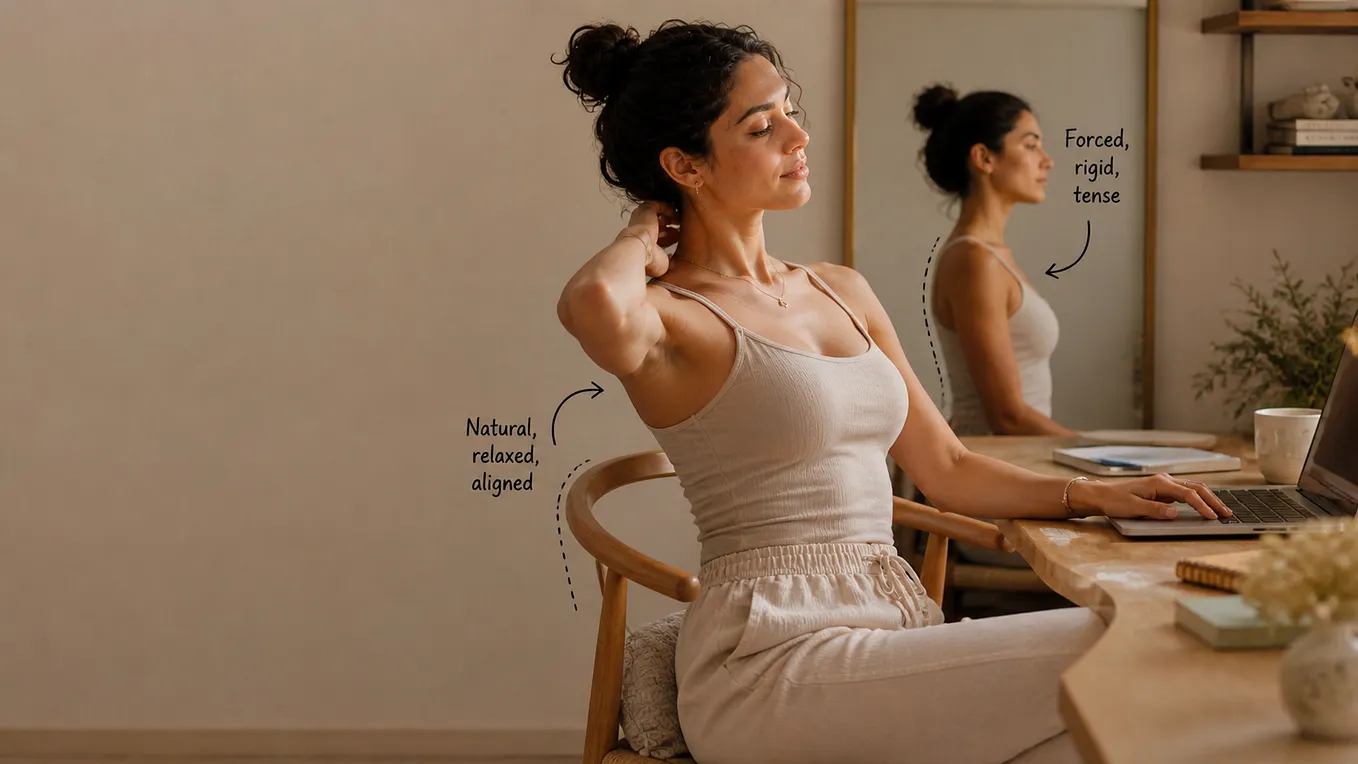
Observe your posture when you are driving or looking at your laptop. Most of us crane our necks forward, a posture now known as “tech neck” or “text neck.” For every inch your head moves forward from its neutral position over the shoulders, its effective weight on your spine doubles.
This creates immense pressure on the delicate muscles at the base of your skull and can lead to tension headaches and jaw pain. Many people try to stretch their neck out to relieve the tension, but what they actually need is realignment.
How to do it invisibly
Instead of a big stretch, just draw your chin straight back, as if you are trying to give yourself a double chin. It is a tiny, precise movement. Your head should glide backward over your shoulders without you looking up or down.
This realigns your cervical spine, activates the deep neck flexor muscles, and immediately takes the pressure off the overstretched muscles at the back of the neck. You don’t need a yoga mat for this; you just need to be sitting up. This action is a cornerstone of effective posture correction, and you can do it dozens of times a day.
Practical Resilience
Yoga is often marketed as an escape from the daily grind. I prefer to view it as the toolkit required to navigate the daily grind with resilience.
If you can use these techniques while you are stuck on a commute or in a meeting, you are practicing the true intention of yoga: self-regulation. You are taking control of your physiology when your situation is stressful. It is about building resilience, not just flexibility. Don’t wait until Friday afternoon to address your body’s needs. Your practice is with you, right where you are.