
Introduction
Hiring the right talent is crucial for any organization, but the consequences of a bad hire can be far-reaching and costly. From financial losses to reduced productivity and morale, the implications of hiring the wrong person are dramatic. This article explores the costs associated with a bad hire and how HireScore’s innovative approach helps prevent these issues, ensuring you make the best hiring decisions.
Understanding the Costs of a Bad Hire
Financial Impact
The financial repercussions of a bad hire are substantial. Direct costs include recruitment expenses, onboarding, and training. However, the indirect costs are far more significant. These include lost productivity, decreased employee morale, and potential damage to your company’s reputation. For safety sensitive jobs a bad hire can even lead to human injury or death. The Society for Human Resource Management (SHRM) suggests that the cost of a bad hire can range from 50% to 200% of the employee’s annual salary. For a $50,000 position, this could translate to a cost of $25,000 to $100,000. Moreover, this excludes executive roles which could easily cost an organization hundreds of thousands or even millions of dollars.
Impact on Team Dynamics
A bad hire can disrupt team dynamics, leading to decreased collaboration and morale. When a new hire does not fit well with the team or lacks the necessary skills, it places additional burdens on other team members, leading to increased stress, potential conflicts, and unwanted turnover.
Reduced Productivity
An underperforming employee can significantly reduce overall productivity. They may require additional supervision and support, diverting resources away from other important tasks. This not only affects the immediate team but can also impact the broader organization.
The Role of Traditional Recruitment Methods
Keyword Resume Scanning Pitfalls
Many traditional recruitment systems rely on keyword resume scanning to filter candidates. This method is inherently flawed, as it often overlooks highly qualified candidates who may not use the right keywords in their resumes. This process can lead to missed opportunities and lower overall accuracy. Additionally, keyword scanning may incorrectly match candidates to roles they are not suited for, resulting in poor job performance and higher turnover rates. Even when using more advanced AI techniques or manual review, the problem still exists. Essentially the issue lies in the source of data itself. In other words, general applications and resumes simply do not solicit a sufficient amount of job specific information to make accurate decisions.
Candidate Frustrations
Candidates are increasingly frustrated with keyword resume scanners. They often resort to watching YouTube tutorials, paying for professional resume services, or scouring the internet for tips on how to beat these systems. This not only consumes time and resources but also detracts from the candidate’s overall experience. Furthermore, candidates may feel pressured to tailor their resumes in ways that do not truly reflect their skills or experience, leading to mismatches between their actual capabilities and the job requirements. This can result in hiring individuals who are not genuinely qualified for the role, exacerbating the problem of bad hires.
How HireScore Prevents Bad Hires
Customizable Recruitment Solutions
HireScore’s strength lies in its high level of guided customization, allowing the recruitment process to be tailored to the specific needs of each organization. This customization ensures that the evaluation criteria align with the unique success factors of each job and company, leading to more accurate and effective hiring decisions. By focusing on the precise requirements of the role, HireScore helps identify candidates who are genuinely the best fit, reducing the risk of a bad hire. Furthermore, by tracking these qualifications deliberately and applying machine learning/AI analytics to outcomes, qualifications are refined over time to enhance accuracy.
Comprehensive Assessment Process
HireScore offers a range of assessment tools designed to evaluate candidates comprehensively. These assessments include:
- Situational Judgment Tests (SJT): Evaluates candidates’ problem-solving abilities in job-related scenarios.
- HireScore Personality Assessment (HPA): Assesses personality traits to determine cultural and role fit. Results are mapped to specific role profiles to ensure best fit without assuming there is a right or wrong type of personality (there isn’t!).
- Problem Solving Tests: Measures generalized problem solving related to quantitative reasoning, verbal, reasoning, logic reasoning or mechanical aptitude.
- Technical Skills Tests: Evaluates job-specific technical skills, such as electrical troubleshooting, welding, accounting, or software proficiency.
- Structured Interviews: Uses standardized questions with scoring guides to assess candidate responses consistently and minimize the negative effects of cognitive biases.
- Work Demos: Allows candidates to demonstrate their practical skills in a simulated work environment.
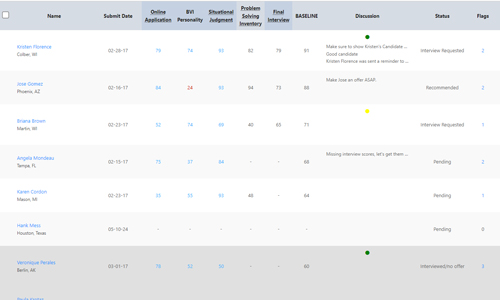
Our PhD level Industrial and Organizational Psychologists will create an ideal process using these validated assessments, as appropriate. HireScore ensures a holistic evaluation of each candidate’s capabilities, reducing the likelihood of hiring mistakes.
Accurate Candidate Rankings
HireScore’s algorithmic candidate rankings provide necessary insights for confident and informed hiring decisions. By considering screening results, assessments, and interview performance, HireScore generates a composite score tailored to specific job requirements. This enables you to identify the most promising candidates and make choices that align with organizational goals.
Enhancing Candidate Experience
Simplified, High Engagement Application Process
HireScore streamlines the application process and makes it far more specific to the job which applicants appreciate. It allows for passive candidates to apply without having to create a resume or create an account. This high engagement process significantly improves the candidate experience, making it more likely that top talent will complete the process.
Continuous Improvement and Data-Driven Decisions
HireScore’s data-driven approach helps in continuously improving the recruitment process. By analyzing data from past hires and applicant interactions, the platform identifies friction points and areas for enhancement. This ongoing optimization ensures that your recruitment strategy evolves to attract more and better-qualified candidates over time.
Promoting Diversity and Inclusivity
Eliminating Bias
HireScore’s AI-driven assessments and unbiased rankings help foster diversity and inclusivity within your organization. By focusing on accurately and objectively matching the right candidate with the right position, HireScore enhances productivity, safety, and employee retention.
Building a Diverse Workforce
A diverse workforce brings in different perspectives and ideas, fostering innovation and better decision-making. By using HireScore, you can ensure a fair and unbiased hiring process that attracts a diverse range of candidates.
You can check out more on how HireScore implements these practices [HERE].
Conclusion
The costs of a bad hire are significant, affecting not only the financial bottom line but also team dynamics, productivity, and overall company morale. Traditional recruitment methods, particularly those relying on keyword resume scanning, often fall short in identifying the best candidates. HireScore offers a solution that addresses these issues head-on, providing a comprehensive, data-driven approach to hiring that improves candidate experience, enhances diversity, and ultimately leads to better hiring decisions. By leveraging HireScore’s innovative platform, you can avoid the pitfalls of bad hires and build a stronger, more effective team.
Ready to start preventing the costs of a bad hire? HireScore is ready to help. Schedule a free demo to see if HireScore will work for you and your organization [HERE].
Related Categories