

A linear equation in one variable is an equation that has only one variable and the highest power (degree) of the variable is 1. It is used to represent situations where the value of one quantity depends on another.
Examples: 2a + 3a = 20, 5x + x = 12, etc.
The above equations are linear in one variable as they only have one variable and the highest degree of the variable is 1.
Graph of Linear Equation in One Variable
These linear equation can be easily represented on the graphs and they represent the straight line which can be horizontal to the coordinate axis or vertical to the coordinate axis.
We represent the mathematical condition using these equations as the condition "a number which is 5 less than twice of itself" is represented by the linear equation,
x = 2x - 5 , Where x is the unknown number.
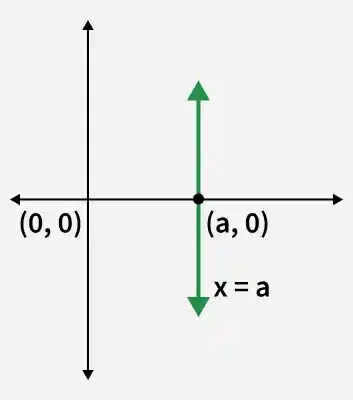
In the above equation there is only one variable (x) and the degree of the variable is one thus, it is a linear equation in one variable.
Standard Form of Linear Equation in One Variable
A linear equation in one variable can be expressed in the standard form
ax + b = 0
where x is the variable and a and b are the constants involved. These constants (a and b) are non-zero real numbers. These equations have only one possible solution for the value of the variable.
Solving Linear Equations in One Variable
Linear Equations in One Variable can easily be solved by following the steps discussed below,
- Step 1: Write the given equation in standard form and if a or b is a fraction then take the LCM of the fraction to make them integers.
- Step 2: The constants are then taken to the right side of the equation.
- Step 3: All the variables and the constant terms are then simplified to form one single variable term and one single constant.
- Step 4: The coefficient of the variable is made 1 by dividing both sides with a suitable constant to get the final result.
Example: Solve 3x + 1/2 = (1/2)x - 13/2
Step 1: Arranging in standard form and taking LCM
3x - (1/2)x + 1/2 + 13/2 = 0
⇒ (6x - x + 1 + 13)/2 = 0
⇒ 6x - x + 1 + 13 = 0
Step 2: Transposing the constant to the right-hand side
6x - x = -1 - 13
Step 3: Simplification
5x = -14
Step 4: Make coefficient of x to 1
Dividing both sides by 5 we get,
5x/5 = -14/5
x = -14/5
This is the required solution.