ENTRY 3 : THE ART & LIFE (THE SAO CIVILIZATION)
How they made, believed and lived daily.

Last week we met the people. Today we walk with them.
1. We Enter One Town, And We Have Seen Them All
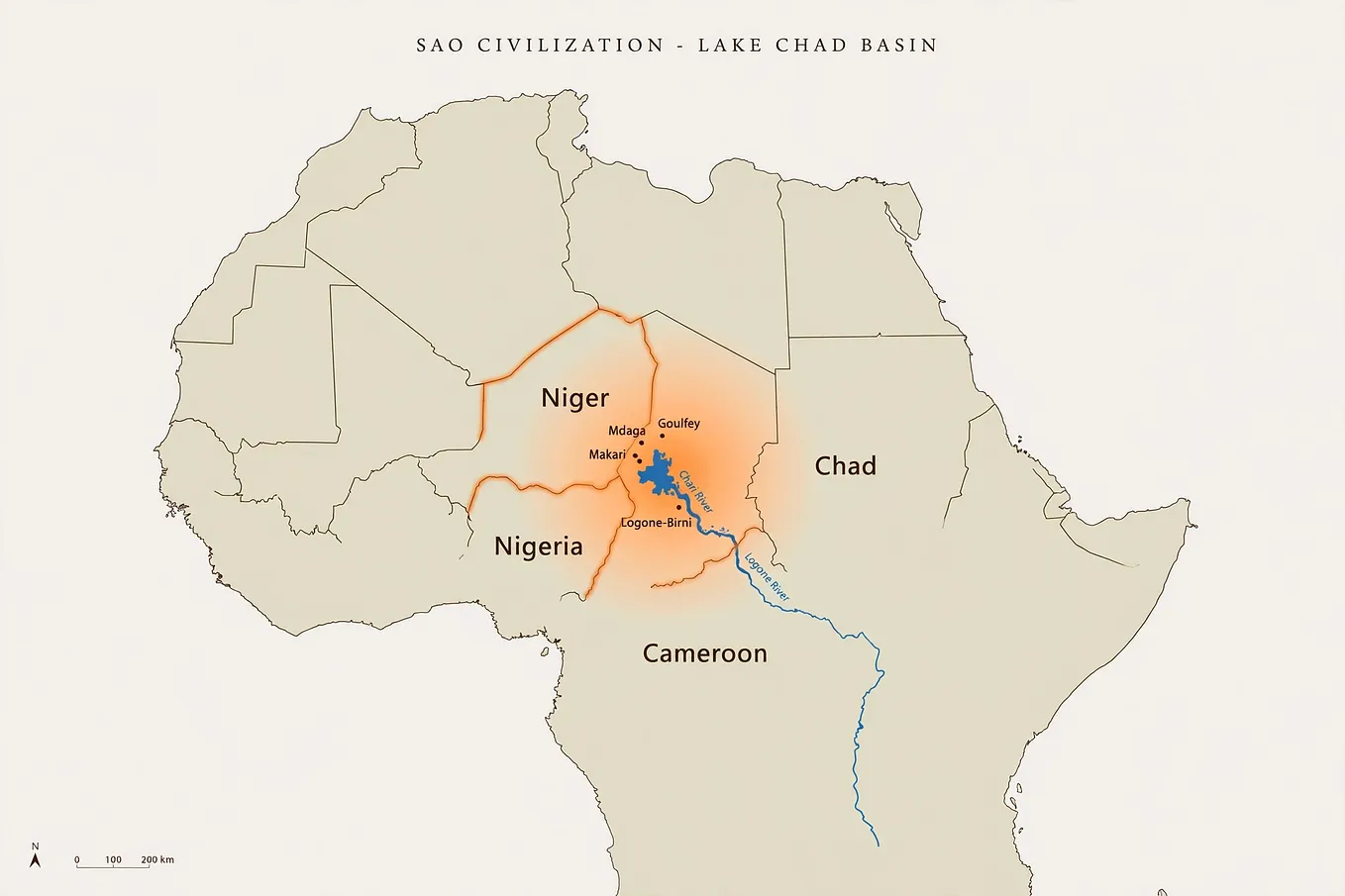
We enter through the gate of one town, one of hundreds spread around Lake Chad, from the Chari and Logone rivers in Chad and Cameroon, to the edges of what is now northeastern Nigeria. Different chiefs, different lands, but when you walk in, you already know the place.
The mound under your feet, built up year after year so the flood would not reach the house. The round houses of earth with pointed roofs. The wall that closes at night. The same pattern, town after town.

2. The Potter: Clay Was Life
You pass the potter first. She is working clay, and in a way she is working the whole life of the people.
The same clay becomes the pot a woman cooks millet in, the big jar where grain is stored, and the jar where a dead person is buried. The pots are not plain. They carry chevron marks, lines that mean something. The small figures she makes (small people, small animals, baked in fire) are not toys. They are found in graves, in town after town, kept close.
In every home, clay was food, storage, and burial. Life from start to finish.

3. The Bronze Worker: Bronze Was Honour
A little further on, you meet the bronze worker. Clay was for everyone. Bronze was for honour.
At Houlouf in northern Cameroon, where people dug for ten years, they found them in graves: rings, arm-rings, neck rings, small buttons for clothes. For warriors, leg-guards, arm-bands, spurs for horses. The same kind of bronze turns up in other sites across the basin too, which is how you know this was not one town's habit. It was shared.
To make it, he carves the shape in wax, covers it in clay, melts the wax out, then pours hot bronze inside. One mistake and the whole piece is lost.
When it is done, the person wears it. A man who fought well wears his arm-band. A chief wears his rings. A woman of honour wears her neck ring. And when they die, they are buried with it. Not taken off. Buried with it.
Because it shows who they were and what they had lived through, like a wedding ring, like a graduation gown, like the one thing you wear that says, this is my story.
4. The Blacksmith: Iron Was Work
Then you meet the blacksmith. If bronze was beautiful, iron was useful.
Iron made the hoe, the spear, the knife for fish, the axe for wood. Without iron there is no farm. Without iron there is no defence. Without iron there is no town.
So in town after town you find the same three workers side by side: the potter, the bronze worker, the blacksmith. One feeds you. One honours you. One protects you.
Get The Intellectual Scribe’s stories in your inbox
Join Medium for free to get updates from this writer.
5. A Full Day
Stay a full day and the rhythm is familiar.
In the morning, women cook in their pots, fishermen take nets to the lake and river, farmers go to the floodplain fields, children carry water in small pots.
By midday, potters are working clay, smiths are working iron and bronze, traders are arriving with beads from far away (red beads, glass beads). That matters. These towns were not cut off. They traded with each other and with people beyond.
In the evening, the town gathers, food is shared from common pots, stories are told, and if there is a problem, the chief and elders sit and settle it. They live in the same kind of house as everyone else.
At night the walls close, people sleep on mats beside their pots and tools and rings, and under the floor, in the mound, are their ancestors, buried in jars.

6. How They Buried: What They Believed
We end where they ended life (at the burial).
They left no books, so we learn what they believed by how they buried, and they buried the same way across all those lands.
They laid the dead curled up, like a baby in the womb, knees bent, arms folded. They put the head on a pillow. They decorated the jar. They buried the person with their rings and beads. They closed the jar with another jar on top, like closing a door gently.
Why?
Because for them, death was not throwing away. Death was a return. Like being born again.
To bury someone well was to love them well. Their belief was not written in words. It was written in clay.
Nuggets to carry from today:
- Art was not extra, Art was life: The pot you cook in can be beautiful. The work you do with your hands can be beautiful.
- What you make tells your story: You could see who a person was in what they made and what they wore. People will know us the same way , by what we do, not just what we say.
- Every person has dignity: They gave a dead person a pillow, a decorated jar, and their rings. Even when a person cannot pay you back, they still matter.
Follow for more updates…
https://www.facebook.com/akinkunmi.oyaniran
https://www.instagram.com/oyaniranpeter3089?rpxt=OXJlYTF5ZGhiaWU4
© THE AFRICAN DIARY
#TheIntellectualScribe #TheAfricanDiary #TheSAOCivilization #AfricanHistory