Nobody Votes Against a Future They Own
The Ownership Revolution. The Cosmic Birthright.

Nov 04, 2026 · @Antonio
Somewhere on Earth tonight, a child is born.
They arrive into a civilization pouring the concrete for its own successor. Data centers the size of cities. Solar farms visible from orbit. Chip fabs that cost more than aircraft carriers. Robots rolling off the line by the thousand.
By the time they can walk, they will live beside more productive capacity than every king, emperor, and industrialist in human history, combined.
And in the dark of the nursery, their parent watches them sleep and feels something they cannot name.
It is not fear of the machines.
It is the fear that the world being built around them will leave them with no place in it.
They are not alone. This June, Pew asked Americans what artificial intelligence will mean for jobs. Seventy-one percent said fewer. Among adults under thirty, seventy-three. The generation with the most future left is the most afraid of it.
We are about to deliver the greatest economic news in the history of our species, and our mood is dread.
We fear the wrong thing.
People do not fear a future of abundance. They fear a future where the abundance belongs to someone else.
This essay is about making it ours.
We’ve seen this movie before
For ten thousand years, humanity had to squeeze everything it wanted through one narrow aperture: human hands, human minds, human hours. So we built a civilization around rationing them. Give civilization your hours, and it pays you back in claims on what they produce. Work. Earn. Belong. The paycheck was the plumbing.
Now the aperture is opening. Cognition is being industrialized. Labor is right behind it.
This should be the most optimistic story ever told. It is not, because the audience has seen this movie before.
When the Industrial Revolution swept Britain between 1780 and 1840, output per worker rose forty-six percent. Real wages rose twelve. Economists have a name for that sixty-year gap: Engels’ pause. Wealth arrived first. Prosperity arrived late. Ownership arrived last of all.
Every wave since has run the same tape. The gains of disruption flow first to whoever owns the disruption.
People know this. Not as history. As instinct. It is why the word automation lands in the chest before it lands in the mind.
The hand pump and the water tower
I recently spoke with a mother deciding between a dental procedure her family’s insurance wouldn't cover and repairing her car. One or the other. Not both.
What does abundance even mean in a world where that decision exists? Food or fuel. Health or home. The math does not math.
Abundance and prosperity are not the same thing.
Prosperity is abundance plus participation.
I learned that the hard way. I was explaining the future I believe we can build, energy dividends, thermodynamic income statements, quadrillions, on and on, and someone stopped me and said: How does any of that help me, Antonio? I had been so busy describing what I saw that I missed the only thing that mattered. They were left out of it. However beautiful the future sounded, it was not theirs.
That was my moment. The wealth is not the problem. The wealth is coming; we are pouring the concrete for it right now. The problem is the stake.
A wage is a hand pump. Money comes out only while you stand there working the handle. An ownership stake is a line to the water tower. The machines keep the tower full whether anyone needs your labor or not.
A wage is permission to participate. Ownership is belonging. A wage ends when the work ends. Ownership compounds while you sleep.
For half a century after the war, between sixty and sixty-six cents of every dollar American business produced went to workers. This summer the Bureau of Labor Statistics put it at 52.8 cents, the lowest on record. Run the tape forward. Ten cents. Five. The richest tenth of households already hold eighty-eight percent of the stock market; the bottom half hold less than one.
Walk into a post-labor economy with that plumbing intact and the machines lose their customers, demand collapses, and abundance does not become utopia.
It becomes feudalism with better marketing.
Get Antonio’s stories in your inbox
Join Medium for free to get updates from this writer.
Machines do not distribute prosperity. Ownership does.
My dead mentor’s most dangerous prophecy
I have a dead mentor for moments like this.
Joseph Schumpeter. As a young man in Vienna, he is said to have set three ambitions: greatest economist in the world, finest horseman in Austria, greatest lover in Europe. He later claimed two of the three, and was coy about which.
Where his colleagues saw equilibrium, he saw explosions. Civilizations do not stroll into the future, he insisted. They convulse. He named the storm creative destruction, and the phrase still smells like smoke a century later. The old world burns. The new one emerges. For one brief, electric moment, both exist at once.
We are living in that moment.
But Schumpeter carried a darker prophecy. In 1942, in Capitalism, Socialism and Democracy, he asked whether capitalism could survive. His answer: No. I do not think it can.
Not because it would fail. Because it would succeed. A system that keeps delivering miracles people feel no belonging to eventually loses the consent of the people it feeds. Prosperity without participation does not feel like prosperity from the inside. It feels like exclusion. And exclusion, given enough time, votes.
He was wrong about the calendar and right about the mechanism. He could have been writing about this morning.
The twist he never lived to see: his hero was the entrepreneur, who assembles new combinations and drags the future into the present, and his whole theory assumed the hard part was prying capital loose from gatekeepers. Now imagine an economy where productive power itself is a birthright. The most important entrepreneurs of the next century may not found companies. They will found systems of ownership.
That is the new combination. The wave Schumpeter never got to ride.
A stake denominated in physics
So what do people want? Not promises; they have heard those. Not a stipend. I do not want a civilization that tells most people: the important work belongs to us now; here is enough money to be silent.
People want a path, and every rung already exists somewhere on Earth. A company whose workers own it. A city that owns its solar farm and shares the revenue with the people who live in its shade. Alaska, which has paid every resident a dividend from its oil since 1982, with no committee deciding who deserves it. The revolution is not invention. It is scale.
And the ladder does not stop at the atmosphere.
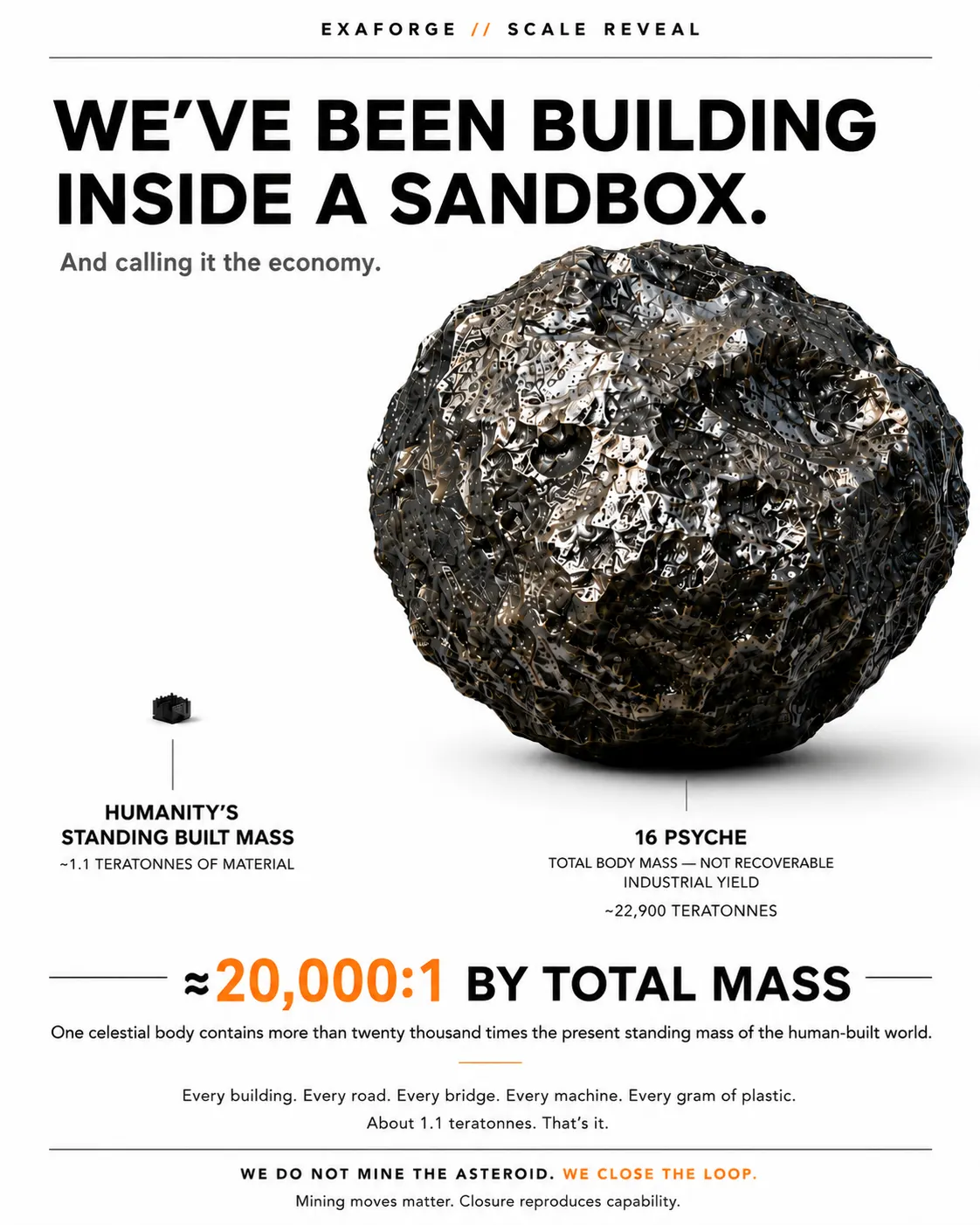
My bet is a stake denominated in physics, not political promises. A birthright of one hundred kilowatt-hours of energy per person, per day, harvested by an industrial buildout that leaves this planet: collectors in the daylight that never ends near Mercury, the metal of 16 Psyche, the Jovian system. The Solar Estate is the water tower. The Stellar Dividend is the line to your house.
One hundred kilowatt-hours a day is 4.2 kilowatts of continuous power. A working humanoid robot draws about half a kilowatt. Run the division.
Eight robots. On the clock, around the clock, for you, forever.
They are not coming for your job. Eight of them are going to work for you. In human shifts, that is a staff of forty. Price it in dollars and the number falls every year, by design; that is what abundance does to prices. Price it in hours, and it never moves: seventy thousand hours of labor a year, issued at birth, for life.
I think of that mother. Her car and her teeth and her children, all three. Her time, the one asset she could never buy more of, handed back to her while her workforce goes on enriching her family. Every year. For life.
The Sun radiates 3.8 × 1⁰²⁶ watts. A full year of the entire species’ dividend, every person’s birthright, leaves it in under three microseconds. It has been making that payment for four and a half billion years. It has simply never had a counterparty. A collector field smaller than Denmark, parked near Mercury, funds every child ever born. We are not straining the star. We are taking the first sip.
Iain M. Banks imagined the far shore. In his Culture novels, money doesn't exist. The Culture has an old saying: money is a sign of poverty. Banks was right about the destination and mercifully vague about the bridge. Money is not abolished by decree. It is out-competed, compounded into irrelevance one payout at a time, until the ledger is kept in kilowatt-hours instead of dollars.
The Stellar Dividend is the last inheritance humanity will ever need to translate into money. It is a liquidity of power that asks no one’s permission. Eight billion spectators become eight billion founders. The first economy in history where the entrepreneur’s scarce resource is a birthright.

While the concrete is still wet
Technologists argue about which constraint will slow the future. Energy. Compute. Chips. Wrong map. The last bottleneck is consent. This year alone, local opposition has blocked or delayed more than $130 billion of data center construction in the United States. Call it ignorance. Or read it correctly: the sound of a social contract being defended by people who believe it is being broken.
Break the contract, and every gain of the machine age arrives wearing the face of an occupying power. Honor it, and the machines become what they are: a nervous system working on behalf of the species.
Humanity does not need a guarantee of employment. Humanity needs a guarantee of participation.
Every civilization bequeaths its defining asset. Agricultural civilizations left farmland. Industrial civilizations left factories. Digital civilizations left networks. Ours will leave the machines that turn energy, matter, and intelligence into prosperity at planetary scale, and the estate that powers them. Not land. Not gold. A cosmic birthright: a claim on the productive work of an entire solar system.
I did not inherit an industrial dynasty. Most people never will. That is not an argument against inheritance. It is the argument for building one that every child is born into.
The child born tonight can inherit that. Or watch it.
The abundance is arriving on schedule. Participation is a choice, one we make now, in law and in plumbing, while the concrete is still wet. Because history keeps one ledger above all the others, and the entry is always the same:
Nobody votes against a future they own.
Somewhere tonight, a child is born.
Their staff clocks in.