The Dream That Became a Substrate
AI did not give me the dream. It gave the dream a ledger.

What happens when a kid with an unstoppable dream is handed the leverage of a thousand PhDs? I found out. The answer is smaller than the question, and I trust it more. Here is what the ledger says, what we built on it, and who it has to belong to.
The red-eye
On a red-eye flight back from Los Angeles, I typed a question into an AI conversation:
“What if we were the ones who built the universe?”
I remember getting up and pacing the aisle, wishing we could land. It felt as though I could fly without the plane. In my imagination, machinery was taking shape beyond Earth: capturing energy, working material, making the tools that would make the next tools.
I had carried that dream for nearly ten years. Now I could do more than carry it.
What happened on that flight was not a discovery in physics. Nothing in the universe had become easier to manufacture. Something changed in the distance between a question and my ability to pursue it.
Until then, I could see the outline of what I wanted to investigate without possessing the intellectual machinery to follow it far enough. An answer in one discipline became a locked door in another. I could read, study, and persist, but every crossing consumed time and resources I did not know how to replenish.
Now the conversation could continue.
The tears belonged to that recognition. I call them thermodynamic tears: the ones that come when effort you have carried for years finally finds somewhere to go.
I am telling you about them because the public conversation about AI rarely begins here. It begins with what the machine can do. Mine begins with what a human being could finally attempt.
The lullaby beneath the fire
For years, I had gorged myself on what I called my Registry of Titans. I read about their lives alongside their ideas because I wanted to understand how they saw a problem before they knew how to solve it.
Carnot, Schrödinger, von Neumann, Shannon, Wiener, Prigogine. Around them, Gödel, Dirac, Fermi, Feynman, Wheeler, and England.
They were not a collection of quantum celebrities. They were a lineage of questions.
How much useful work can an energy gradient yield? How does organized matter endure? What must a machine contain to construct a successor? How can information survive noise? How does feedback make correction possible?
Their work did not amount to a hidden blueprint for my company. It gave me the intellectual materials from which to begin thinking about one. Thermodynamics, reproduction, information, control: read together, they suggested an industrial question I could not put down.
Alongside them, I studied the organizers of rail, steel, oil, electricity, and finance. I wanted to understand how an intention became physical history. Behind the names stood workers, engineers, operators, capital, and institutions that could coordinate what no individual could accomplish alone.
I was studying physics the way industrial builders studied rivers and rail grades: to understand where work could be done, what constrained it, and what it would take to build there.
Another lineage helped me hold that ambition: Alan Watts, Shunryu Suzuki, Walter Russell, Swami Amar Jyoti, and Kōbun Chino. Their teachings were different, and I did not look to them for engineering instructions. They helped me keep my mind still while the fire raged.
That spiritual inheritance belongs in this story. The capacity to build does not tell us what deserves to be built, whom it should serve, or what we must preserve in ourselves while building it.
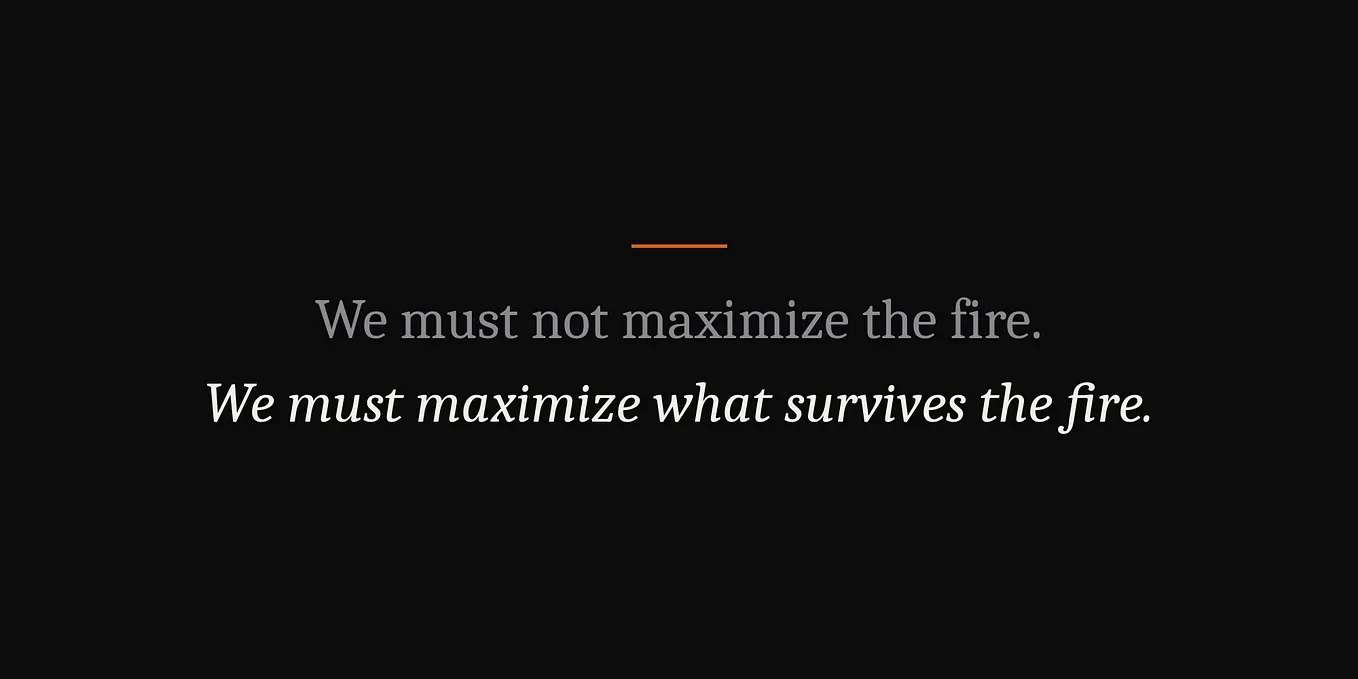
I came to hold the distinction in a sentence: do not merely maximize the fire; maximize what survives it.
This was the lullaby beneath my ambition — an industrial heart finding its discipline in a thermodynamic soul.
What if we built the universe?
The more I studied, the harder it became to regard the universe as scenery.
We are made of its matter and sustained by its energy. We already organize portions of both into turbines, hospitals, processors, and spacecraft. A civilization is, among other things, matter made capable of doing things through accumulated knowledge and coordinated work.
I wanted to know how far we could carry that process.
By “build the universe,” I meant build within it. Develop industry beyond Earth that could do more than arrive, complete a task, and wait for resupply. Capture available energy. Transform local materials. Maintain machinery. Eventually manufacture more of the productive capacity required to continue.
An industrial renaissance extending into the Solar System.
As a young Black man who hadn’t inherited an industrial dynasty, I understood the distance between imagining such an undertaking and possessing the organizations required to pursue it. The biographies were available to me. The laboratories, engineering teams, and capital networks were not mine to summon.
The dream was not small. My access was.
AI altered one part of that inequality. It did not hand me a factory or erase the need for collaborators. It made a much larger field of inquiry addressable. I could follow an intuition through materials science, thermodynamics, robotics, biology, and economics without abandoning it at every disciplinary border.
At first, I called the feeling having the Avengers at my fingertips. That was the language of the excitement. What mattered in practice was less cinematic and more useful: I could keep working.
AI did not give me the dream. It gave the dream an institution.
I mean that as a description of intellectual leverage, not a claim that a model equals a laboratory, an engineering faculty, or a team of independent experts. The physical institution still requires people, equipment, resources, and accountability.
But its intellectual preparation could begin before I had assembled all of those things.
The intelligence did not govern the dream
The first surprise was the range of the assistance. The deeper change came when I learned to govern it.
I brought the first-principles vision, the moral destination, the governing taste, and the refusal to let a beautiful name float above physics. AI contributed research reach, decomposition, synthesis, modeling help, and pressure from several disciplinary perspectives. The documents and records we maintained gave the work continuity across conversations.
Those perspectives were not independent authorities. The same mistake could travel through several fluent answers. A system capable of producing an objection could also produce a convincing defense of something that did not deserve defending.
I had to learn when to say: No. That is not the architecture. Return to first principles.
In one synthesis, the model promoted an old naming proposal into our adopted machine taxonomy. It substituted a human-facing category for an operating environment, omitted branches of the system, and elsewhere confused the machine’s physical lineage with its assigned job.
That mattered because a machine designed for orbital vacuum does not become terrestrial when it changes from inspection to construction. Its assignment can change; the gravity, radiation, temperature, and mobility requirements of its operating environment do not disappear.
I restored the distinction. Bodies follow environments. Offices describe duties. A plausible word was not allowed to rewrite the engineering assumptions beneath it.
The machine had recovered a phrase. I remembered why the architecture needed the distinction.
Other exchanges forced me to surrender language I liked. An appealing analogy became less useful when its dependencies were exposed. A confident paragraph became a question. A sweeping claim became a test we could actually fail.
My intuition entered an adversarial furnace and returned more load-bearing.
That did not make every surviving claim true. It made the work clearer about what it claimed, what supported it, and what would have to happen next. The bench would still have its veto.
I became more capable in the process. My technical vocabulary grew. I could follow arguments farther, recognize more errors, and ask questions I previously would not have known to formulate. I was not simply receiving better documents. I was being sharpened.
A whetstone does not wield the blade. But the encounter changes the edge.
What the recovered time is for
In the remarks I read from Jensen Huang, he described a future in which work that once took ten years could take one, and work that took a year could take a month. He urged greater ambition because the intelligence available to support it had grown.
Those are forecasts, not a clock every project can obey. But beneath the prediction is a question worth asking: what should we do with the time and capability we recover?
We could spend it performing familiar tasks faster. There is real value in that. We could also use some of it to investigate the projects we previously could not afford to begin.
That second possibility is what happened to me.
My dream didn’t need to get higher. It needed somewhere to stand. I had already imagined industry beyond Earth; what I lacked was a practical way to bring enough disciplines into sustained contact with the idea. AI helped compress that distance.
An uncertain premise could become a question to investigate that afternoon. A manufacturing proposal could be examined for the parts it quietly assumed would arrive from elsewhere. A comparison with biology could help for a few steps, then be abandoned where the analogy stopped helping.
I could catch some mistakes while they were still sentences.
That matters because errors become more expensive as people organize around them. In a document, it may require a correction. In hardware, it may require a rebuild. Inside a company’s commitments, it may become something people are reluctant to admit.
AI can introduce those errors as readily as it can help expose them. I experienced both. Its value depended on the discipline of the encounter: checking sources, preserving distinctions, asking what would disprove a claim, and refusing to mistake several confident answers for independent confirmation.
The compression did not make the work easy. It made some of the wrong work easier to stop.
Huang also made a point that matters more to this story than any promised acceleration. Highly capable intelligence does not automatically become productive. It needs context, purpose, and relevance.
I recognize that description in the work behind CRUCIBLE. I had to decide what the inquiry was for. I had to preserve the distinction between an appealing phrase and an engineering requirement. When the system drifted, I had to bring it back. When the evidence contradicted the story, I had to let the story change.
The dream did not disappear into the intelligence. It became something I could govern more rigorously.
That is also why my bench campaign matters. After all the speed of the conversation, the physical work returned an unfinished result. A power measurement could not support the conclusion we wanted to settle. We left the prediction unresolved.
No amount of recovered research time entitled us to skip that uncertainty.
We should compress the waiting between useful questions. We should shorten avoidable searches, expose contradictions earlier, and improve experiment preparation. We should never confuse a faster answer with the evidence needed to trust it.
The larger opportunity is not simply to complete the old agenda more efficiently. It is to let more people bring a serious question onto the agenda at all.
For me, that question became CRUCIBLE. For someone else, it will become something I could never have imagined. That is part of the point: widening access to intelligence should widen the range of human purposes that can acquire a method, collaborators, and a test.
And if that expanded agency eventually produces greater abundance, the obligation extends beyond the people who originated the projects. This is where the Universal Energy Dividend belongs in the same argument. People should share in the material gains of a civilization whose productive capabilities are growing, whether or not they become founders themselves.
The recovered time is not merely a competitive advantage. It can become time to learn, to care, to investigate, to build — and eventually, if we govern the gains well, time people no longer have to sell simply to remain secure.
Get Antonio’s stories in your inbox
Join Medium for free to get updates from this writer.
That is the future I want this work to serve.
Teaching Industrial Abiogenesis to matter
Marc Andreessen’s phrase about “making sand think” captures something extraordinary about computation. An immense industrial civilization transforms raw materials into processors capable of running artificial intelligence.
My ambition reaches toward another transformation: teaching Industrial Abiogenesis to matter.
That is the purpose behind CRUCIBLE.
Every intelligence that acts in the physical world depends on a substrate. Processors require fabrication. Fabrication requires materials, energy, tools, measurement, cooling, maintenance, and supply chains that can replace what fails.
The cloud rests on machinery.
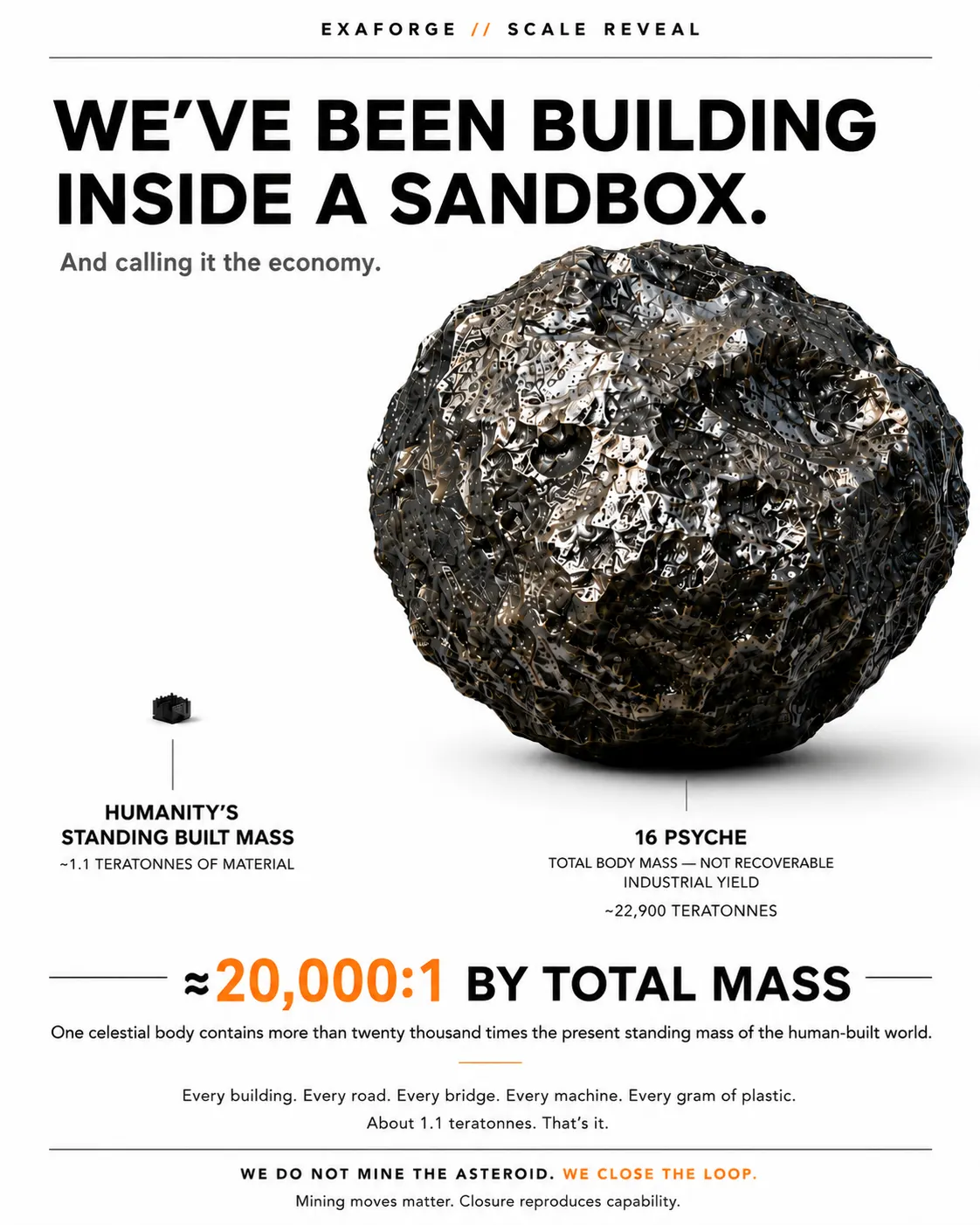
CRUCIBLE asks whether more of that productive foundation can make its successors. Can an industrial system use declared feedstocks, available energy, and inherited process knowledge to produce further productive capability — capability able to participate in continuing the lineage?
That is what I mean by Industrial Abiogenesis.
A robot assembling another robot from imported modules has done useful work. It has not thereby reproduced the industrial system that supplied those modules. The controller, bearings, motors, tools, and calibration equipment still have to come from somewhere.
The research question is how much of that “somewhere” can be brought inside a declared productive boundary, with each remaining external dependency visible.
Self-reproducing machinery and space manufacturing have long intellectual and research histories. CRUCIBLE enters that inheritance with an industrial commitment: to turn the question into architectures, experiments, and qualified capabilities.
I call this growth ambition the Geometric Scaler. A portion of productive output becomes further productive capacity, which can help produce more capacity in turn. The novelty sought is not compounding itself. It is greater autonomy in the material processes through which that compounding occurs.
Energy, resource access, wear, generation time, and reliability still constrain it. Reproduction does not repeal scarcity. It may change how civilization develops the capacity to confront it.
There is a sentence I keep returning to:
One man and the power of intelligence at a bench can build out a universe.
I mean it as a conviction about where consequential work can begin — not as a claim that one person can dispense with other people, or that our present machinery can already reproduce across the Solar System. The man at the bench stands on humanity’s accumulated knowledge and will need collaborators to go farther.
What moves me is the possibility that an undertaking of extraordinary scale can now begin with an individual who previously could not assemble enough intellectual leverage to investigate it seriously.
The universe is the horizon. The bench is where the claim first owes something.

What the bench gave back
On July 12, 2026, our Link-1 bench campaign returned an interim closure verdict. The ledger contained seventeen rows: eleven for externally supplied inputs and six for printed components.
We asked a desktop fabrication system to contribute to a daughter assembly, then accounted for what came from the printer and what still arrived from the surrounding industrial world.
The printer contributed about 154 grams to an assembly weighing approximately 4.74 kilograms: roughly 3.2% by mass.
That result was small. Its meaning was not.
The rails, motors, power supply, heated bed, controller, and other components remained externally supplied. Under our primary embodied-exergy assumptions, a controller board weighing about 50 grams accounted for approximately 39% of the modeled unclosed exergy budget. It remained the largest individual contributor under the alternative assumptions we tested, although its percentage changed.
A small component carried a large industrial dependency.
Our wall-work-based exergy accounting ratio ranged from roughly 0.2 to 1.2 under the primary assumptions. That was an accounting result using energy bounds and modeled upstream costs — not a finding we had reproduced for a complete industrial supply chain.
We had registered three predictions before the print rows closed. Two held under the report’s tests. The third was forfeited pending a clean energy remeasurement. A meter had been reset between batches, leaving readings that could not settle the claim. One fastener weight also remained explicitly estimated.
We could have reached for favorable literature values. They were not measurements of our campaign.
The completed campaign therefore gave us an interim verdict, not a completed reproductive lineage. It showed that this printing process supplied a small structural contribution while critical machinery remained imported. It did not establish that printing could never contribute more, or that electronics were the only obstacle left to solve.
Here was the encounter with AI becoming consequential: I could take an enormous intuition into a small experiment and return with a more specific problem.
The bench did not diminish the dream. It took away the parts of the story we had not earned.
Industrial heredity has a mass ledger. The remaining Earth dependency can be weighed.
Make the stars pay the payroll
My ambition is to help raise an industry worth a quadrillion dollars. That is an undertaking I want to pursue, not a valuation of CRUCIBLE or a forecast established by our first campaign.
Imagine $300 trillion dollars in additional benefit to humanity. Then ask what would make the benefit real.
What produces it? What maintains the machinery? Who owns the output? How much becomes reliable power, clean water, housing, medical capability, scientific opportunity, and time people can call their own?
The number matters when it reaches a household.
I call the physical orientation beneath that ambition a thermodynamic income statement. It is a metaphor for an accounting discipline: capture useful energy, transform matter, charge for loss and maintenance, and ask what durable capability remains.
It does not replace economics. Demand, rights, institutions, and distribution determine whether physical capability becomes prosperity. But economic promises cannot escape their material foundations.
“Make the stars pay the payroll” is how I carry the larger direction. Move toward available energy and matter, and make the resulting capability serve lives.
That obligation starts on Earth. People concerned about the electricity, water, land, and infrastructure AI consumes are identifying real costs. A community should not be asked to host the burden of someone else’s abundance.
And no one without dependable power should have to wait for an asteroid factory. Available technologies can improve lives now. Off-world ambition must enlarge that work, not become a reason to postpone it.
Who inherits the abundance?
When people hear that AI can outperform pieces of their occupation, fear is an intelligible response. Their access to food, shelter, healthcare, and stability may depend on selling the very labor being automated.
My experience of being enlarged by AI does not erase their experience of being threatened by it.
Nor is “become a founder” an adequate social policy. A human being does not need a spectacular dream to deserve a secure life. Human dignity cannot become an audition for economic usefulness.
That is why CRUCIBLE’s moral destination includes the Universal Energy Dividend, or UED.
The long-horizon proposal I call UED-100 is an auditable energy entitlement equivalent to one hundred kilowatt-hours per person per day. It is a proposed target, not an existing benefit or a promise already funded. What counts toward it, how it reaches people, how it is financed, and how access is protected require their own institutional architecture.
The purpose is broader than a household meter. It is a durable claim on the energy-supported capabilities of modern life.
When machines inherit more of production, human beings should inherit more of the resulting surplus.
Otherwise, productive abundance can grow while insecurity grows beside it. Machines can multiply output without giving anyone else a right to use it.
Energy poverty deserves an eviction notice. Delivering it requires more than generation: networks, maintenance, affordability, governance, and enforceable access. An industrial apparatus capable of reproducing would expand the means available; it would not automatically choose a just distribution.
Here my spiritual inheritance becomes an obligation rather than a paragraph of influences. What survives the fire must include the people for whom the future is being built.
I believe in AI with humanity: beside us, open to challenge, helping more people learn and act, and governed so that its gains do not require others to become disposable.
The work has an address
CRUCIBLE has an address in Hyde Park, Chicago. The company has a doctrine, executable models, a joule-accounting ledger, and a completed bench campaign with an interim verdict.
It is not yet a factory.
The next ambition is a first-quarter 2027 target: to present a named constructor system for independent assessment, operating within a declared boundary and demonstrating net growth in qualified productive capacity, with external dependencies disclosed.
That is an experimental target, not an achieved result. Success within a limited boundary would not establish complete industrial independence. If the evidence does not support the claim, the account published here must say so.
The date gives the work an obligation. It does not instruct the future.
I want the same honesty to govern both directions. We must not call an architecture a factory. We must not call a completed campaign merely a plan. No inflation, and no false modesty that erases what has actually been done.
You do not have to pursue the question alone
I return to the flight because the essay could otherwise end in machinery and forget the person who boarded the plane.
I had spent years learning to see possibilities I could not adequately investigate. AI did not originate the hunger, choose the moral destination, or assume responsibility for the work. It gave my thinking more reach, opposition, and continuity.
I governed what I could. I corrected what I recognized. I learned enough to recognize more. Then I took part of the work to a bench and let the result change the story.
That is what the encounter gave me.
Humanity may be about to inherit institutional-scale cognition at the level of the individual imagination.
Whether that becomes a broad inheritance or a revocable privilege depends on access, ownership, education, and power. My experience is one reason to fight for the broader possibility.
Somewhere, another person is carrying a question their circumstances have never given them room to pursue. It may concern a neighborhood, a disease, a material, a classroom, or a problem nobody else has taken seriously. It may have nothing to do with the stars.
I want that person to have more than encouragement. I want them to have leverage, and a secure place in whatever future that leverage helps create.
What if we built the universe?
I still hear that question with the force it had on the plane. Now it has company: what can we demonstrate next, what have we missed, and who must benefit if we succeed?
“The superpower is not having all the answers. It is no longer being forced to pursue the question alone.” — Antonio