Charon’s Obol. Its origins are unknown to scholars.


Charon’s obol is an allusive term for the coin placed in or on the mouth of a dead person before burial. Greek and Latin literary sources specify the coin as an obol and explain it as a payment or bribe for Charon, the ferryman who conveyed souls across the river that divided the world of the living from the world of the dead. Archaeological examples of these coins, of various denominations in practice, have been called “the most famous grave goods from antiquity.
The custom is primarily associated with the ancient Greeks and Romans, though it is also found in the ancient Near East. In Western Europe, a similar usage of coins in burials occurs in regions inhabited by Celts of the Gallo-Roman, Hispano-Roman and Romano-British cultures, and among the Germanic peoples of late antiquity and the early Christian era, with sporadic examples into the early 20th century.
Some of the oldest coins from Mediterranean tombs have been found on Cyprus. In 2001 Destrooper-Georgiades, a specialist in Achaemenid numismatics, said that investigations of 33 tombs had yielded 77 coins. Although denomination varies, as does the number in any given burial, small coins predominate. Coins started to be placed in tombs almost as soon as they came into circulation on the island in the 6th century BCE, and some predate both the first issue of the obol and any literary reference to Charon’s fee.
Source: Wikipedia
Although the Wikipedia article does not mention the origins of this custom, it suggests the Egyptian Book of the Dead for further reading.
To the question: “What is the scientific consensus on the origins of the Greek and Roman tradition of Charon’s Obol,” ChatGPT said:
In short: the Greek origin of the Charon-specific interpretation is well supported, but the ultimate origin of the underlying funerary practice remains uncertain. The strongest modern scholarship treats Charon’s obol not as a universal ancient rule, but as one interpretation of a diverse and evolving set of burial customs.
Human Breeding Farms
Diodorus witnessed an Egyptian burial between 60 and 57 BCE
The body is ready for burial, and the relatives give notice of the date of burial to the judges and the relatives as well as to the friends of the deceased, and they solemnly declare that “he is ready to cross the lake” saying the name of the deceased. Then forty-two judges are summoned and they seat on a semicircle that has been placed by the banks of the lake, the boat that was constructed in advance is launched and on it stands the boatman who is called in the Egyptian language ‘Charon.’ That is why they say that when in the old days Orpheus came to Egypt, he saw this custom and fashioned the fable of ‘Hades,’ copying half and inventing the rest himself; but this we are to discuss below. When the boat is launched and ready for the reception of the coffin, it is lawful for any person who thinks it proper to bring forward an accusation against the deceased. If it can be proved that he had led an evil life, the judges rule accordingly, and the body is deprived of the accustomed sepulture; but if the accuser fails to establish what he has advanced, he is subject to the heaviest penalties. When there is no accuser, or when the accusation has been disproved, the relations cease from their lamentations and pronounce encomiums on the deceased. (A,91:1–5)
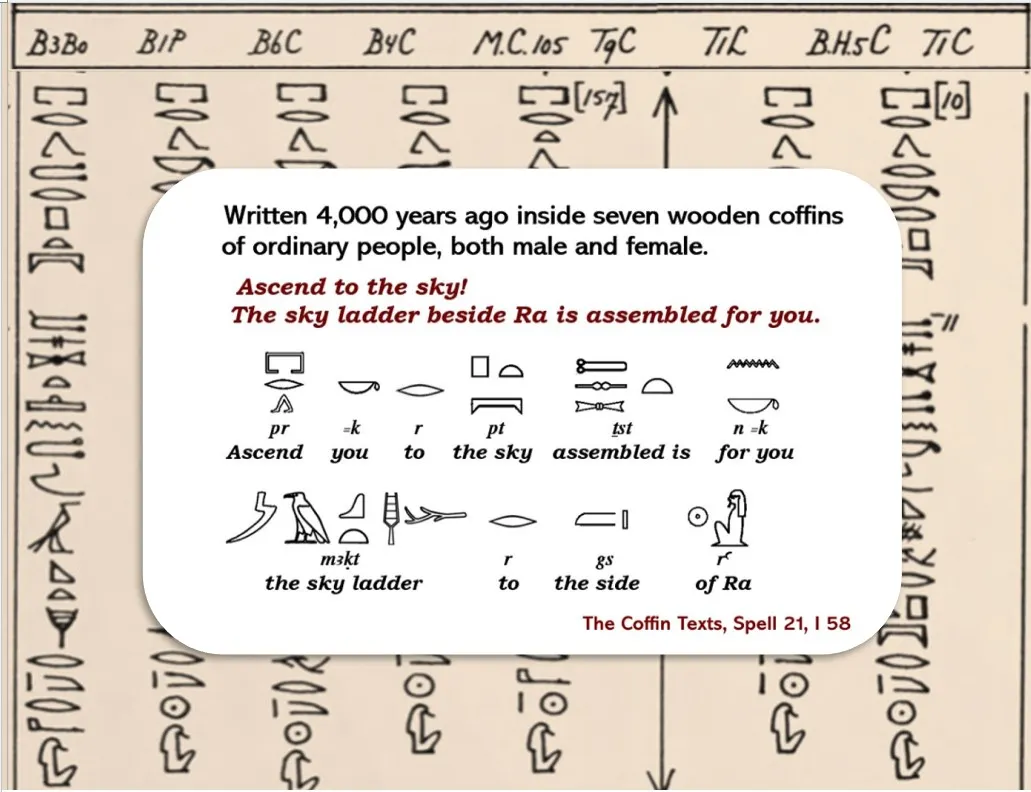
The following passage is the introduction to Chapter 1 of the Book of the Dead.
The sentence in red font is the original title of the Book of the Dead. It actually means “Crossing over towards the West” because the West was the land of light, while the East was considered the land of darkness.
This chapter was recited when the body was buried after crossing the lake on the boat Diodorus mentions.

In all three kinds of judgment, there follows the passage on the ferryboat.
(a) The Osirian after-death judgment
The imaginary Osirian after-death judgment had nothing to do with crossing a river or lake by ferryboat. Traditionally, however, the judgment was followed by a ferry crossing because the ancient Egyptians knew the lake the ferry sailed on had been formed by gods who had become the Osirian gods, who now were about to judge the person reciting the passage from the Book of the Dead.
The judgment site constituted the outlet of a Human Breeding Farm Institution (known as an “Enclosure”) where abducted lowly women were impregnated by high class males (gods and kings) and gave birth to offspring whose purity (resemblance to pure father) was assessed by the judging gods .

The public harem where the abducted women lived, was situated inside the Enclosure.
The Enclosure was placed in an impassable marshland to prevent the women from escaping. Communication with the enclosure was achieved by flooding the marshland to create a small lake and using the ferryboat (originally a reed float).

This is a report of a past event, not a prediction of the outcome of the pending Osirian judgment of the deceased King Pepi. The texts in the pyramids were originally written in the first person. The deceased king was supposed to recite the texts before the judging gods, informing them that he was pure as per his original assessment. In this case, the King would be informing the judging gods that when as a young man was judged, he was found to be a pure one and so the feed canal was opened, the Marsh of Reeds was filled, the Canal of Kha on which the ferryboat sailed was flooded, and thus he was transported to the West, the land of the pure.
The reason scholars do not know — or pretend not to know — the origins of the custom of the Charon’s Obol is reflected in the translations above, where the term ”land of the pure” is either left untranslated or rendered as “horizon,” projecting a clear image of an earthly landscape on the horizon.
(b) The Real-life judgment
The Pyramid Texts, the oldest religious texts, inform that the human breeding farms were originally used by the gods to produce humans, and the younger didactic texts inform that the pharaohs, imitating the gods, used human breeding farms to produce the workforce required in building all the preternatural edifices, temples, statues, tombs, and pyramids of ancient Egypt.
The Pyramid Texts assert that the landing site of the ferryboat was constructed by the gods.
In the following passage, written in the pyramids of Pepi I, Merenre, and Pepi II, the marshland is called “Wetland Paat” and the ferryman is ordered to take the king to the landing place of the ferryboat that the gods had constructed in their first years.


According to the translators, what the gods created was the field, not the landing place of the ferryboat on that field.

Here, the translators inform their readers that the gods created the field gradually during the New Year’s days, the annual festivals, or the first days of the seasons.

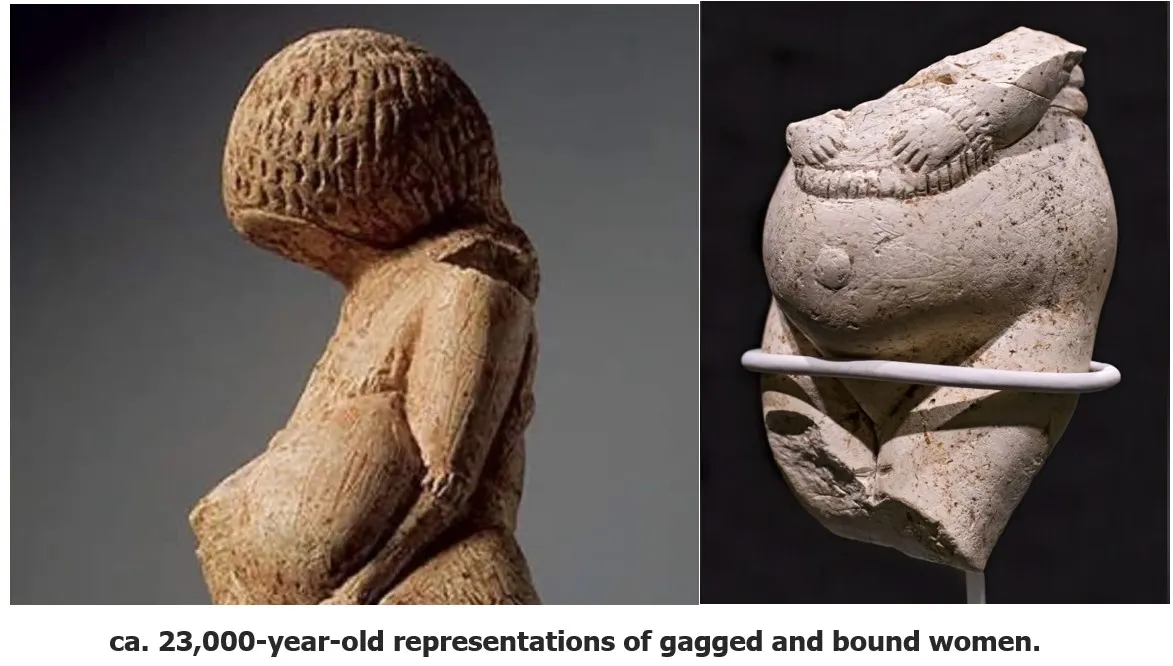
When the gods impregnated gagged and bound women 45,000 years ago, no payment or bribery of the ferryman was mentioned.

Relevant article:
Gods the founders of Human breeding Farms
Get Dimitrios Trimijopulos’s stories in your inbox
Join Medium for free to get updates from this writer.
https://www.academia.edu/176379065/Gods_the_Founders_of_Human_Breeding_Farms

Egyptologists claim that Egyptian peasants constructed the monuments during the agricultural off-season. Suggesting that kings adopted the practice of using human farms from the gods would challenge academia’s fundamental beliefs. All the more so if they claimed the kings forced their officers to pay for the entertainment they enjoyed by impregnating the women of the Enclosures, so that they would bear some of the expenses of running the Enclosures.
“The Instruction of Amenemope” is a literary work of the didactic genre composed during the Ramesside Period (ca. 1300–1075 BCE). The instructions address exclusively the youngsters born and raised in the Enclosures, who were about to undergo judgment, as well as the officials and assessors of the Enclosure.
In his prologue, the author summarizes the contents of the instructions as follows:

The youngsters would be instructed on how to attain social superiority (by learning to speak Egyptian, since most of the mothers were foreigners, and by being loyal to the pharaonic regime).
The assessing officials would be instructed on how to assess completeness (complete purity: physical resemblance to the noble father).
The ferryman, as the gatekeeper of the Enclosure, could serve as an assessing officer by rejecting individuals forwarded to him for transportation. In chapter 12, we read:

In chapter 29, the instructions given to the ferryman are of a different sort and even more revealing:


The fare was covered by noble officials (the possessors of nobility) who traveled from West to East to inseminate the women of the Enclosure’s harems (this “fare” produced the practice of “Temple prostitution” when the Enclosures developed into temples).
The bribe was paid by those wanting to sail from East (the place of the judgment site) to the West (the land of the pure).
Crossing from East to West without bribing the ferryman was considered proof of purity.

The question arising here is whether the gatekeepers of the Enclosures in the historical period retained the title of ferryman while the Enclosures were not yet surrounded by marshland or the waters of some lake, or whether the judgment was staged so that the pure ones would still cross some body of water, as in the before-burial judgment that Diodorus described.
The only site known that could have housed a human breeding farm is Merimde Beni Salama
Béatrix Midant-Reynes in her account of the excavations at the Neolithic (5th millennium BCE) site of Merimde Beni Salama, on the western area of the Delta of the River Nile, 45 km northwest of Cairo. states that the patterning of the graves at Merimde constitutes a somewhat controversial aspect of the site and continues:
180 graves were excavated by the Austrian expedition. The bodies were wrapped in mats or animal skins, and in 85 per cent of the cases they were laid on their right sides, in oval fairly shallow pits, often covered with plant fibres. Usually laid in a contracted position, preferably with their heads towards the south and the face looking towards the north-northeast. The extreme rarity of adult males compared with the large numbers of young children has led to the suggestion that the latter (and sometimes also women) were buried within the dwellings or in their immediate proximity, while men, perhaps often killed in the course of hunting or war, might have been buried in those parts of the outside world where they died
( Beatrix Midant-Reynes, The Prehistory of Egypt, Blackwell, 2000, p.116)
The children, however, were not actually buried because their bodies were found into rubbish pits.
The settlement consists of small huts made of wattle and reed with round or elliptical ground plan. There are no separate areas for cemeteries. The dead were buried within the settlement in a contracted position in oval pits without grave goods. Bodies of children were simply thrown into rubbish pits.
Source: https://www.ucl.ac.uk/museums-static/digitalegypt/neolithic/merimde.html
Children, probably not yet considered full members of the community, were simply thrown into the settlement’s waste pits.
Those throwing the bodies of the children into the settlement’s rubbish pits were most probably the officials running the human breeding farm at Merimde, not the mothers of the children.
Plato’s report on Near Eastern human breeding farms was accurate because he mentioned the “fold” (Enclosure) and the “nursery,” which was part of the Enclosure. One wonders, however, whether he also knew how they disposed of the discarded children.

Another piece of evidence supporting the hypothesis that Merimde was — or contained — a human breeding farm is the fact that it was located in the Nile Delta, not far from a marshy area.

Human breeding farms are unknown in history. Acknowledgment of their existence would have assisted in comprehending recurring legends such as those of abducted women or the practice of regicide.
Inevitably, however, such an investigation would lead to the conclusion that the gods created humans in human breeding farms, causing irreparable damage to religion.
45,000 Years of Human Breeding Farms Undetected by Religion-Protecting Academics

Dimitrios Trimijopulos
October 18, 2026