The person who misled humanity


The term Θέωσις (theosis) derives from the verb θεῶ, θεῶμαι (theō, theōmai) to make divine, to become a god. In Koine Greek and Modern Greek, it is identified with the concept of deification.
The theory claiming that the gods were deified humans is known as Euhemerism. The ancient Greek mythographer Euhemerus (4th–3rd century BCE), suggested that gods were originally mortal human beings — such as powerful kings, heroes, or conquerors — who were admired, remembered, and eventually deified after their deaths.
Euhemerus was not the first to attempt to rationalize mythology in historical terms: euhemeristic views are found in earlier writings including those of Sanchuniathon, Xenophanes, Herodotus, Hecataeus of Abdera and Ephorus. However, the enduring influence of Euhemerus upon later thinkers such as the classical poet Ennius (b. 239 BC) and modern author Antoine Banier (b. 1673 AD) identified him as the traditional founder of this school of thought.
Source: https://en.wikipedia.org/wiki/Euhemerism
The ancient Greeks knew nothing about celestial gods. They did not appoint any celestial gods as patron gods of Mount Olympus.
When word from the Near East reached philosophers and poets that the gods lived in the sky, they promoted belief in heavenly gods.
Homer, whom Plato accused of being a liar for attributing to the gods all the wickedness of humans, is the one who wrote:
• high in the clouds do they abide (Odyssey book 16, line 264)
• what if haply he be some god come down from heaven! (Odyssey book 17, line 484)
• the gods, who hold broad heaven. (Odyssey book 6, line 244)
People’s beliefs developed similarly worldwide, eventually leading them to believe that the gods lived both in the mountains and in the sky.
To the ancient Dacians (Thracians), Mount Ceahlău was considered as the abode of the god Zamolxis.
To the Sumerians, the gods were living in the Cedar Forest up in the mountains.
To the ancient Israelites, the abode of the Elohim gods was Mount Horeb, and of the god Yahweh Mount Zion.


Mount Kailash was the abode of Lord Shiva, his consort Parvati, and other deities. It is sacred to four religions Hinduism, Bon, Buddhism, and Jainism.
In China, Mount Tai was the abode of the great deity Dengue Dadi.
In Japan, Mount Fuji is the home to the goddess Sengen-sama.
Wikipedia lists 91 holy/sacred mountains all over the world — the American continent included — but none in Northern Europe, the land of the Norsemen and the Celts.
To the people, the gods moved from the mountains to the sky; therefore, it is historically proven that theosis produced the concept of heavenly gods.
Moreover, traditions, myths, and legends mention no other way humans learned of the existence of gods. Theology inherited the gods from popular lore. The gods theologians produced have nothing to do with the origin of the concept of gods.
Philosophers and theologians are compelled to admit that the concept of gods was not produced by some revelation, but they react by invoking the genetic fallacy to claim that even if the concept of gods was the aftermath of a mistake, a lie, or a joke, philosophical and theological arguments prove that under the mistake or the joke may lie some divine truth.
The ancient Greek scholars, advocates of Euhemerism, believed that deification was realized as in their time, i,e., after death, and they paid no attention to the poets who mentioned transportation of living people to the sky by various means.
The twin giants Otus and Ephialtes, known as the Aloadae, wanted to overthrow the Olympian gods.
According to Homer’s Odyssey (Book 11, lines 305–320):
• They placed Mount Ossa on top of Mount Olympus.
Get Dimitrios Trimijopulos’s stories in your inbox
Join Medium for free to get updates from this writer.
• They intended to pile Mount Pelion on top of Ossa.
• Their enormous mountain construction would create a pathway to heaven.
• They planned to reach the gods and challenge their authority.
Apollo eventually killed them before they reached adulthood.
The original passage explicitly describes their intention to make the sky accessible via a ladder made of mountains.
The ancient Greek poet Pindar, in Fragment 30, describes the goddess Themis being brought from the springs of Oceanus to Olympus (regarded heaven) by a shining heavenly pathway and a sacred stairway.
This is particularly interesting because it involves an actual celestial staircase, rather than mountains being piled up to reach heaven.
The sky-ladder is mentioned in the Hebrew Bible.

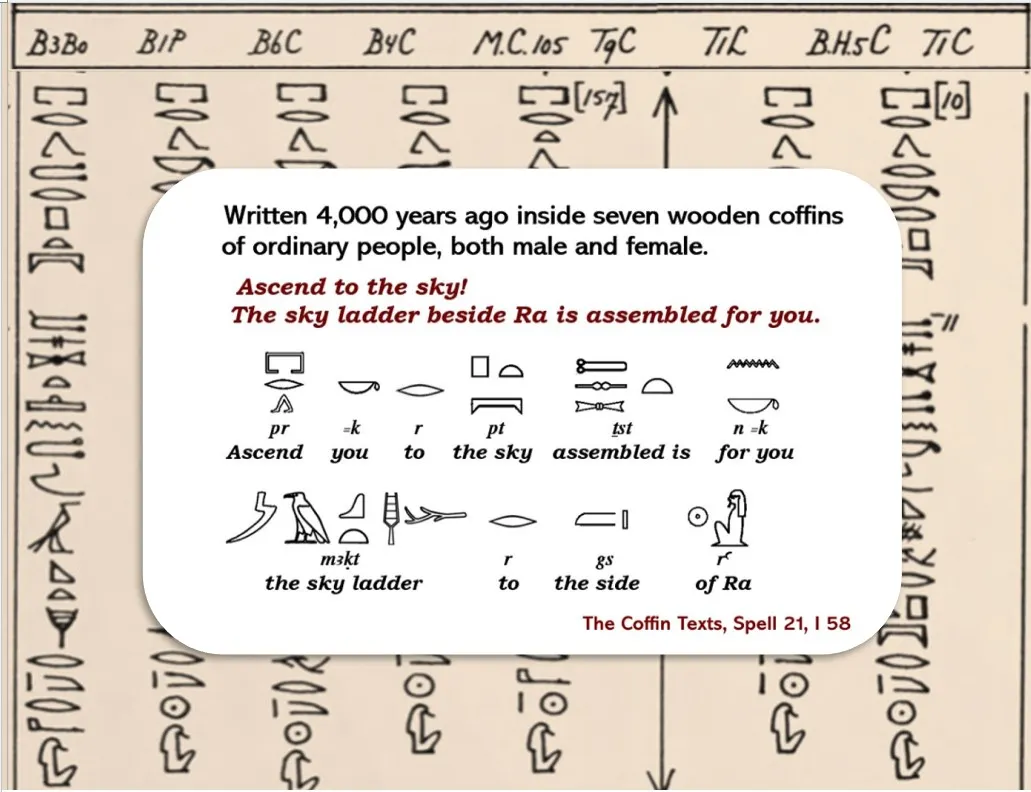
The Egyptian Pyramid Texts make it clear that the gods owned a sky-ladder each.

Eventually, people came to believe they could become gods by climbing a ladder to the sky.

The sky-ladder, appearing as a bridge, a tall tree, or even as the rainbow, was mentioned in the myths and legends worldwide. Most important is the fact that the American Natives, who had been isolated in the American continent for approximately 20,000 years, do mention sky-ladders.
The historical causes, along with the relevant evidence that led to the concept of theosis are presented in the following 33-minute-read article:
https://www.academia.edu/180210181/Religion_Academia_and_Brazen_Lies
https://medium.com/@dtango/religion-academia-and-brazen-lies-3c0c1b54374d
In short, it can be said here that the concept of theosis is the result of two consecutive fundamental lies.
The first lie was told about 40,000 years ago when the ancestors of the Norsemen and the Celts (the only ones who did not designate a mountain as sacred) migrated from the Near East to Europe. It was said then that they did not leave the land but that they moved to the mountains of the Near East.
The second lie was told about 20,000 years ago. Those searching for the nonexistent lords in the mountains were told the lords climbed ladders and went to live in the sky.
That was certainly the idea of a single person who either said it to tease the naïve persecutors of the lords or was a genius who understood that, since people could believe that people lived on the summits of mountains, where life could not be sustained, they were foolish enough to believe that people could also live in the sky.

Whether male or female, one person alone came up with the excuse of the sky-ladder.
One single person who lived 20,000 years ago in the Near East led humanity into a tragic delusion.
The brilliant minds of philosophers produced torrents of verbiage to persuade the laity that the last god who climbed the sky-ladder was the creator of the universe, citing the universe as proof of that creator’s existence.
Philosophy has helped lead humanity into the tragic delusion of religion, while no matter how hard philosophers reason, reflect, and meditate, they cannot reach the truth, which, in this case, is the shameful foundation of religion: theosis.

Dimitrios Trimijopulos
November 11, 2026