Purpose as the Starting Point: The Physics of Moving from Point A to Point B
How Purpose, Efficiency, Effectiveness, Innovation, Prioritisation, Coaching, and Continuity Move Us from Where We Are to Where We Want to Be

Human progress can be viewed as movement.
There is a Point A — where we are now.
There is a Point B — where we hope to arrive.
Between them lies something far more complicated than a straight line.
We choose directions. We spend energy. We discover that some methods work while others do not. We encounter constraints, change priorities, invent alternatives, learn from people around us, and occasionally discover that the destination itself needs to change.
Management has developed different words for these forces: purpose, efficiency, effectiveness, innovation, prioritisation and coaching.
They are usually discussed as organizational capabilities. Yet they are equally relevant to an individual trying to build a career, learn something difficult, improve a relationship, create a business, develop a habit, lead others, or simply move toward a better tomorrow.
Underlying all six is another force that receives less attention:
Continuity.
Continuity is what allows today’s understanding to remain available tomorrow.

Purpose: Giving Point B a Meaning
The English word purpose reaches back through Old French porpos and related forms associated with intention, aim and something put forward.
Its meaning has expanded considerably.
In organizations, purpose appears in mission statements, leadership philosophies, brand narratives and strategic direction. For individuals, however, purpose can be much simpler.
Why am I moving at all?
Philosophically, purpose gives meaning to movement. Scientifically, it can be understood as a directional constraint: among countless things we could pursue, purpose narrows the field toward what matters.
A person without purpose may still be extraordinarily busy.
But movement is not necessarily progress.
If Point A represents the present and Point B represents an intended future, purpose answers the first question:
Why is B worth reaching?
Its future importance may increase as AI makes execution easier. When machines can generate, calculate, organize and automate increasingly complex work, the distinctly human question becomes less about whether something can be done and more about why it deserves to be done.
But purpose alone cannot carry us there.
It needs energy to be used intelligently.
Efficiency: Protecting the Energy of the Journey
Efficiency entered English through ideas of producing an effect, ultimately tracing to Latin efficere — to accomplish or bring about.
Modern management made efficiency closely associated with output relative to resources.
Time. Money. Labour. Energy. Attention.
Every person wakes with limited resources.
Twenty-four hours. Finite attention. Finite physical energy. Finite money. Finite emotional capacity.
Efficiency asks:
How much of what I possess is actually helping me move?
Science gives us a useful parallel. No physical system transfers energy perfectly; some energy is dissipated.
Human lives experience their own forms of dissipation.
Unnecessary repetition. Searching for forgotten information. Relearning something already understood. Switching constantly between contexts. Reconstructing old conversations. Repeating mistakes whose lessons disappeared with time.
Efficiency, therefore, is not merely about doing things faster.
It is about reducing unnecessary loss between intention and progress.
Yet being efficient creates another danger.
We can become extremely good at travelling in the wrong direction.
That introduces effectiveness.
Effectiveness: When Movement Produces Meaning
Efficiency and effectiveness are frequently placed beside one another, but they answer fundamentally different questions.
Efficiency asks whether resources are being used well.
Effectiveness asks whether the intended result is actually being achieved.
Imagine climbing a mountain rapidly, using excellent equipment and maintaining perfect pace — only to discover that you climbed the wrong mountain.
The journey was efficient.
It was not effective.
For individuals, effectiveness introduces an important checkpoint between Point A and Point B:
Is what I am doing producing what I actually wanted?
A student may spend hours studying but retain very little.
A founder may hold dozens of meetings without acquiring customers.
A manager may send hundreds of messages while the team remains unclear.
A person may maintain an elaborate productivity system while making little progress toward what matters.
Effectiveness forces us to compare activity with consequence.
Without remembering what was attempted, why it was attempted and what happened afterward, effectiveness becomes difficult to evaluate.
We need yesterday’s evidence to improve tomorrow’s choices.
Innovation: When the Existing Road Is Not Enough
Innovation derives from the Latin innovare — to renew or alter.
Today, innovation is frequently associated with technology, startups, research laboratories and disruptive products.
Its deeper principle is broader:
What if the existing route from A to B is no longer the best route?
Innovation begins when accepted assumptions become questions.
Why must this happen this way?
What if these two ideas were combined?
What if a constraint could become an advantage?
What if something designed for one purpose could solve another problem?
Scientifically, innovation resembles experimentation.
Hypothesis. Attempt. Observation. Learning. Adjustment. Another attempt.
Innovation therefore depends upon accumulated learning. An experiment whose results disappear cannot meaningfully contribute to the next experiment.
The future of innovation may increasingly involve humans working alongside AI systems capable of producing enormous numbers of possibilities.
The scarce capability may no longer be idea generation alone.
It may become our ability to preserve why ideas emerged, what was tried, what failed, what succeeded and what should happen next.
But possibilities create another problem.
There will always be more routes than we can travel.
So we must prioritise.
Prioritisation: Deciding What Deserves the Present
The idea of priority originally carried a powerful implication: something that comes before something else.
Modern life transformed priority into priorities.
Everything became important.
Get Shreedharan Soundiah’s stories in your inbox
Join Medium for free to get updates from this writer.
Health is important. Work is important. Learning is important. Relationships are important. Customers are important. The future is important.
And suddenly attention is divided among dozens of competing Point Bs.
Prioritisation restores sequence.
What deserves attention now?
This is not merely productivity.
It is resource allocation at the level of human life.
Attention directed toward one thing necessarily means attention unavailable elsewhere.
Purpose tells us what matters.
Prioritisation determines what matters now.
Efficiency protects the resources assigned to it.
Effectiveness checks whether those resources created the intended outcome.
Innovation finds alternatives when they did not.
But even a well-designed journey encounters something deeply human:
We cannot always see ourselves clearly.
That is where coaching enters.
Coaching: Progress Through Another Perspective
The word coach has an unusual journey.
It originally referred to a carriage that transported people from one place to another. Over time, the metaphor moved into education, sport and eventually leadership and personal development.
That historical transition is remarkably appropriate.
A coach helps someone move.
Not necessarily by travelling the journey for them, but by helping them understand where they are, where they want to go and what may be preventing movement.
The great coach does not simply provide answers.
A coach asks questions.
What happened?
Why does this matter?
What are you overlooking?
What have you already tried?
What could you do differently?
What happens next?
Philosophically, coaching introduces reflection.
Scientifically, it creates another observation point within a feedback system.
Personally, it provides something difficult to manufacture alone:
Perspective.
As human coaches begin working alongside AI systems capable of remembering patterns, surfacing previous commitments and connecting learning across longer periods, coaching itself may evolve.
But a powerful coaching conversation today can still become a forgotten conversation months later.
Unless its learning travels forward.
Continuity: The Force Running Through Everything
Look again at the journey.
Purpose defines why Point B matters.
Efficiency protects the resources required to travel.
Effectiveness checks whether movement is producing the intended result.
Innovation discovers another route when the existing route is insufficient.
Prioritisation determines what deserves attention at this moment.
Coaching introduces reflection, perspective and guidance along the way.
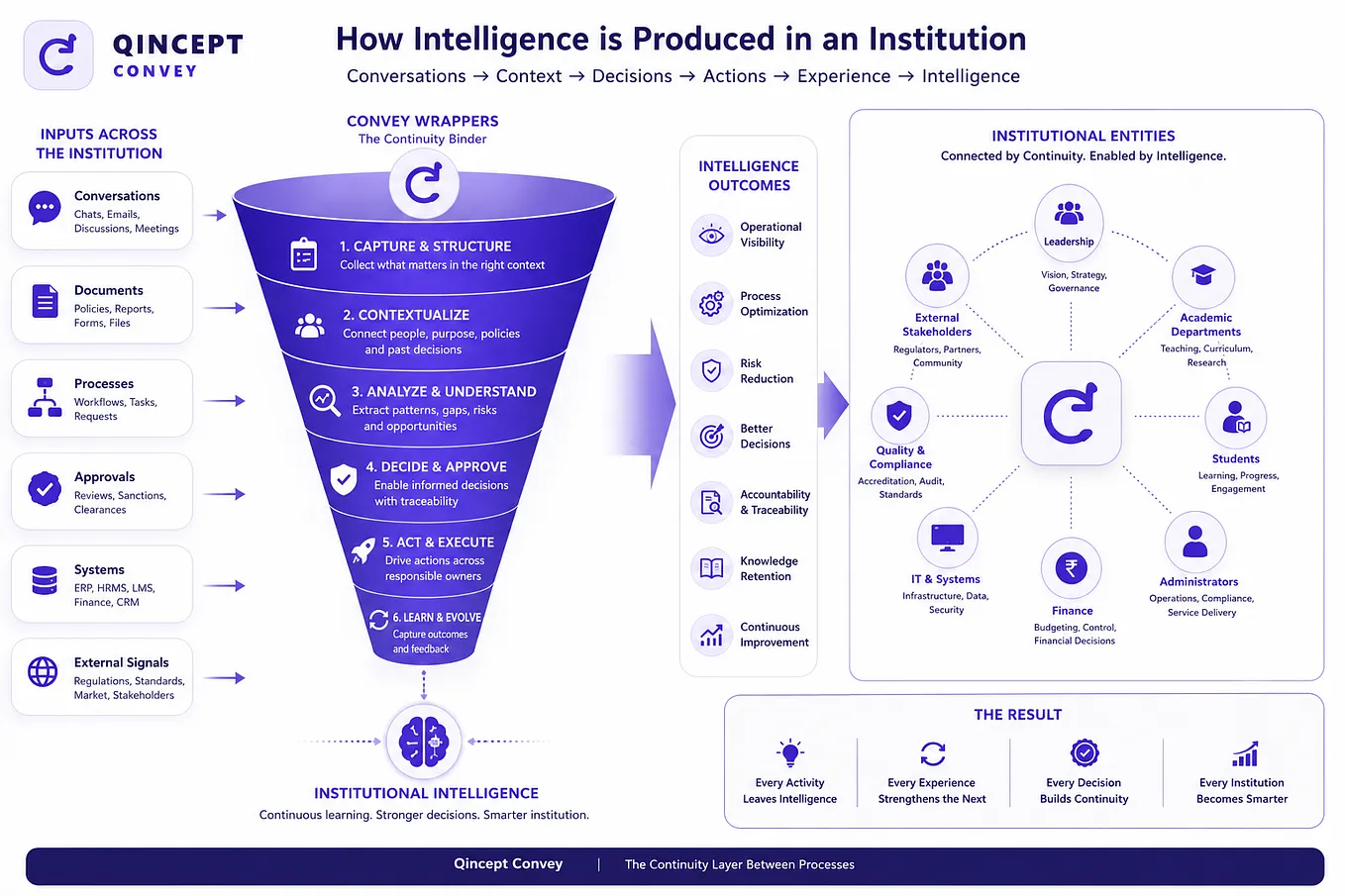
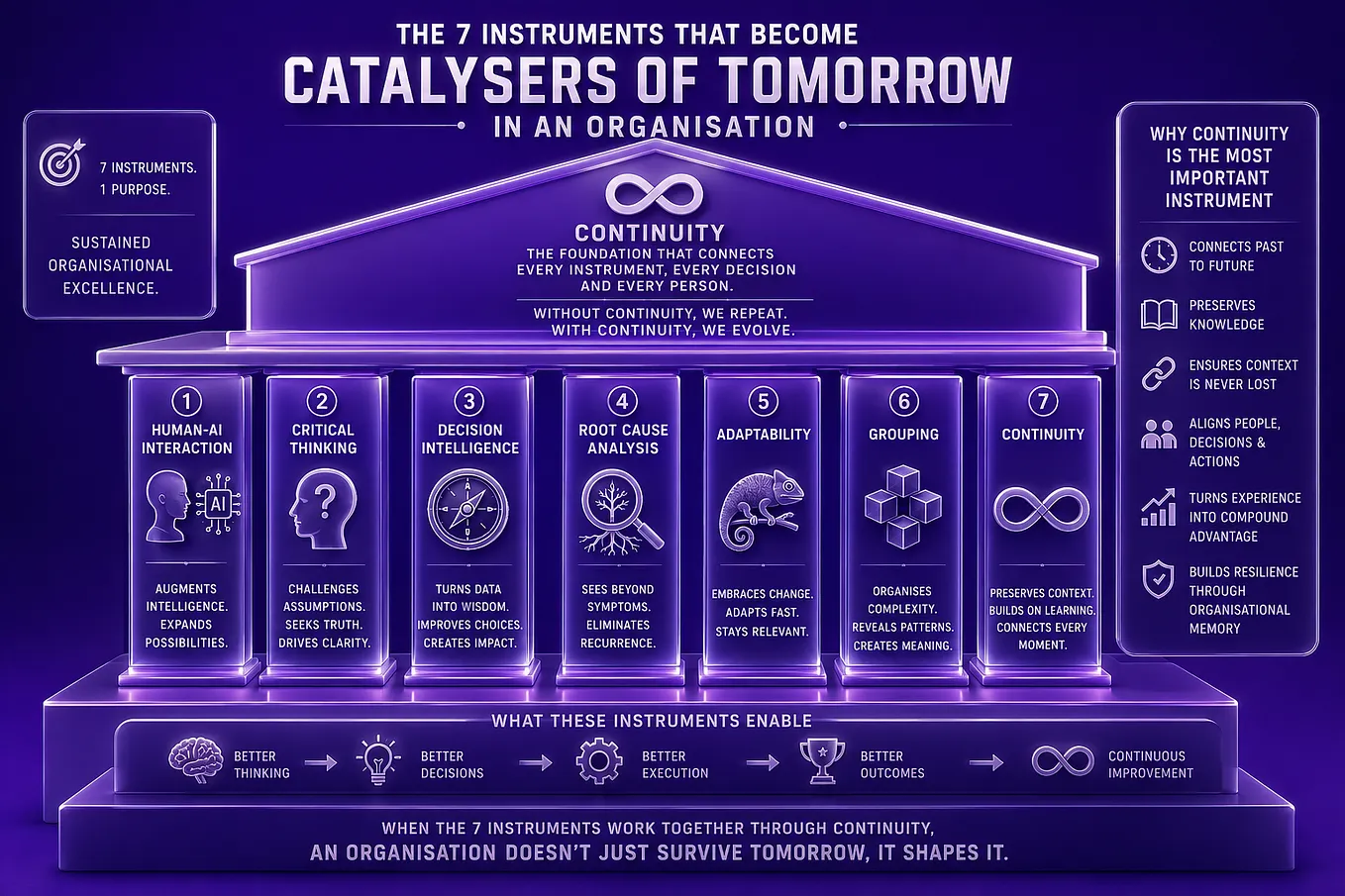
And continuity connects every stage across time.
Without continuity, purpose can slowly become disconnected from everyday activity.
Efficiency improvements are rediscovered repeatedly.
Evidence of effectiveness disappears.
Innovation repeats previous experiments.
Priorities lose their original reasoning.
Coaching conversations become isolated moments.
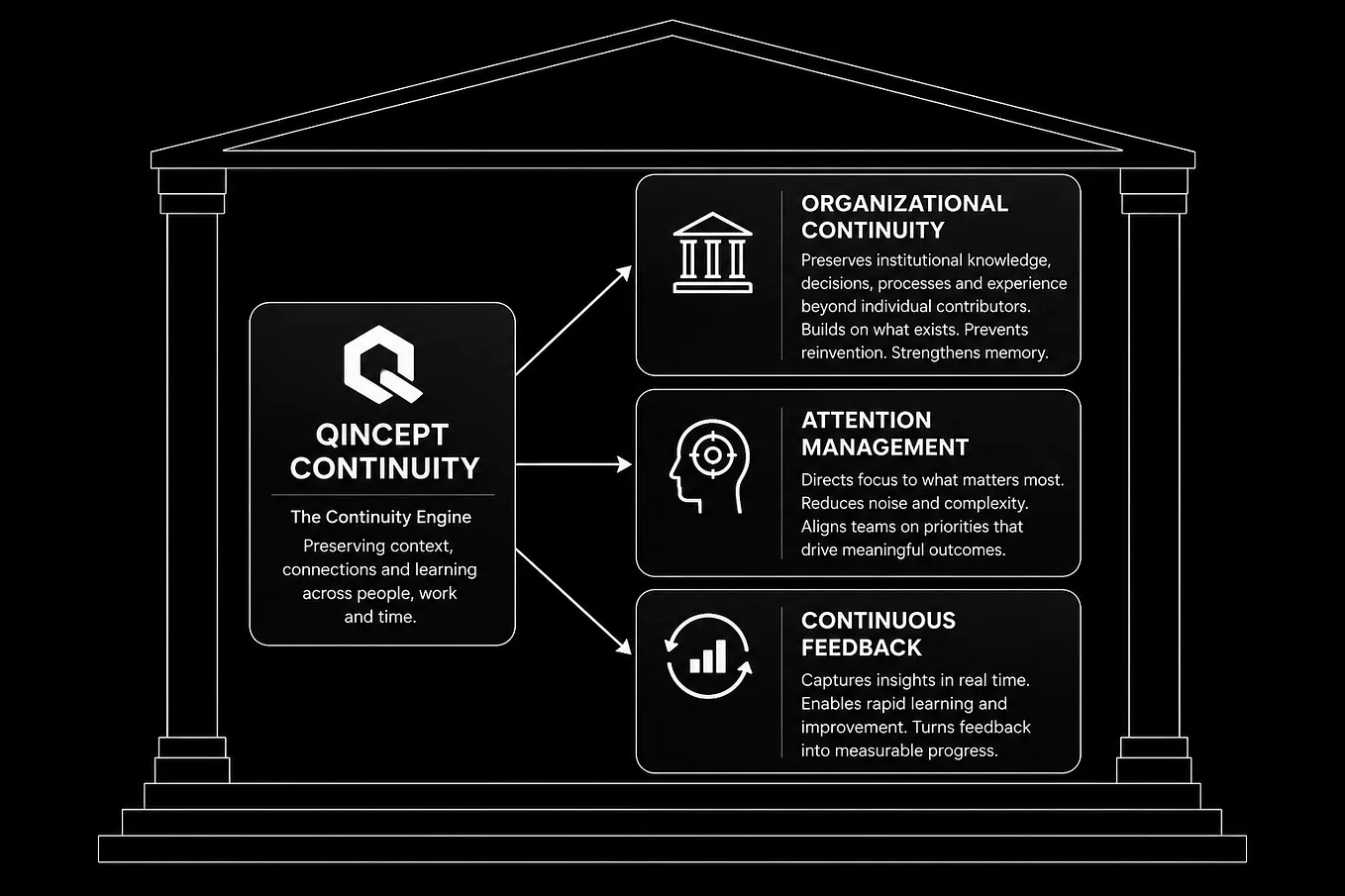
Continuity changes the journey because it preserves the relationship between what happened, what was understood, what was chosen and what should happen next.
It keeps us checked in — not merely to a system, but to our own movement.
The Now and the Later
Perhaps one of the most interesting challenges in human progress is maintaining a meaningful relationship between the person making choices today and the person who will inherit their consequences tomorrow.
We constantly exchange resources between these two versions of ourselves.
The present invests.
The future receives.
The present learns.
The future benefits.
The present makes mistakes.
The future should not need to repeat them.
This is why continuity extends beyond organizational memory.
It can become a principle for living and working across time.
A decision should carry its reasoning.
An experiment should carry its learning.
A priority should carry its context.
A coaching conversation should carry its insight.
An accomplishment should become a foundation rather than an isolated event.
And a failure should leave behind something useful.
The Physics of Moving Forward
The journey between two points is rarely a straight line.
We begin with purpose.
We learn to use our resources efficiently.
We examine whether our actions are effective.
We innovate when the road changes.
We prioritise when possibilities multiply.
We seek coaching when another perspective can help us see what we cannot see alone.
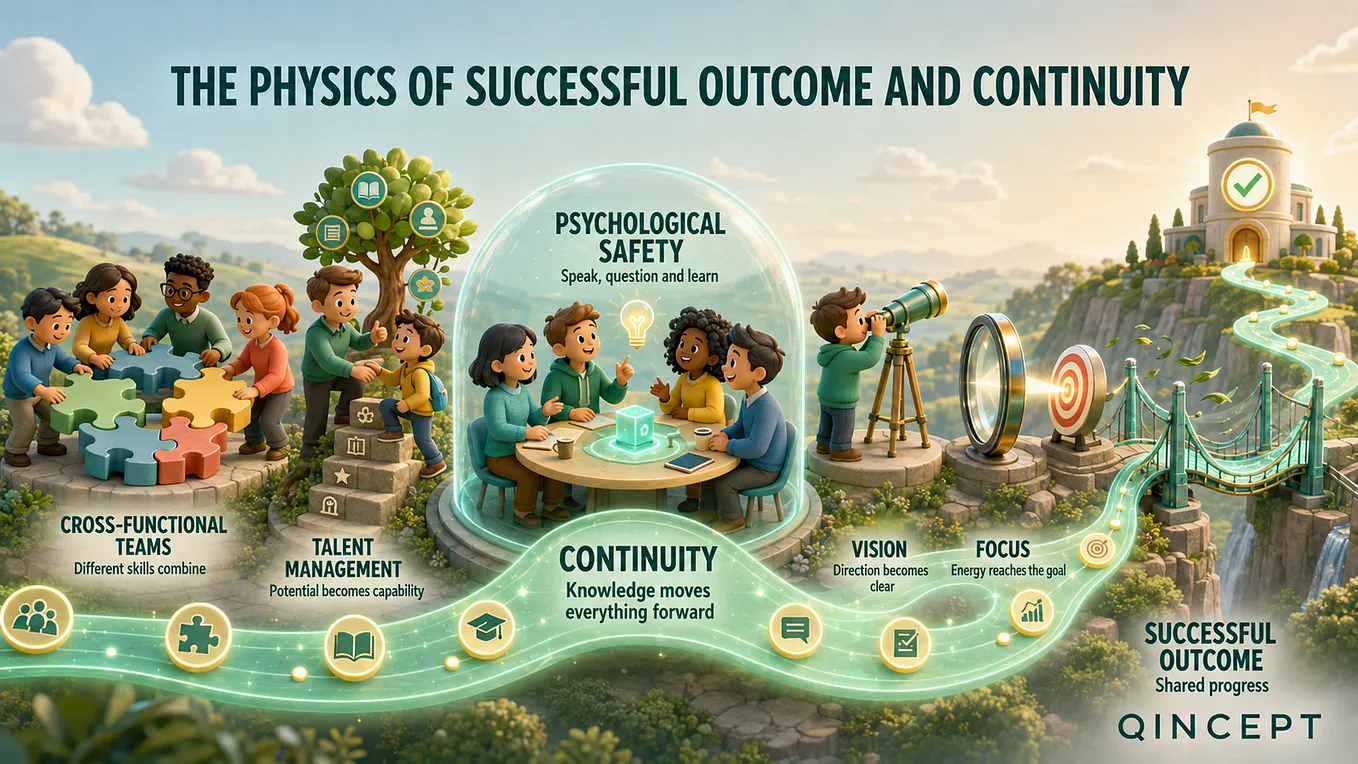
And throughout the journey, continuity ensures that progress does not disappear simply because time has passed.
Perhaps this is the deeper physics of individual progress.
Purpose creates direction.
Efficiency conserves energy.
Effectiveness validates movement.
Innovation creates new paths.
Prioritisation concentrates attention.
Coaching improves perspective.
Continuity carries learning through time.
Point A is where we are.
Point B is where we intend to go.
What determines the journey is what we are able to carry forward between them.