The Forgotten Civilizations That Were Far Ahead of Their Time


History remembers Rome, Egypt, and Greece. But plenty of other civilizations were pulling off remarkable feats long before the modern world showed up, and most of us have never heard their names.
Introduction
Ask someone to name history’s greatest civilizations and you’ll almost always get the same three or four answers: Egypt, Greece, Rome, maybe China. Fair enough — these societies genuinely reshaped human history. They raised monuments that still take our breath away, built governments that outlasted empires, and left cultural fingerprints we’re still tracing today.
But that’s a pretty narrow slice of the story.
Across Asia, Africa, the Americas, and the Middle East, there were civilizations doing things that are frankly hard to believe given how long ago they happened. Cities had working drainage systems thousands of years before anyone had heard of modern plumbing. Astronomers charted the sky with an accuracy that puts a lot of amateur stargazers to shame. Merchants built trade networks stretching across continents, long before anyone had a map that showed the whole picture.
And yet most of these civilizations barely register outside a history classroom.
Here are five that deserve a lot more credit than they get.
- The Indus Valley Civilization
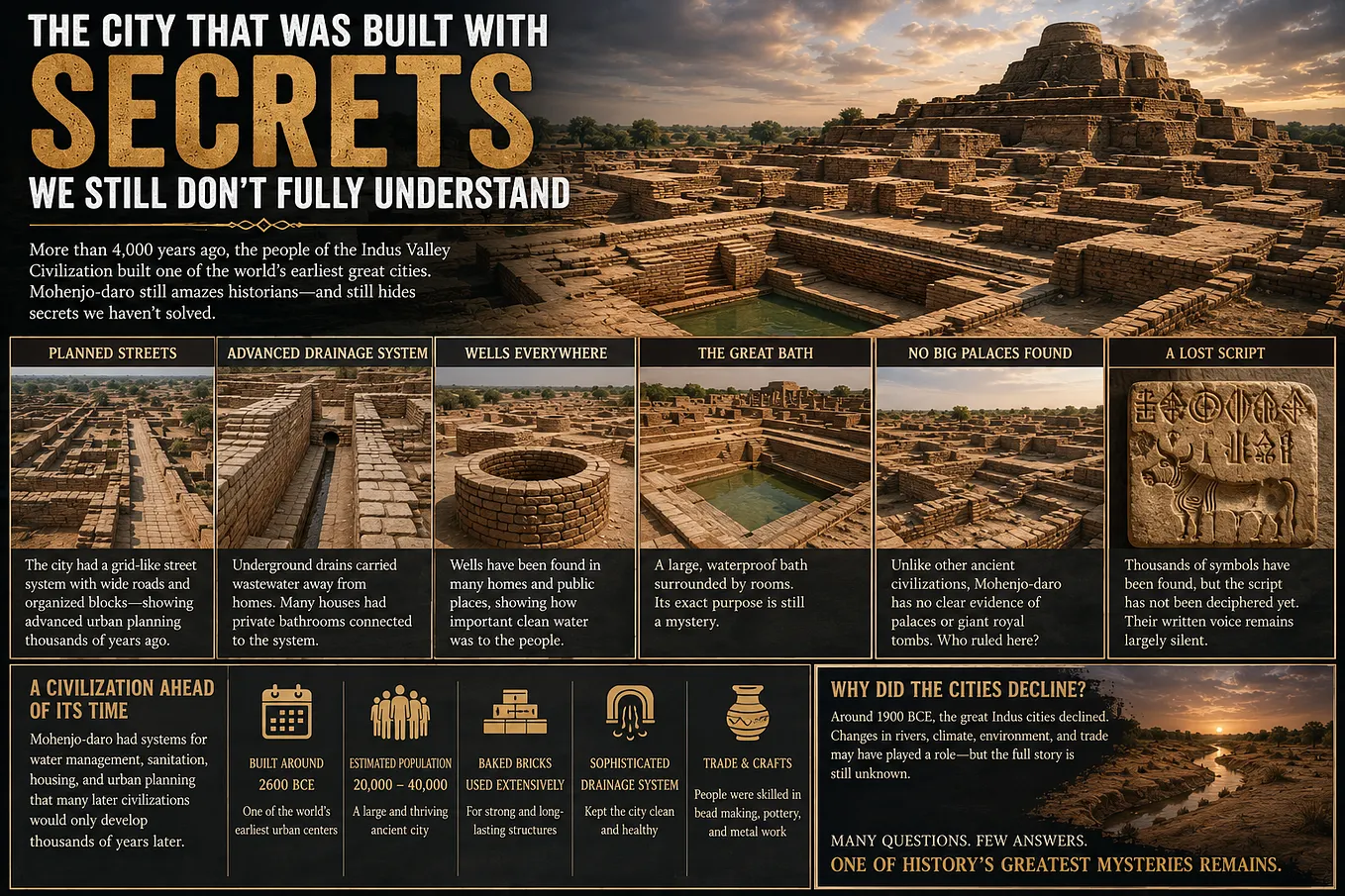
Around 2600 BCE, one of the world’s first true urban civilizations was taking shape along the Indus River. Cities like Mohenjo-daro and Harappa weren’t just settlements — they were planned, in a way that still impresses urban designers today. Streets ran in neat grid patterns. Homes had private bathrooms, which was not exactly standard practice at the time. Wastewater moved through drainage systems engineered well enough that you’d assume they came centuries later.
The civilization also traded extensively with its neighbors, which tells you something about how organized its economy must have been. What’s frustrating is how much we still don’t know — the Indus script has never been fully deciphered, so a huge part of this civilization’s own voice is still locked away.
The takeaway: a great city isn’t built by population size alone. It’s built by planning.
- The Maya Civilization
Most people picture pyramids when they think of the Maya, and sure, those are impressive. But the real story is in the science. The Maya built calendar systems capable of tracking astronomical cycles with startling precision, and they arrived at the concept of zero independently — an idea that quietly reshaped mathematics wherever it later spread.
Their astronomers tracked planetary movement long before anyone had a telescope to help. Their cities, meanwhile, were engineered specifically for the tropical environments they sat in, which is its own kind of genius — building smart for the conditions you’re actually working with, rather than importing ideas that don’t fit.
The takeaway: curiosity, left to run, tends to produce discovery.
- The Nabataean Civilization
Petra might be the most photogenic ruin on this list — an entire city carved into sandstone cliffs in what’s now Jordan. The Nabataeans turned it into a major hub connecting trade routes between Arabia, Egypt, and the Mediterranean.
Here’s the part that doesn’t get enough attention: Petra sits in one of the driest regions on Earth. Keeping a thriving population alive there took serious engineering — channels, reservoirs, underground cisterns, all built to capture and store rainfall that showed up rarely and unpredictably. Managing water that well, in that climate, is arguably the more impressive achievement than the carvings themselves.
Get Muhammad Usman Writes’s stories in your inbox
Join Medium for free to get updates from this writer.
The takeaway: some of the best innovation comes from places where survival simply wasn’t optional.
- The Kingdom of Aksum
Aksum, spanning parts of modern Ethiopia and Eritrea, became one of the most powerful trading civilizations in the ancient world. Between roughly the 1st and 7th centuries CE, it controlled routes linking Africa, Arabia, India, and the Mediterranean — moving gold, ivory, spices, and other goods across a genuinely global network for its time.
It even minted its own currency, which wasn’t common practice for most civilizations of that era. And its stelae — massive carved stone towers — are still standing today, still stopping archaeologists in their tracks.
The takeaway: connection and trade have always been engines of prosperity, not just modern economic buzzwords.
- The Caral Civilization
Before the Inca, before most of what we associate with ancient Peru, there was Caral. Dating back to around 3000 BCE, it’s one of the oldest known civilizations in the Americas — and one of the more surprising ones, because archaeologists have found almost no evidence of warfare there.
Instead, Caral built pyramids, public plazas, and organized communities apparently centered on agriculture, trade, and cooperation rather than conflict. It’s a rare case in the archaeological record, and it complicates the assumption that early civilizations were built primarily through conquest.
The takeaway: stability and shared purpose can do as much for a civilization’s longevity as ambition can.
What Made These Civilizations Extraordinary?
Separated by oceans, centuries, and completely different cultures, these societies still share something in common. They invested in knowledge. They solved real, practical problems with the tools they had. They built systems — water, trade, governance, astronomy — that made everyday life better for the people living under them.
None of that required a shared origin point or a single “cradle of civilization.” Innovation showed up wherever people had a reason to look for it.
Why Are They Often Forgotten?
A few reasons, really. Some of these civilizations left writing systems we still can’t fully read, which means we’re missing their side of the story entirely. Others faded before later empires took over the historical spotlight — and history, as it’s usually taught, tends to follow the empires that lasted longest or wrote the most about themselves. Climate shifts, natural disasters, and invasions played a role too.
And honestly, school curricula only have room for so many names. The result is that plenty of remarkable civilizations get quietly left out, even as archaeologists keep digging up more evidence of what they accomplished.
Lessons for the Modern World
It’s easy to assume innovation is a modern invention — that we’re the first generation clever enough to solve hard problems. History disagrees. People built cities without machinery, tracked the stars without telescopes, and solved serious engineering problems without a single computer in sight.
What they had wasn’t better tools. It was patience, observation, and a willingness to cooperate on problems too big to solve alone. Those qualities haven’t gone out of style.
Final Thoughts
The Indus Valley, the Maya, the Nabataeans, Aksum, and Caral all prove the same point in different ways: human ingenuity has never belonged to one culture or one era. Their work still shapes how archaeologists, engineers, and historians think about what’s possible.
Progress was never just about wealth or military strength. It’s about ideas that make life better and outlast the people who had them.
So next time the conversation turns to history’s greatest civilizations, it might be worth naming a few that don’t usually make the list. Sometimes the most important achievements are the ones nobody talks about.