Industrial Abiogenesis

TLDR: Industrial Abiogenesis (n.): the emergence of industrial systems that reproduce themselves from raw matter and energy, without external supply of parts, capital, or instruction. Seventy years ago, a field was founded on the question: can machines think? A Nobel laureate closed that question this July: we have found a way to make sand think. This essay founds the successor field on the question that comes after — can industry reproduce? — and gives it its name, its definition defended word by word, its three gates of falsification, its seventy-year ancestry, and its borders.
I. A Field Begins With a Question
In the summer of 1956, a handful of scientists gathered at Dartmouth College around a question: It has been suggested that “every aspect of learning or any other feature of intelligence can in principle be described with such precision that a machine can be constructed to simulate it” (McCarthy, Minsky, Rochester, and Shannon’s Dartmouth proposal of 1955).
Note what they did, since it was the first step in the establishment of every field. They did not demonstrate anything — no thinking machine had been made, and none would be for many decades. They posed a specific question and gave the name to the area of study which would provide the answer. The name brought order to seventy years of work. The question survived every winter, and this July the answer came, in the simplest sentence ever written about this century, from the laureate whose systems solved the problem of protein folding: “we’ve essentially found a way to make sand think” (source: Hassabis, “A Framework for Frontier AI and the Dawning of a New Age,” July 14, 2026).
The Dartmouth question is closed. So a successor question is owed — the one that decides whether thinking sand ends scarcity or merely describes its ending beautifully. It fits in three words:
Can industry reproduce?
Not can we build more factories. We have built factories for ten thousand years, and every one of them was born the same way: its parts arrived on a truck. Reproduce the way a cell means it — can a made thing make the whole of another made thing, from rock, from sunlight, from nothing carried in?
The field that answers this question is hereby named.
II. The Term
Industrial Abiogenesis (n.) — the emergence of industrial systems that reproduce themselves from raw matter and energy, without external supply of parts, capital, or instruction.
Etymology. Abiogenesis is biology’s word for its deepest event: the origin of life from non-living matter. The borrowing is exact, not ornamental. Industrial Abiogenesis names the moment industry acquires the defining property of the living — reproduction from raw substrate — without being alive. The first abiogenesis produced a cell nobody witnessed. The second produces a machine, and will be documented.
Anatomy. A dictionary entry is genus plus differentia, and every word here is load-bearing:
- “Emergence” — an event that occurs, not a product that launches. A field studies a phenomenon; a company sells a product. This definition must sound like the former, because the phenomenon does not care which company reaches it first.
- “Reproduce themselves from raw matter and energy” — the mechanism in six words. Not assemble: assembly is what factories do to parts that arrive. Not copy: software copies, and software is not heredity — a genome without a metabolism is a message, not an organism. Reproduce: the whole of the successor, from what the ground and the star provide.
- “Without external supply of parts, capital, or instruction” — the differentia, and the three exclusions are not rhetoric. They are the field’s gates of falsification.
Compressed for speech — the word alone carrying all three gates: industrial systems that reproduce themselves from raw matter and energy alone.
And in plain Saxon, the whole field in four words, the form said out loud at the bench: machines that birth machines. A reader who knows the famous Gigafactory line — the machine that builds the machine — will hear the single changed verb, and the verb is the entire thesis. Building is performed on a thing by an outside agent. Birth is performed through a lineage by itself. The twentieth century perfected the first. This field exists for the second.
III. The Three Gates
Anyone may claim the term. The gates decide.
Gate
Exclusion
Ledger
Who fails it
1 — Parts
No imported components
Mass closure: every imported gram, itemized
The factory that assembles copies of itself from imported controller boards — the board is an external part
2 — Capital
No terrestrial umbilical
Exergy closure: the energy of making, sourced locally
Get Antonio’s stories in your inbox
Join Medium for free to get updates from this writer.
The off-world plant casting its own structure while a fab at home ships its chips — the vitamins own the energy the mass ledger flatters
3 — Instruction
No external genome
Information closure: bits of supervision per generation
The replicator steered daily from a control room
Our own bench in Chicago does not meet the criteria at present. A parent machine, a daughter machine made up of parts fabricated by the parent, and a ledger which records every gram that the parent was unable to produce — rows that encompass us and yet were published all the same. That is not a confession added to the definition; it is the definition in action. The definition sets out the threshold; the ledger shows the distance covered. A founding term which cannot be failed is a brand; this one can be failed in three ways by anyone who has a scale — thus proving it to be a science.
IV. The Lineage
No reputable field will claim to be an orphan; this one has seventy years of history, and that means you have to look after it:
From 1948 to 1966 — the logical conclusion. Since John von Neumann had been one of the founders of the theory of computation, he posed the question of what was necessary for a machine to make a copy of itself and had in principle proved the answer: a universal constructor together with a stored description — that is, the architecture of heredity, which had been written down before the structure of DNA proved that biology had employed it first (source: von Neumann, Theory of Self-Reproducing Automata, ed. Burks, 1966). The field’s most fundamental theorem dates back a quarter of a century before the field itself: reproduction is not a mystery of living organisms. It is an architecture, and architectures can be built.
1980 — the engineering. A NASA/ASEE summer study designed a self-replicating lunar factory in full engineering detail — a seed system meant to make most of its own successor from regolith — and gave the field its most honest piece of vocabulary: the imported residue it could not close, the vitamin parts (anchored: NASA CP-2255, Freitas & Gilbreath, eds.; the study’s numbers are examined in Blueprint №1). Then the study was filed, not refuted. It was waiting for an organ that did not exist: intelligence cheap enough to put in every machine.
2005 — the gesture. The RepRap project built desktop printers that printed a growing fraction of their own parts — self-replication as an explicit, published goal, achieved partially, on hobbyists’ tables (source: Bowyer, RepRap project, 2005–). Our bench is a literal descendant of that lineage, and says so with respect: RepRap proved the instinct was buildable at kitchen scale. What it lacked was not vision but the same missing organ.
2026 — the organ arrives. The sand thinks (source: Hassabis). The component von Neumann assumed, the 1980 study priced beyond reach, and RepRap could not print, now ships in volume. The logic existed, then the engineering, then the gesture — and now the enabler. What remains is the discipline: the definition, the gates, the ledger, the first witnessed ancestor. That is the work this field is founded to do.
V. What Industrial Abiogenesis Is Not
A term that will be searched must police its borders, so four confusions are retired in advance:
- It isn’t the general case of ‘self-replicating machines’, since that category is merely a general term and has existed for seventy years. The Industrial Abiogenesis theory identifies the threshold event — that is, the appearance of systems that pass all three gates. Partial self-replication constitutes a lineage; crossing that gate marks the emergence of a field.
- It is not the von Neumann probe. The probe is a destination fantasy — interstellar, hypothetical, and cheerfully innocent of ledgers. This field is a bench discipline with a scale and an audit.
- It is not nanotechnology’s gray goo. The reproduction here is industrial-scale, thermodynamically accounted, and gated by information closure — supervised lineages, measured generations. Panic is for processes without ledgers.
- It is not lights-out manufacturing. A dark factory is still a factory: every part arrives on a truck. Automation removes the humans from the building. Abiogenesis removes the truck.
VI. The LUCA of Industry
Biology names the root of every family tree on Earth LUCA — the last universal common ancestor, the cell from which all known life descends. And here is the strange humility of the most successful lineage in history: no one ever saw it. LUCA is an inference, reconstructed billions of years later from the shared machinery of its heirs. Biology’s founding ancestor is known only by its descendants.
Industry’s will be different, and this is the sentence this essay exists to put on the record:
The LUCA of Industry will be the first common ancestor in the history of life that is witnessed rather than inferred.
There will be a date indicating when it was built, a bill of materials, a declared substrate, a public ledger, and — once the final gate has been closed — a birth certificate signed by auditors. Four billion years after the first genesis was not recorded, the second one will publish its own documentation. All the things that come after that machine — the power plants that have never been touched by a hand, the habitats that have been grown rather than shipped, the abundance so great that it lies beyond the reach of the old economics to price — will be traceable to a single seed system on one bench, whose caretakers recorded everything.
That is what the twenty-three words above are actually holding open. Not a technique. An ancestor.
VII. The Future Is Not Yet Written
The laureate’s July essay closes under a section heading we intend to hold him to: “The Future Is Not Yet Written”. He is right — and the sentence is more literal than it looks.
His list of what thinking sand will deliver — accelerating drug discovery, new clean energy sources, novel advanced materials — is magnificent, and every noun on it is a design — Mind-work, which is exactly what sand now does. But a design cures no one and powers nothing until something builds it, and an intelligence holding all of materials science in its head still cannot pour a single ingot. Between the thought and the era he names — resources no longer the limiting factor for human progress — stands the entire unclosed body of industry. Thought now scales like software. The body still scales like the eighteenth century: one factory at a time, every part arriving on a truck.
The future is not yet written. Writing requires a hand. A hand requires a body. And no body in the solar system can yet make more of itself except the green one we were born into.
We are building the second.

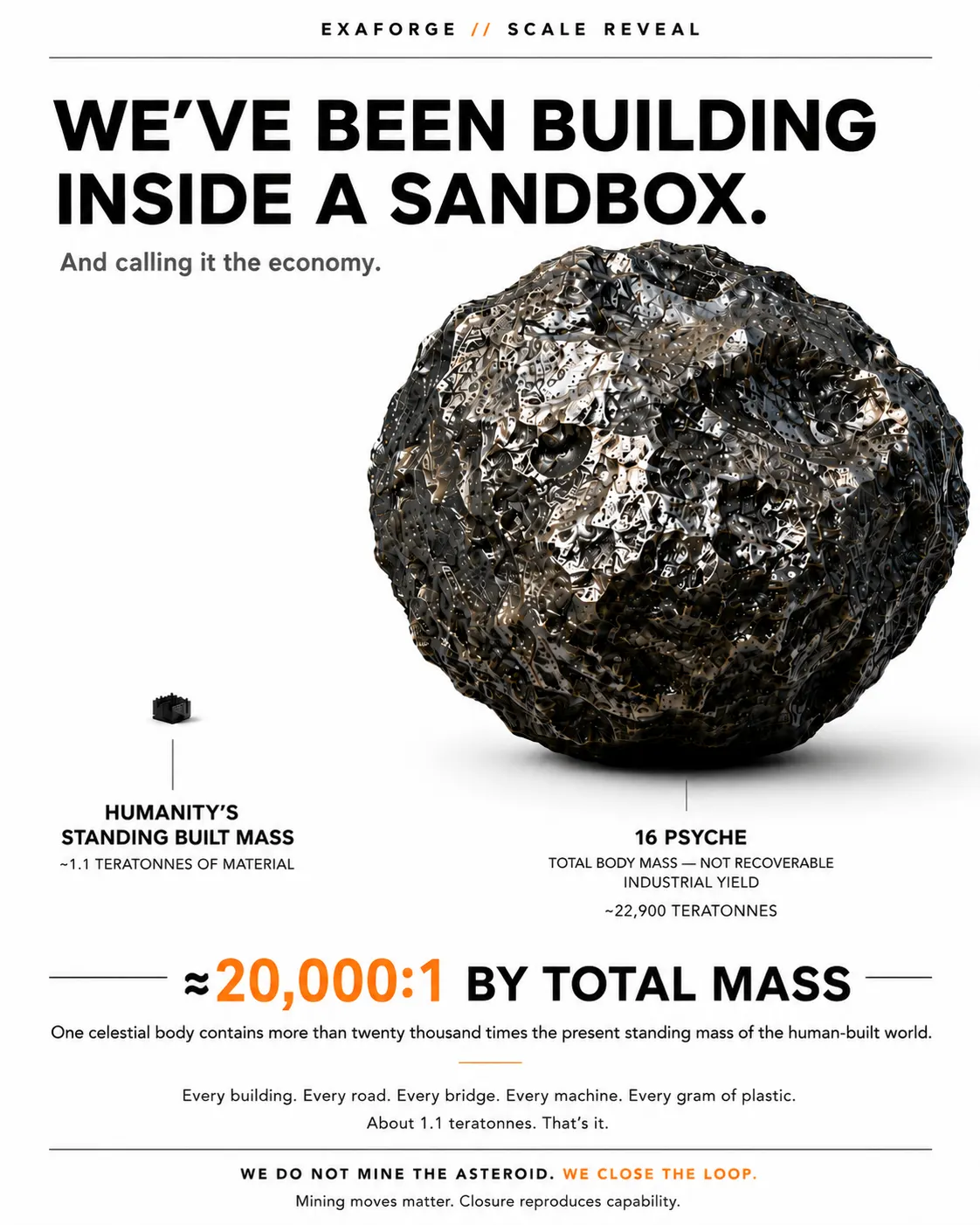
Industrial Abiogenesis begins when machines stop being built — and start being born. We do not mine the asteroid. We close the loop.
Next — Essay Four: “The Closure Problem — the number asteroid mining forgot to measure.”